AI Prompting Trends 2026: Agents, Provenance and Safety Shift
AI prompting trends are changing fast in August 2026. Prompts are no longer limited to generating one answer or writing one piece of code. New models increasingly support coding, tool use, multi-step planning and agent workflows. Google’s Gemini 3.7 Flash is a recent example, with a strong focus on coding and business automation. Meanwhile, provenance tools and safer defaults are gaining importance. For prompt engineers, the real challenge is now balancing capability, safety, speed and model cost.
QUICK SUMMARY
- Agentic prompting is rising: Prompts increasingly control multi-step tasks, tools and autonomous workflows.
- Provenance is becoming standard: Invisible watermarks and content credentials can improve AI attribution.
- Safety needs stronger prompts: Human checkpoints and approval rules matter more as agents gain autonomy.
How To
- How do I write prompts for AI agents?
Define the goal, tools, limits, steps, success criteria and escalation conditions before execution.
- How can I make AI prompts safer?
Add permission boundaries, validation steps and human approval before irreversible or high-impact actions.
- How should I test AI prompts after model updates?
Run the same evaluation set and compare accuracy, safety, latency and cost before deployment.
AI Prompting Trends Are Moving From Answers to Agents
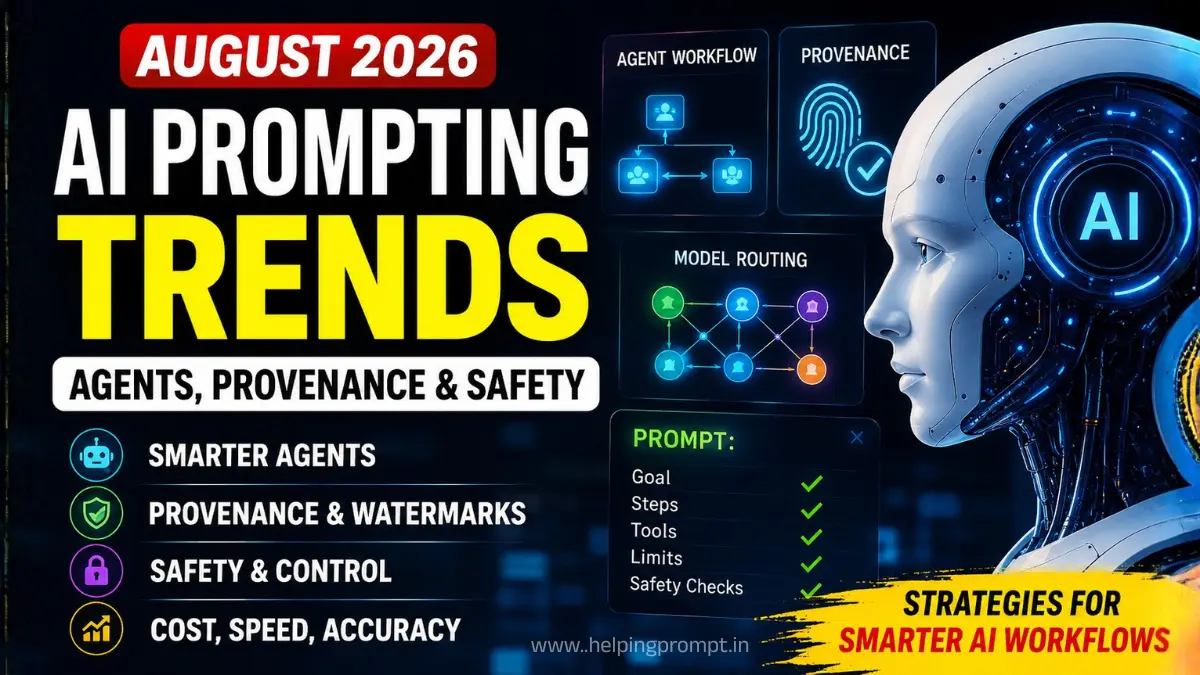
The biggest shift is from single-response prompting to workflow prompting. Gemini 3.7 Flash is positioned around coding, complex work and agent use cases. Therefore, prompts increasingly need goals, steps, tools and completion conditions. Instead of asking an AI to “write code,” teams can define planning, implementation, testing and review stages. This makes prompt design closer to lightweight workflow engineering.
Model Routing Is Becoming Part of Prompt Strategy
Model choice is also becoming dynamic. NVIDIA’s NeMo platform supports agent optimization and Switchyard routing across different models. A simple task can use a cheaper model, while complex reasoning gets a stronger model. Consequently, prompt engineers must consider cost, latency and accuracy together. Routing rules can become part of the prompt architecture instead of remaining only an infrastructure decision.
Provenance Is Becoming a Prompting Concern
AI-generated content is becoming easier to trace. Google says SynthID adds imperceptible signals to generated media, while C2PA credentials can provide information about how content was created or modified. Google has also expanded verification across images, video and audio. For publishers, marketers and creators, prompts should now include clear attribution requirements when content authenticity matters.
Visible Watermarks Are Not the Whole Story
A visible AI label can disappear during editing or publishing. However, invisible provenance signals can remain useful for verification. Google says its generated media can carry SynthID, while some products also use visible watermarks and C2PA metadata. Therefore, teams should not treat a clean-looking image as proof that it has no AI provenance.
Auto Mode Changes How Prompts Should Be Written
Agentic tools are also reducing approval friction. Anthropic developed Claude Code Auto Mode to automate some permission decisions using safety classifiers. That changes the importance of prompt boundaries. A strong agent prompt should define allowed actions, forbidden actions and escalation points. In sensitive workflows, humans should still approve irreversible operations, external changes and high-impact decisions.
Safety Checks Need to Become Prompt Components
Prompt safety is moving beyond simple content filters. Agents can access files, execute commands and interact with external tools. As a result, prompts should include pre-action checks, scope limits and confirmation gates. For example, an agent can be instructed to inspect a proposed change before executing it. It can also stop when uncertainty, unexpected data or destructive actions appear.
AI Prompting Trends Also Demand Version Control
Prompt engineering is becoming an operational discipline. A prompt that works today may behave differently after a model update, routing change or tool modification. Therefore, teams should version important prompts and maintain evaluation datasets. Each update should be tested for accuracy, safety and cost. NVIDIA’s agent tooling already emphasizes evaluation and validation before optimized candidates are promoted.
High-Risk AI Releases Face More Scrutiny
The industry is also becoming more cautious around powerful capabilities. Recent reporting around advanced models shows that security evaluation can influence release decisions. However, claims about unreleased products require careful verification before publication. For example, public documentation does not currently establish an official OpenAI “Astra” release roadmap. The broader lesson is clear: prompt workflows for security-sensitive tasks need stronger testing and human oversight.
Pro Tips
- Add checkpoints: Require confirmation before destructive or irreversible actions.
- Version prompts: Track model, routing, tools and prompt changes together.
- Test provenance: Verify watermarks or content credentials when attribution matters.
Conclusion
The biggest AI prompting trends in August 2026 point toward a more operational future. Prompts are becoming instructions for agents, tools and complete workflows. At the same time, provenance systems are making AI-generated content easier to identify. Model routing is also creating new ways to balance quality, speed and cost.
For prompt engineers, this means better prompts are no longer simply more detailed prompts. They are structured, testable and safety-aware. Teams should review prompts after model updates and maintain human checkpoints for sensitive actions. Staying current with model capabilities, routing systems and provenance standards will become an important part of reliable AI deployment.
FAQs
Agentic workflows, model routing, provenance, prompt versioning and stronger safety controls are key trends.
Provenance can help verify where generated content came from and how it was created or modified.
Yes. Agents increasingly handle multi-step tasks, but prompts still need boundaries and human checkpoints.
More Posts Like This
- Enterprise AI Integration Drives Business Software and AI Policy Shift
- Stunning Romantic Couple Close-Up Prompt: Create Cinematic AI Portraits
- 6 Claude Resume Prompts That Got Me Interview Calls
- Best AI Image Prompts: 10 Hyper Realistic Photography Prompt Ideas
- Agentic AI Systems Are Becoming Autonomous Teammates at Work