Nvidia Nemotron 3.5 Lightning: AI Compute Gets More Accessible
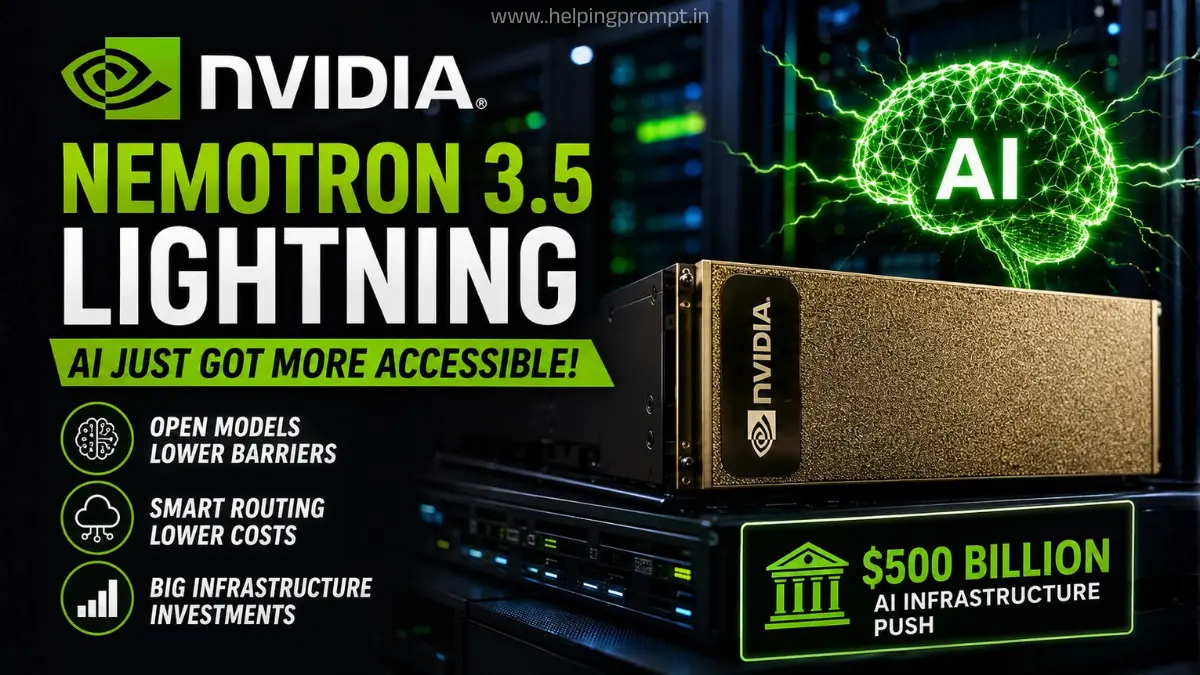
Nvidia Nemotron 3.5 Lightning is pushing AI closer to everyday developers and businesses. Nvidia has released a lightweight open model built for efficient agentic workloads. At the same time, its software stack is making model routing easier. Nvidia is also bringing major financial institutions into AI infrastructure funding. Together, these moves could reshape how companies buy, deploy and scale AI. More importantly, they could reduce the upfront barrier to powerful AI systems while creating fresh demand for Nvidia’s GPUs.
QUICK SUMMARY
- Nemotron 3.5 Lightning targets efficient, long-running AI tasks with a smaller compute footprint.
- Nvidia’s routing software can send workloads to different models based on cost and complexity.
- Up to $500 billion in planned financing could accelerate AI infrastructure spending and GPU deployment.
How To
- How can businesses use Nvidia Nemotron 3.5 Lightning?
Businesses can evaluate it for coding, security, routing and other repetitive agentic workloads.
- How should companies measure AI deployment costs?
Measure cost per completed task, latency, GPU utilisation and output quality together.
- How can companies reduce AI inference costs?
Use model routing to send simple requests to efficient models and reserve larger models for complex tasks. Nvidia’s Switchyard approach supports this strategy.
Why Nvidia Nemotron 3.5 Lightning Matters
Nvidia’s latest open model reflects a shift toward efficient AI rather than simply larger models. Nemotron 3.5 Lightning is designed for tasks such as code review and security monitoring. The model can bring capable AI workloads closer to local systems and smaller deployments. Therefore, companies may need fewer expensive cloud resources for selected tasks.
Smaller Models Could Change AI Economics
The economics are important because AI agents can make many model calls. A cheaper model can handle routine steps while stronger models manage difficult reasoning. This approach can lower token usage and improve latency. Nvidia’s broader Nemotron strategy supports open weights and deployment across cloud, edge and data-center environments.
Routing Becomes Part of the AI Stack
Nvidia is also developing tools around model orchestration. Its Switchyard project can route requests between different AI backends and model tiers. That matters because businesses rarely need the strongest model for every request. Instead, routing can match workload complexity with an appropriate model. Consequently, companies can optimise cost, speed and reliability together.
Open Models Lower Deployment Barriers
Open-weight models give enterprises more control over deployment and customisation. Nvidia says Nemotron models provide access to weights, training information and technical resources. Developers can also deploy them using frameworks such as vLLM, SGLang, Ollama and llama.cpp. This flexibility can help startups and enterprises reduce dependence on a single proprietary AI provider.
Nvidia’s Infrastructure Strategy Goes Beyond GPUs
The bigger story is Nvidia’s growing role across the AI infrastructure chain. The company has partnered with major financial firms around plans to mobilise more than $500 billion for AI infrastructure. The initiative covers areas including data centres and computing capacity. However, the agreements are not yet equivalent to completed financing. That distinction matters for investors and customers.
Why Financing Could Increase GPU Demand
AI infrastructure requires enormous upfront capital. Financing can allow more companies to build computing capacity sooner. That potentially expands the market for Nvidia GPUs and related systems. Meanwhile, efficient models can make that hardware more useful across a wider range of workloads. The combination creates a powerful feedback loop between software adoption, infrastructure spending and chip demand.
The Bigger Enterprise AI Shift
The direction is becoming clearer. AI companies are moving from single-model deployments toward systems using multiple specialised models. Lightweight models can handle routine tasks, while larger models tackle complex reasoning. Orchestration decides which system should respond. For enterprises, this could mean better cost control without abandoning advanced AI capabilities.
Pro Tips
- Watch cost per AI task, not only benchmark scores.
- Compare local, cloud and hybrid deployment economics.
- Track Nvidia’s financing commitments separately from completed investments.
Conclusion
Nvidia’s latest strategy shows that the AI race is no longer only about model size. Nemotron 3.5 Lightning brings efficient open-weight AI into more practical deployments. Routing tools can further reduce unnecessary inference costs. Meanwhile, large-scale infrastructure financing could help businesses expand computing capacity faster. Together, these moves could make powerful AI more accessible to smaller teams and enterprises.
However, the biggest impact may be Nvidia’s ecosystem advantage. More accessible models can increase AI usage, while greater usage can support demand for computing infrastructure. For businesses, the next metric to watch is simple: how much useful AI work can be delivered per rupee spent?
FAQs
It is an open AI model designed for efficient, long-running tasks and enterprise workloads.
It can reduce costs for suitable workloads by using a smaller, efficient model instead of larger systems.
It could help fund more AI data centres and computing capacity, potentially supporting future GPU demand.
More Posts Like This
- India Pushes for Unified Global AI Standards Before IndiaAI Impact Summit, Focus on Ethics and Privacy
- A 4K Selfie Moment with Chandrashekhar Azad Ravan Goes Viral, Setting New Standards for Face-Match AI Images
- AI Safety and Policy Trends to Watch Over the Next 12 Months
- Gemini 3.7 and Grok 4.6: A New AI Model Arms Race