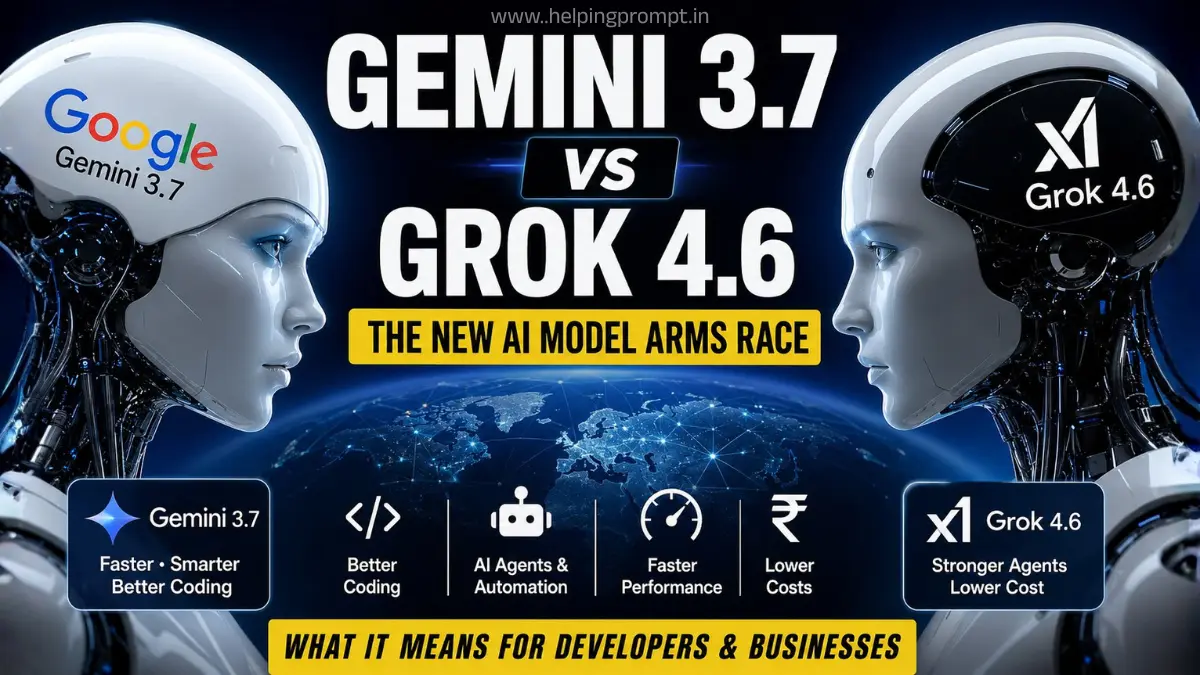
Gemini 3.7 and Grok 4.6: A New AI Model Arms Race
The AI model race has entered another fast-moving phase. Google launched Gemini 3.7 Flash on August 13, while Grok 4.6 also arrived this week. Both releases focus heavily on coding, agents and real-world workloads. More importantly, they show how frontier AI is shifting from raw intelligence toward speed, efficiency and price. For developers and businesses in India, that change matters because cheaper models can make advanced AI automation more practical. The next battle may not be about the biggest model, but the best value.
QUICK SUMMARY
- Gemini 3.7 Flash targets coding, web development and multi-step AI agents.
- Grok 4.6 pushes stronger agent performance while competing aggressively on cost.
- The model race is increasingly about capability, speed, efficiency and pricing.
What Gemini 3.7 and Grok 4.6 Mean for the Model Arms Race
Google’s Gemini 3.7 Flash is positioned as a workhorse model for coding and agent workflows. Google says it improves software engineering, instruction following and UI generation. It is also priced aggressively during its introductory period. That makes the model important beyond benchmarks. Developers can now consider higher-capability AI for larger production workloads without automatically accepting premium-model costs.
Grok 4.6 takes a different but equally important route. xAI is pushing performance alongside cost efficiency. Reports put its API pricing at about $2 per million input tokens and $6 per million output tokens. That is substantially below several competing frontier models. As a result, businesses may compare models based on the cost of completing a task, not simply the cost per token.
HOW TO
- How should I compare Gemini 3.7 and Grok 4.6?
Run the same real-world tasks on both models and compare accuracy, speed and total cost.
- How can businesses benefit from this model race?
Businesses can use cheaper AI agents for coding, content, customer support and workflow automation.
- How should I choose an AI model in 2026?
Focus on task performance, reliability, API cost and integration rather than benchmark scores alone.
Why AI Agents Are Becoming the Main Battlefield
The biggest shift is toward AI agents that can complete multi-step tasks. Gemini 3.7 Flash focuses on coding, web development and business workflows. Grok 4.6 is also designed around longer-running and complex tasks. Therefore, the winning model may be the one that needs less human correction. That could matter more than a small benchmark advantage.
Cost Is Now a Competitive Weapon
AI pricing is becoming a major differentiator. Google introduced Gemini 3.7 Flash at $0.75 per million input tokens and $3.75 per million output tokens through the end of 2026. Standard pricing is scheduled to rise afterward. Meanwhile, Grok 4.6 is being positioned as a lower-cost frontier option. For Indian startups, agencies and developers, this could reduce automation costs significantly.
Coding Is Moving From Assistance to Execution
Coding remains one of the clearest tests for agentic AI. Gemini 3.7 Flash is designed to improve first-pass code accuracy and software engineering tasks. Grok is also targeting engineering-heavy workloads. Consequently, developers may increasingly ask AI to plan, build, test and modify software. The role of the programmer could shift from writing every line toward reviewing and directing AI-generated work.
The Model Arms Race Is No Longer Only About Size
Earlier AI competition often focused on model scale and benchmark scores. Now the equation is broader. Speed, token efficiency, reliability, tool use and inference cost all matter. Grok’s rapid model cycle and Google’s cheaper Flash strategy reflect this change. In other words, a smaller or faster model can become more commercially useful than a larger model if it delivers similar results at lower cost.
What This Means for Indian Businesses
For Indian businesses, cheaper agentic AI could have a practical impact. Agencies could automate content workflows, customer support and reporting. Developers could build software faster. Small businesses could access AI-powered services without enterprise-level budgets. However, companies should test models on their own workflows before switching. Benchmark leadership does not automatically translate into better results for every business.
What Happens Next?
The next stage will likely involve even tighter competition between Google, xAI, OpenAI, Anthropic and other model developers. Releases may become more frequent, while prices continue to move. Moreover, model providers will compete through ecosystems, APIs and agent platforms. That means users may choose an AI provider based on the complete workflow rather than the model alone.
PRO TIPS
- Test AI models using your real business tasks, not only public benchmarks.
- Track cost per completed task, rather than token price alone.
- Compare reliability, speed and tool use before changing your AI stack.
CONCLUSION
Gemini 3.7 Flash and Grok 4.6 show how quickly the AI model race is changing. Capability still matters, but it is no longer the only deciding factor. Speed, pricing, coding ability and agent performance are becoming equally important.
For Indian developers and businesses, this competition could be positive. More capable models at lower costs can make automation accessible to smaller teams. However, the best model will depend on the workload. Therefore, users should keep testing models as new releases arrive and prices change.
FAQs
Gemini 3.7 Flash focuses on coding, web development, software engineering and AI agents.
Grok 4.6 increases pressure on rivals through stronger agent capabilities and aggressive pricing.
Not necessarily. Their performance depends on the benchmark, task, speed and cost requirements.