Google Agentic Era: Gemini Omni and AI Agents
Google has unveiled its biggest AI transformation yet. At Google I/O 2026, the company introduced the Google Agentic Era, a vision where AI moves beyond answering questions and starts completing tasks independently. From Gemini Omni’s cinematic content creation to AI agents that manage research, coding, and productivity workflows, Google’s latest announcements signal a major shift in how people interact with technology. As AI becomes more proactive, businesses, developers, and content creators could see faster workflows and entirely new digital experiences.
Google Agentic Era Takes Center Stage at I/O 2026
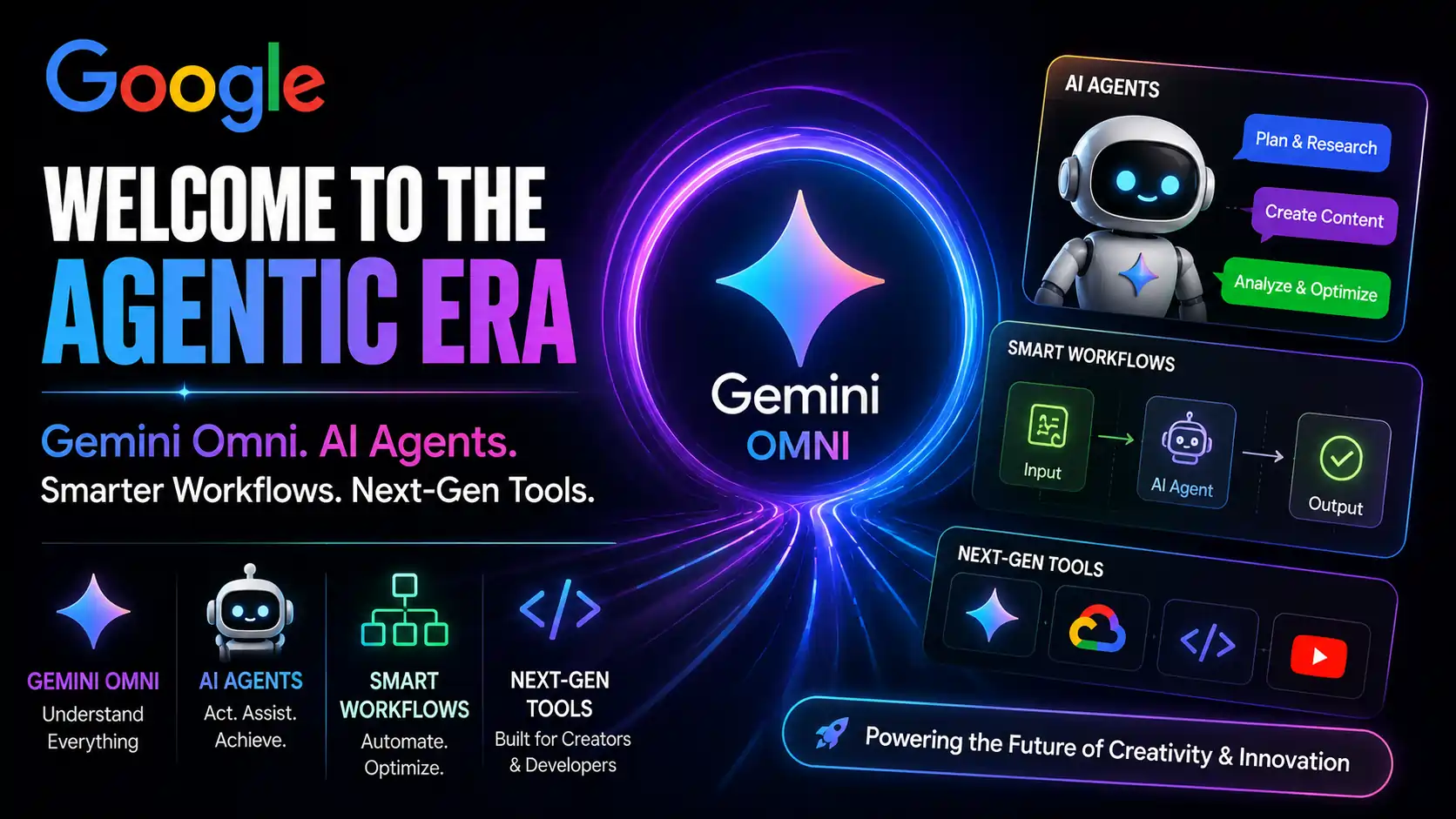
The biggest message from Google I/O 2026 was clear: AI is entering an action-first phase. Instead of simply generating text or images, Google’s latest systems are designed to perform complex workflows across multiple applications. This new approach is called the Google Agentic Era, where intelligent agents can research information, organize tasks, draft content, and assist with business operations while keeping users in control of final approvals.
Gemini Omni Becomes Google’s Most Advanced Multimodal AI
Google introduced Gemini Omni as its most capable multimodal model to date. The system can understand text, images, audio, video, and real-world concepts simultaneously. As a result, users can transform simple prompts into cinematic videos, hyper-realistic visuals, and advanced creative projects. Moreover, content can be refined through natural conversation, making editing faster and more intuitive for creators.
Gemini 3.5 Flash Focuses on Speed and Reasoning
Alongside Omni, Google announced Gemini 3.5 Flash as the default intelligence layer across its ecosystem. The model is optimized for coding, reasoning, research, and long-running tasks. Furthermore, its reported processing speed positions it among the fastest AI systems available today. This upgrade aims to improve productivity while supporting increasingly sophisticated agent-based workflows.
Docs Live and NotebookLM Expand Content Creation
Google also introduced Docs Live, a feature that converts spoken ideas into structured articles within seconds. Meanwhile, NotebookLM received major upgrades for handling larger datasets and longer context windows. Consequently, researchers, students, journalists, and marketers can quickly analyze source materials and generate organized outputs without switching between multiple tools.
Gemini Spark Brings Always-On AI Assistance
One of the most discussed announcements was Gemini Spark. This background AI assistant integrates with Workspace applications such as Docs, Sheets, and Gmail. It can prepare drafts, organize tasks, compile research, and suggest workflow improvements. However, users remain responsible for approving sensitive actions, creating a balance between automation and control.
Antigravity 2.0 Targets Developers and Enterprises
Google’s Antigravity 2.0 platform introduces an agent-first development framework. Developers can deploy specialized AI agents through managed environments with built-in security protections. Additionally, CodeMender can identify and fix vulnerabilities automatically. The new Migration Agent also promises faster movement from React Native and iOS codebases to native Android applications.
Web, Commerce, and UX Enter a New AI Phase
Several announcements focused on digital experiences. Google Stitch enables website and brand design using voice commands, while WebMCP helps AI agents interact directly with web tools and forms. At the same time, Universal Cart creates a persistent shopping experience across Search, YouTube, Gmail, and AI platforms. These changes could reshape e-commerce, web development, and customer journeys.
Android XR Glasses Bring AI Beyond Screens
Google’s hardware strategy now extends beyond smartphones and laptops. New Android XR smart glasses, developed with Samsung, Warby Parker, and Gentle Monster, will integrate Gemini directly into daily life. Users can access navigation, translation, contextual information, and voice assistance through lightweight wearable devices. Therefore, AI becomes more accessible without requiring constant screen interaction.
- How to use Google Agentic Era tools for productivity?
Start with Gemini-powered Workspace features to automate research, drafting, and task management.
- How to benefit from Gemini Omni content creation?
Use natural language prompts to generate and refine videos, visuals, and creative assets quickly.
- How to prepare for the Google Agentic Era?
Learn AI workflow automation, monitor new Google tools, and adapt digital strategies around intelligent agents.
Conclusion
Google I/O 2026 showcased a significant transition from generative AI to action-oriented intelligence. Through Gemini Omni, Gemini 3.5 Flash, and a growing ecosystem of autonomous agents, Google is building technology that can actively support work, research, coding, and content creation.
For businesses, developers, and creators, the Google Agentic Era could become one of the most important technology shifts of the decade. Staying informed about these tools will be essential as AI increasingly becomes an active participant in digital workflows rather than a passive assistant.
FAQs
The Google Agentic Era refers to AI systems that can perform tasks and workflows, not just generate responses.
Gemini Omni supports advanced multimodal understanding and can create videos, images, and other content from various inputs.
The Google Agentic Era could transform productivity, software development, and digital experiences through intelligent automation.