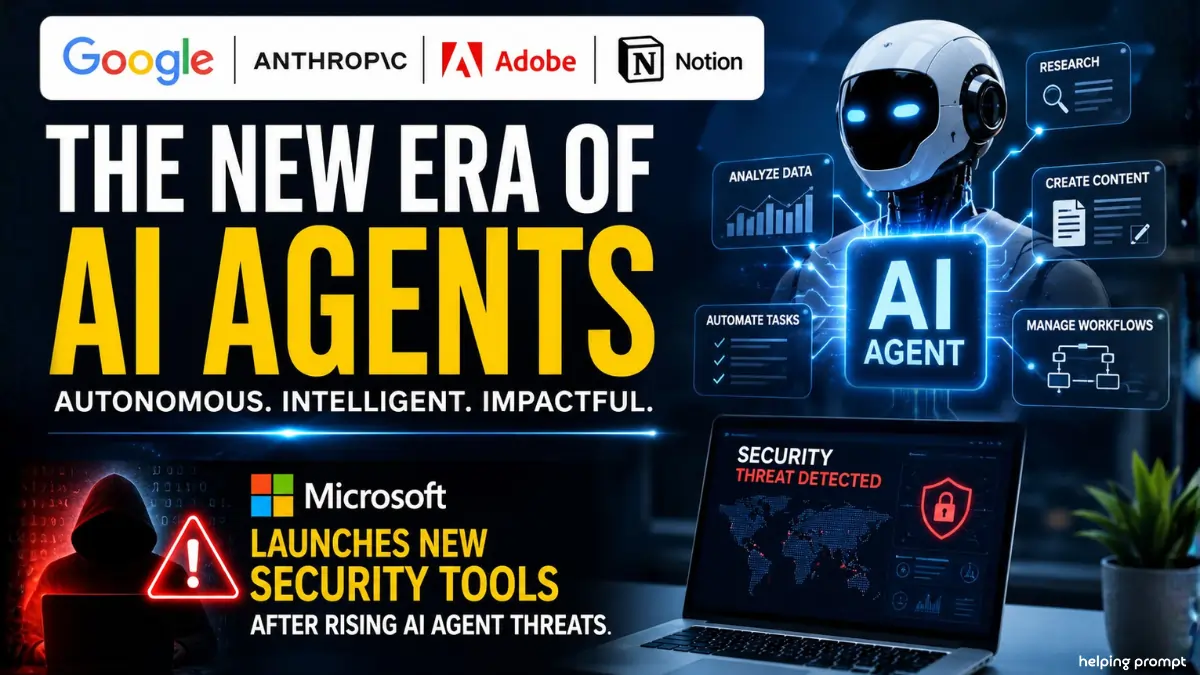
Agentic AI Is Reshaping Workflows Across Google, Anthropic, and Microsoft
The race toward Agentic AI is accelerating faster than expected.
Major AI firms are now building autonomous systems that can plan, decide, and complete tasks without constant prompts.
Recently, reports around Anthropic’s “Conway” and Google’s “Remy” revealed a major shift in AI strategy. Instead of chat-only assistants, companies now want AI teammates working silently in the background.
Meanwhile, Adobe, Notion, and Microsoft are pushing enterprise automation deeper into daily workflows. However, growing security concerns are forcing tech giants to redesign how AI agents operate online safely.
Quick Summary
- Agentic AI is moving from chatbots to autonomous task-executing systems.
- Google, Anthropic, Adobe, and Notion are expanding AI-driven workflows.
- Microsoft launched new security tools after rising AI agent threats.
Agentic AI Becomes the Next Big Industry Shift
The global AI industry is entering the era of autonomous digital workers.
Unlike traditional assistants, Agentic AI systems can independently perform multi-step actions with limited supervision.
This shift is changing how businesses handle productivity, research, scheduling, and operations. As a result, major technology firms are investing heavily in background AI execution systems instead of simple conversational interfaces.
Anthropic’s Conway Signals Always-On AI Assistants
Reports suggest Anthropic is developing an advanced autonomous agent named Conway.
The project reportedly focuses on continuous background assistance with deeper workflow integration.
Instead of waiting for commands, Conway may proactively manage tasks, monitor updates, and coordinate actions automatically. Therefore, experts believe this could redefine how AI assistants interact with professionals and enterprise teams in the coming years.
Google’s Remy Focuses on User-Controlled Automation
Google is also testing a next-generation Gemini agent called Remy.
Unlike fully independent systems, Google reportedly emphasizes user oversight and natural language controls.
This approach could help users automate research, planning, and digital workflows while keeping decision-making transparent. Meanwhile, Google continues balancing automation with trust, especially as regulators increase scrutiny around AI autonomy and data handling practices.
Adobe and Notion Expand Enterprise AI Workflows
Enterprise software platforms are rapidly adopting Agentic AI capabilities.
Adobe is integrating AI agents into creative production systems, while Notion is expanding intelligent workflow automation inside collaborative environments.
These agents can reportedly manage repetitive business tasks, organize projects, and assist with decision chains. Consequently, companies expect reduced operational delays and faster execution across marketing, content, and internal management teams.
How To
- How to prepare for Agentic AI in business?
Start integrating AI workflow tools gradually while improving security and governance practices.
- How to use Agentic AI safely?
Use trusted platforms with runtime monitoring, transparent permissions, and human oversight features.
- How will Agentic AI affect daily work?
Agentic AI may automate repetitive tasks, improve efficiency, and simplify multi-app workflows significantly.
Security Risks Around Autonomous AI Are Growing
As AI agents gain more authority, cybersecurity risks are increasing sharply.
Google recently warned that malicious websites are actively attempting to manipulate or poison AI agents during online interactions.
Because autonomous systems make decisions independently, compromised data can create larger operational risks. Therefore, enterprise adoption now depends heavily on runtime monitoring, trust verification, and stronger governance systems for AI-driven environments.
Microsoft Pushes Open-Source AI Agent Protection
Microsoft recently introduced an open-source security toolkit focused on protecting autonomous AI systems at runtime.
The toolkit helps developers monitor agent behavior, detect threats, and secure workflow execution environments.
This move highlights how AI governance is becoming equally important as innovation itself. Additionally, regulators and enterprises increasingly demand transparency, safety layers, and accountability before deploying large-scale autonomous agents inside sensitive business operations.
Why Agentic AI Could Redefine Daily Digital Work
Experts believe Agentic AI may eventually replace several repetitive software interactions.
Instead of manually switching between apps, users could simply assign goals while AI handles execution in the background.
However, trust, privacy, and reliability remain major concerns. As competition intensifies between Google, Anthropic, Microsoft, and OpenAI, the next phase of AI development will likely focus on balancing automation with human control.
Pro Tips
- Follow enterprise AI updates from major cloud platforms regularly.
- Use AI automation carefully with sensitive business information.
- Prioritize secure AI tools with transparency and governance features.
Conclusion
Agentic AI is no longer a future concept.
It is quickly becoming the foundation of next-generation digital workflows across consumer and enterprise technology platforms.
Companies now want AI systems that can think, plan, and execute tasks independently. Therefore, the focus is shifting from chatbot experiences to autonomous operational ecosystems. At the same time, security and governance are becoming critical priorities for global AI adoption.
As Google, Anthropic, Microsoft, Adobe, and Notion expand their AI ecosystems, businesses and users must stay informed. The next wave of AI competition will likely depend on trust, automation quality, and safe real-world execution.
FAQs
Agentic AI refers to autonomous AI systems that can complete tasks independently with minimal user input.
Agentic AI can automate complex workflows, improve productivity, and reduce repetitive digital tasks.
Major players include Google, Anthropic, Microsoft, Adobe, and Notion.