
Gemini Omni vs Google Flow: Which AI Tool Fits Creators Better?
Google is rapidly expanding its AI ecosystem, and many users are now comparing Gemini Omni vs Google Flow. While both products are connected, they serve very different purposes. Gemini Omni works as Google’s powerful AI engine behind video, image, and audio generation. Meanwhile, Google Flow provides a dedicated workspace designed for professional creators. As AI filmmaking and content creation become more mainstream, understanding this distinction can help users choose the right platform for their projects and maximize creative output.
QUICK SUMMARY
- Gemini Omni is Google’s core multimodal AI model powering content generation.
- Google Flow is a professional creative studio built on top of Omni.
- Flow offers advanced editing, project management, and higher generation limits.
Gemini Omni vs Google Flow: Understanding the Core Difference
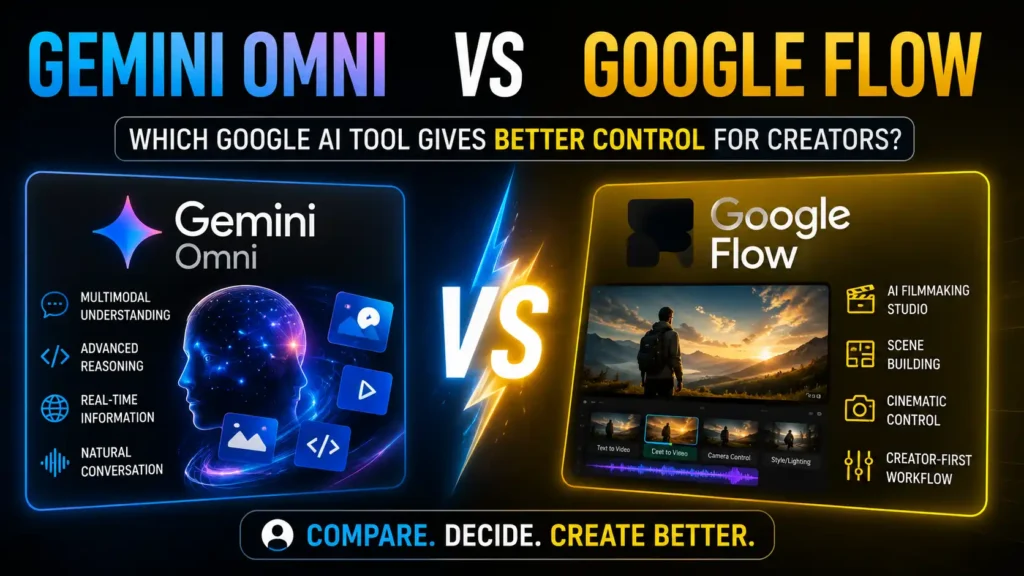
The biggest difference in Gemini Omni vs Google Flow is their role inside Google’s AI ecosystem. Gemini Omni functions as the underlying AI model that generates videos, images, audio, and creative assets from prompts. It performs the heavy computational work behind the scenes. In contrast, Google Flow acts as a dedicated production environment where creators manage projects, organize assets, and refine outputs with greater control and flexibility.
Gemini Omni Powers the Intelligence
Gemini Omni is designed as a multimodal AI engine capable of understanding text, images, audio, and video together. It can maintain character consistency, simulate realistic motion, and generate high-quality visual content. Moreover, Omni is not restricted to a single application. Google integrates it across Gemini, Workspace products, YouTube tools, and other creative experiences to support a wide range of use cases.
Google Flow Focuses on Professional Creativity
While Gemini Omni generates content, Google Flow helps creators shape and manage that content. The platform includes project organization features, asset collections, conversational editing tools, and batch workflows. As a result, creators can handle larger productions efficiently. Instead of working through a simple chat interface, users gain access to a structured environment built specifically for creative development and iterative production.
Why Many Creators Prefer Flow for Large Projects
The standard Gemini app works well for quick experiments and short-form content. However, professional creators often require multiple versions of scenes, detailed revisions, and collaborative workflows. Therefore, Google Flow becomes a more practical option. It allows users to generate numerous assets while keeping projects organized, making the production process faster and more scalable for demanding creative work.
Google Flow Music Adds Advanced Audio Features
Another major advantage of Flow is its audio toolkit. Through Google Flow Music, creators can access capabilities powered by Lyria 3 Pro. Producers can rewrite sections of tracks, modify beat structures, generate music videos, and experiment with new audio styles. Consequently, Flow expands beyond video creation and becomes a more complete multimedia production platform for creators.
Generation Limits Create a Major Separation
One key factor in the Gemini Omni vs Google Flow comparison is usage limits. Standard Gemini applications often include daily generation caps. These restrictions help manage computing resources across large user bases. Meanwhile, Flow uses a creator-focused credit system that supports extensive experimentation. This setup enables professionals to produce dozens or even hundreds of assets without constantly reaching usage barriers.
Which Platform Should You Choose?
The choice depends largely on your workflow. Casual users seeking quick visuals, social media content, or AI assistance may find Gemini sufficient. On the other hand, filmmakers, designers, marketers, and content studios can benefit from Flow’s advanced controls. Because Flow is built for continuous iteration, it supports deeper creative processes that require precision, organization, and scalability.
- How to choose between Gemini Omni vs Google Flow?
Use Gemini for quick content creation and Flow for larger creative projects.
- How to access Gemini Omni features?
Open supported Google AI products where Omni powers generation capabilities.
- How to use Google Flow effectively?
Organize assets, create variations, and use editing tools for iterative workflows.
PRO TIPS
- Use Gemini for rapid content generation and idea testing.
- Choose Flow for complex video projects and asset management.
- Leverage Flow Music for AI-assisted soundtrack production.
CONCLUSION
Google’s AI strategy clearly separates generation from production. Gemini Omni serves as the powerful engine that creates content, while Google Flow provides the workspace needed to refine, organize, and scale creative projects. Together, they form a connected ecosystem designed for both casual users and professional creators.
As AI-powered filmmaking and multimedia production continue evolving, understanding the difference between these tools becomes increasingly important. Users who match the platform to their workflow will gain better efficiency, improved creative control, and a more productive content creation experience. Staying updated on these developments can help creators make smarter technology decisions.
FAQs
Gemini Omni is the AI model, while Google Flow is the creative platform built around it.
Yes. Gemini Omni powers several Google products, including the Gemini app.
Yes. Google Flow targets creators who need advanced production and editing tools.