AI Prompt Testing and Versioning: The New Workflow for AI Teams
AI prompt testing and versioning are becoming essential as AI workflows grow more complex. Recent changes around AI-generated media attribution also show why teams need stronger operational controls. Google now allows visible watermarks to be removed in supported AI media workflows, while invisible provenance signals can remain. As a result, prompt engineers must rethink testing, safety checks and routing. The goal is no longer just better responses. Teams must also control cost, latency, attribution and real-world risk.
QUICK SUMMARY
- Test and version prompts: Treat important prompts like production software.
- Add safety checkpoints: Human review remains important for high-risk decisions.
- Use smarter routing: Balance model accuracy, latency, cost and verification needs.
HOW TO
- How should teams start AI prompt testing and versioning?
Create a baseline prompt, build a representative test set and record measurable results before changing it.
- How can teams reduce AI costs?
Use routing rules that send simple requests to efficient models and escalate complex requests when needed.
- How should AI-generated content be verified?
Use available provenance metadata, watermark detection and verification tools when attribution is important.
Why AI Prompt Testing and Versioning Now Matter
Prompt changes can create unexpected behaviour across AI systems. A small instruction change can affect accuracy, formatting, safety or tool usage. Enterprise testing therefore needs repeatable evaluation and regression checks. Industry guidance increasingly treats prompts as production assets rather than simple text instructions. Teams should record prompt versions, test datasets and performance results before deploying major changes.
Prompt Engineers Need a Version-Controlled Workflow
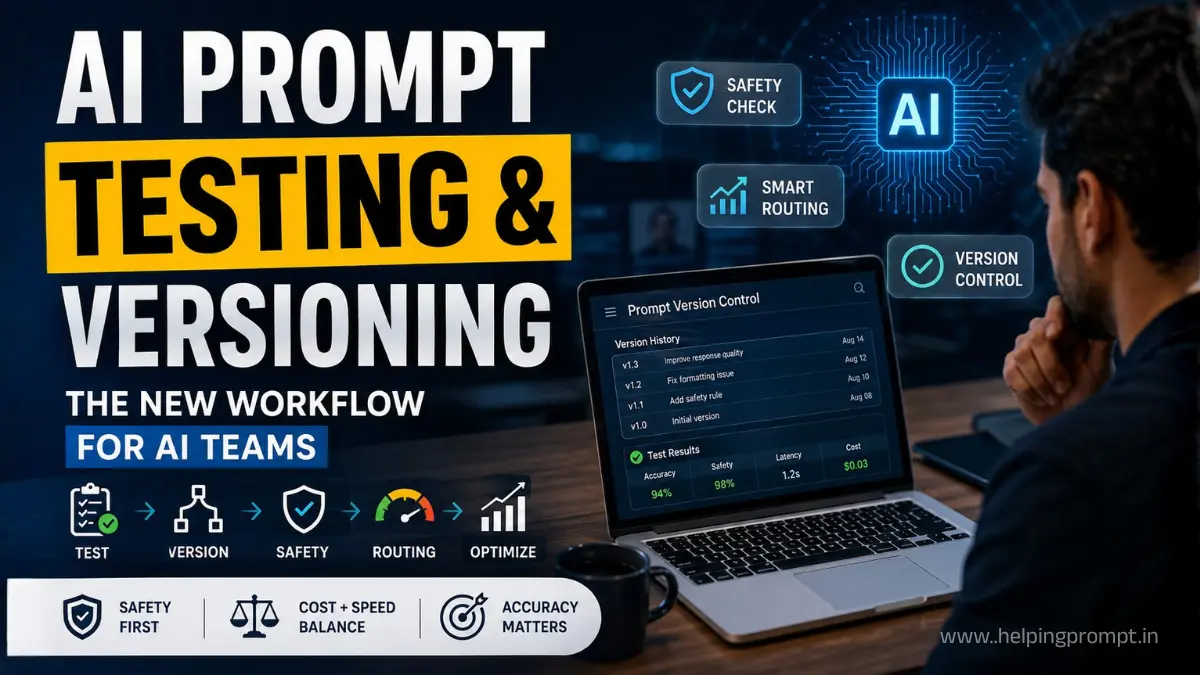
A reliable workflow starts with a clear prompt ID and version number. Each release should document its purpose, model, expected output and safety requirements. Next, teams should test the new version against previous examples. This makes regressions easier to detect. It also helps engineers roll back quickly when a model update changes behaviour unexpectedly.
Safety Checks Should Sit Outside the Prompt
A strong prompt cannot guarantee safe output by itself. AI systems can still produce harmful or inaccurate responses despite careful instructions. Google recommends combining prompt design with additional safeguards and content checks. Therefore, teams should add input filters, output validation and escalation rules. High-risk workflows should also include a human checkpoint before important actions.
Watermark Detection Becomes More Important
Visible AI watermarks are not always reliable attribution signals. Google’s recent change makes visible media watermarks optional in supported workflows. However, invisible signals such as SynthID and provenance metadata can remain available for verification. Therefore, publishers and businesses should use watermark or provenance detection when attribution matters. This is especially useful for journalism, education, advertising and regulated content.
Provenance Needs More Than One Signal
Metadata and watermarking solve different problems. C2PA-style provenance can provide information about content history, while durable watermarking can help preserve an AI signal after some transformations. OpenAI is also expanding verification across supported generated media and providing API access for provenance checks. Teams should avoid treating one detection method as absolute proof.
Routing Must Balance Cost, Latency and Accuracy
Using the strongest model for every request can quickly increase AI costs. Using the cheapest model everywhere can reduce quality. Modern routing systems can classify requests and select models based on risk, evidence needs and expected quality. For example, simple tasks can use faster models. Complex or sensitive requests can automatically escalate to stronger models or human review.
Human Checkpoints Still Matter
AI agents increasingly process external documents, websites and other tool outputs. That creates additional risks from indirect prompt injection and unexpected instructions. Google has identified indirect prompt injection as an important security concern for AI agents. Consequently, human approval should remain part of high-impact workflows. The checkpoint should be triggered by risk, not added blindly to every task.
The New Prompt Engineering Playbook
The practical workflow is becoming clear: version, test, evaluate, route and monitor. Teams should maintain a test set for important prompts and add real failures to it. They should also track accuracy, safety incidents, latency and token costs. Over time, this creates an operational feedback loop. Prompt engineering then becomes an engineering discipline rather than repeated trial and error.
PRO TIPS
- Keep a prompt changelog: Record every production change and its expected impact.
- Create risk-based routing: Escalate sensitive or uncertain requests automatically.
- Verify attribution: Use provenance and watermark detection when content origin matters.
The Bottom Line
AI prompt testing and versioning are becoming core requirements for reliable AI operations. Prompt engineers now need to think beyond response quality. Every production workflow should consider safety, attribution, model selection, latency and cost. Recent developments in AI provenance make this shift even more important.
The best approach is a controlled feedback loop. Test every meaningful prompt change, retain earlier versions and monitor real-world failures. Meanwhile, use human checkpoints for high-risk actions and smart routing for everyday requests. As AI systems evolve, teams that build these controls early will be better prepared for faster model and policy changes.
FAQs
It means testing prompt changes systematically and keeping identifiable versions for reliable rollback and comparison.
Versioning helps teams identify regressions, compare results and restore a stable prompt quickly.
Yes. It can expose unsafe behaviours, but production systems still need separate safeguards and human review.
More Posts Like This
- Amazing Identity Lock AI Portrait Prompt for Full Body Photos
- Studio Portrait Prompt for Luxury Cinematic AI Photos
- AI Photo Annotation Prompt With Glassmorphism Spotify UI
- AI Beach Photoshoot Collage Prompt for Cinematic DSLR Portraits
- Stunning Luxury Mirror Selfie Prompt for Ultra-Realistic AI Photos