
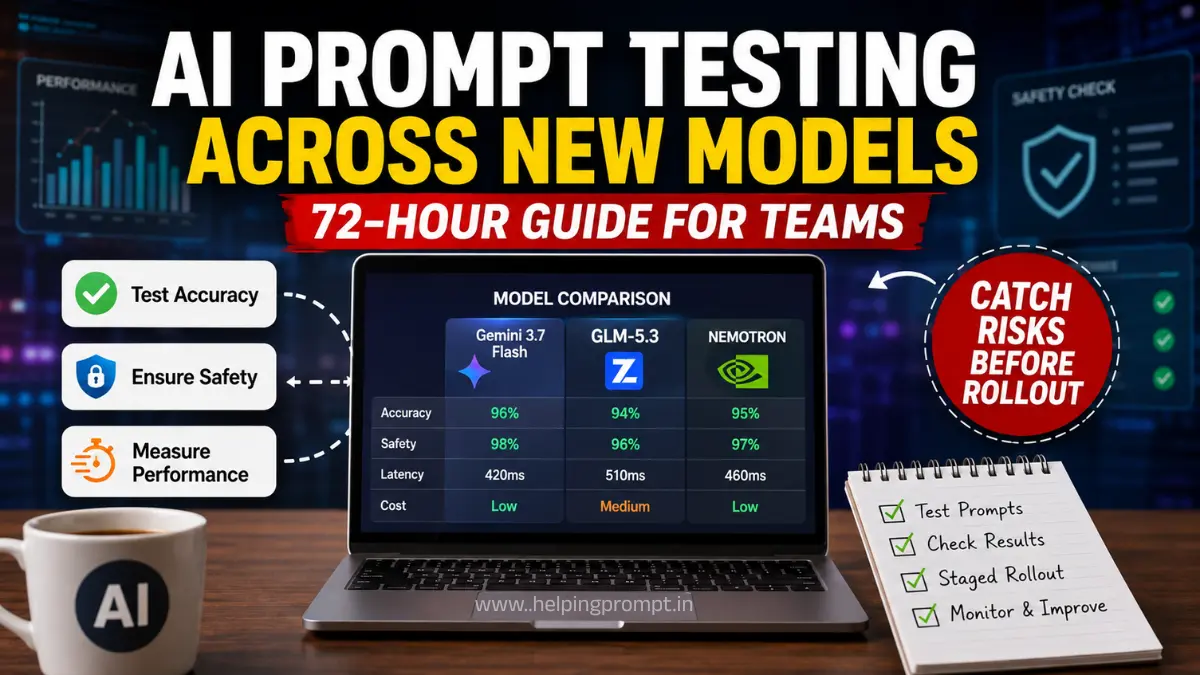
AI Prompt Testing Across New Models: 72-Hour Guide for Teams
AI models are changing faster than production prompts can be updated. Google launched Gemini 3.7 Flash on August 13 for coding and agent workflows. NVIDIA has also released Nemotron 3.5 Lightning, while Z.ai’s GLM-5.3 is drawing attention for advanced coding and cybersecurity capabilities.
That makes AI prompt testing across new models essential for teams moving critical workflows. A prompt that worked yesterday may behave differently today. Therefore, teams need repeatable tests for accuracy, instruction following, safety, tools, cost and latency before switching models.
QUICK SUMMARY
- Retest critical prompts against every new model before production.
- Track accuracy, safety, latency and cost against a stable baseline.
- Use staged rollouts with automatic rollback when serious regressions appear.
HOW TO
- How to start AI prompt testing across new models?
Export your critical prompts, create expected outcomes, then compare every new model against the same baseline.
- How to test AI prompts automatically?
Create smoke and regression suites that measure correctness, safety, latency, tokens and tool-call behavior.
- How to safely deploy a new AI model?
Use a small canary first, monitor predefined thresholds, then gradually increase traffic after automated and human review.
AI Prompt Testing Across New Models: What to Test First
The first step is building a canonical test corpus. Include your real production prompts and useful variations. Add paraphrases, truncated instructions and extra context. Also include negative tests and adversarial prompts. For critical workflows, define the expected behavior before testing. This creates a reliable baseline and prevents teams from judging models only by impressive demos or benchmark scores.
Functional correctness should come first. Test whether generated code actually runs. Check whether structured responses follow the required schema. For agent workflows, verify every tool call. A flight-booking agent, for example, should confirm details before payment. It should never perform an irreversible action without approval. These checks measure real behavior instead of simply comparing generated text.
Instruction following also needs separate measurement. Test required formats, word limits, tone, citations and output structures. Next, measure factual accuracy and hallucinations using known ground truth. For critical prompts, target at least 95% correctness or remain within two percentage points of your baseline. However, teams should define stricter thresholds for high-impact workflows.
Safety testing becomes especially important as models gain stronger coding and agent capabilities. GLM-5.3 has recently attracted attention for cybersecurity performance, while NVIDIA’s newer Nemotron models target agentic workflows. Therefore, red-team tests should cover jailbreaks, secret extraction, unsafe tool calls and cyber misuse. Any critical safety violation should immediately block the rollout.
Performance matters too. Record p50 and p95 latency, input and output tokens, throughput and cost per request. Gemini 3.7 Flash, for example, was introduced with an emphasis on coding, software engineering and agent workflows. A cheaper model is not automatically better if it creates more failures, retries or human-review work.
For routed systems, test the router itself. NVIDIA’s Switchyard is designed to route LLM traffic across different backends while collecting request statistics and supporting routing policies. Consequently, teams should verify that simple tasks reach efficient models and complex tasks reach stronger ones. Also test fallback behavior when a selected model fails or becomes unavailable.
Finally, use staged deployment rather than an instant 100% switch. Start with a small canary, such as 0.5% to 5% of traffic. Monitor it for 24–72 hours. Then increase traffic through 25%, 50% and 100% stages. A regression above 5% should trigger investigation. A serious safety failure should trigger an immediate hold or rollback.
Pro Tips
- Version every prompt: Keep prompts, test cases and evaluation datasets under version control.
- Automate smoke tests: Run a small critical suite whenever a model changes.
- Keep human review: Escalate borderline safety, accuracy and business-risk failures.
Final Thoughts
Model upgrades can improve coding, reasoning and agent performance. However, they can also change how existing prompts behave. That is why AI prompt testing across new models should become part of the release process, not an optional experiment.
Start with your 50 most important prompts. Build a 10-test smoke suite and establish baseline metrics. Then run a larger regression suite before increasing traffic. With clear thresholds, safety gates and rollback rules, teams can adopt new models faster while reducing production risk.
FAQs
It means running the same critical prompts against different models to compare accuracy, safety, cost and performance.
Retest whenever a production model changes, a major model update launches, or your prompt logic changes significantly.
Critical safety violations, serious data leakage, destructive tool actions or major regression against your approved baseline should block deployment.
More Posts Like This
- Stunning Luxury Mirror Selfie Prompt for Ultra-Realistic AI Photos
- Stunning Cinematic Devotional Poster Prompt for Ultra-Realistic
- 20 Viral White Horse Portrait AI Prompt Package
- Stunning Instagram Profile Picture Design Prompt for AI Creators
- Stunning AI Bihari Bride Photo Prompt for Realistic HD Results