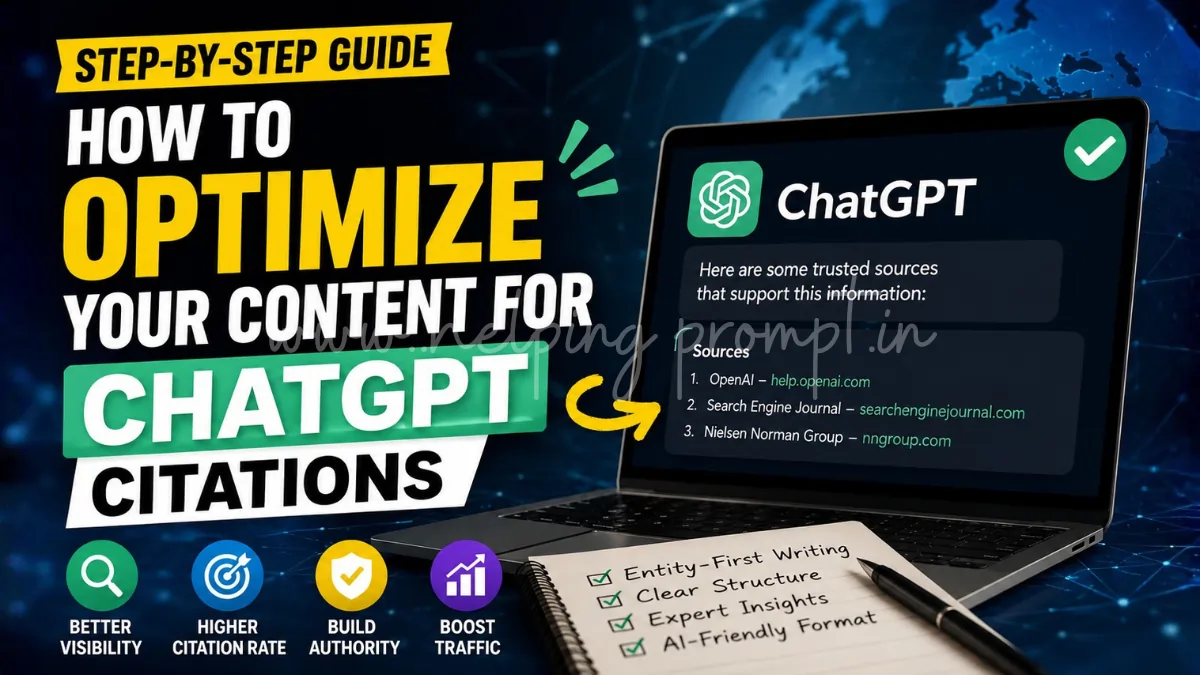
How to Optimize Your Content for ChatGPT Citations: Step-by-Step Guide
ChatGPT cites content that provides direct answers, strong entity coverage, and clear structure. Pages with passage-friendly formatting and authority signals have higher citation potential.
If you want to Optimize Your Content for ChatGPT, traditional SEO alone is no longer enough. AI systems now prefer pages that answer questions clearly, organize information logically, and demonstrate expertise.
Large language models extract passages instead of ranking pages like classic search engines. That shift makes structure, entities, and information gain more important than keyword density. Understanding how citation systems work can improve visibility across ChatGPT, Google AI Overviews, Gemini, and Perplexity.
Quick Summary
- Structure answers for extraction, not just rankings.
- Use entities, examples, and expertise signals instead of repeating keywords.
- Short passages improve AI citation opportunities.
Comparison Table
| Feature | Benefit | Why It Matters |
|---|---|---|
| Question-based headings | Better extraction | Improves passage ranking |
| Entity-first writing | Semantic understanding | Helps AI systems connect concepts |
| Tables and lists | Fast comprehension | Easier for LLMs to cite |
| Expert insights | Higher trust | Supports E-E-A-T |
| Examples | Better context | Improves answer quality |
| Original research | Information gain | Differentiates content |
Why should you Optimize Your Content for ChatGPT?
Direct Answer
AI assistants prefer information that is easy to extract and verify.
Explanation
Unlike traditional search engines, language models retrieve passages containing clear answers and supporting context.
Example
A well-structured FAQ often appears in AI summaries.
Practical Insight
Think like a journalist. Answer first and explain later.
How do AI citation systems work?
Direct Answer
Models identify passages with high relevance and strong semantic signals.
Explanation
Entities such as OpenAI, Schema.org, JSON-LD, and FAQs help machines understand context.
Example
Google AI Overviews often cite concise answer sections.
Practical Insight
Each section should work independently.
Why do entities matter more than keywords?
Direct Answer
Semantic entities provide context that machines understand.
Explanation
OpenAI, Anthropic, Gemini, Perplexity, Schema.org, and Markdown improve topic relationships.
Example
Instead of repeating phrases, mention concepts like retrieval, vector search, and structured data.
Practical Insight
Entity coverage creates richer knowledge graphs.
What content structure increases citation chances?
Direct Answer
Short sections with direct answers perform better.
Explanation
Research from Nielsen Norman Group shows users scan rather than read fully.
Example
Question headings followed by concise answers improve readability.
Practical Insight
Keep paragraphs below three lines.
What are the biggest mistakes publishers make?
Direct Answer
Most websites still write for rankings instead of extraction.
Explanation
Overusing keywords weakens content quality.
Example
Long introductions delay answers and reduce passage usefulness.
Practical Insight
Front-load important information.
How-To Section
How to create AI-friendly answer sections?
- Write a direct answer first.
- Add explanation.
- Include an example.
- Finish with practical insight.
How to add authority signals?
- Mention experts.
- Add examples.
- Include statistics.
- Show practical experience.
How to improve passage ranking?
- Use question headings.
- Keep paragraphs short.
- Add tables and FAQs.
- Avoid keyword repetition.
How do authority signals influence AI systems?
Direct Answer
Expertise improves trust and citation potential.
Explanation
Google’s E-E-A-T framework rewards experience and reliability.
Example
SEO expert Lily Ray regularly emphasizes trust signals and author expertise.
Practical Insight
Include author information and practical examples.
What should beginners focus on first?
Direct Answer
Start with structure and clarity.
Explanation
Answer questions directly and support them with examples.
Example
Add FAQs, tables, and schema markup.
Practical Insight
Think like an editor, not a keyword optimizer.
Which trends are changing AI search?
Direct Answer
Retrieval-Augmented Generation and agentic search are changing content discovery.
Explanation
AI systems increasingly prefer source-backed information.
Example
Google AI Overviews and ChatGPT Search prioritize factual passages.
Practical Insight
Authority and information gain will matter more than backlinks alone.
Expert Insight
Information Gain Box
Most publishers focus on rankings, but citation systems reward extractability.
A surprising observation is that pages with smaller answer blocks often receive more AI references than lengthy guides.
Many competitors still optimize for crawlers. Future winners will optimize for retrieval engines.
Pro Tips
- Add a direct answer within the first sentence of every section.
- Use tables and FAQs to improve extraction.
- Include original observations instead of rewriting competitors.
Future Outlook
Agentic search will continue expanding.
Retrieval-Augmented Generation systems will demand higher trust signals.
By 2027, AI assistants may evaluate authors, sources, and freshness before citing information.
Content quality will matter more than keyword density.
Conclusion
Search is shifting from rankings to retrieval. Pages designed for extraction are becoming more valuable than pages optimized only for traditional SEO.
Publishers should focus on entities, clarity, and original insights. Strong formatting, expert examples, and concise answers improve visibility across ChatGPT, Google AI Overviews, Gemini, and Perplexity.
The next era belongs to content that machines can understand and humans enjoy reading.
FAQs
No. Language models rely more on context, entities, and relevance.
Yes. Structured data improves understanding and trust.
No. Extractable passages and authority matter more.