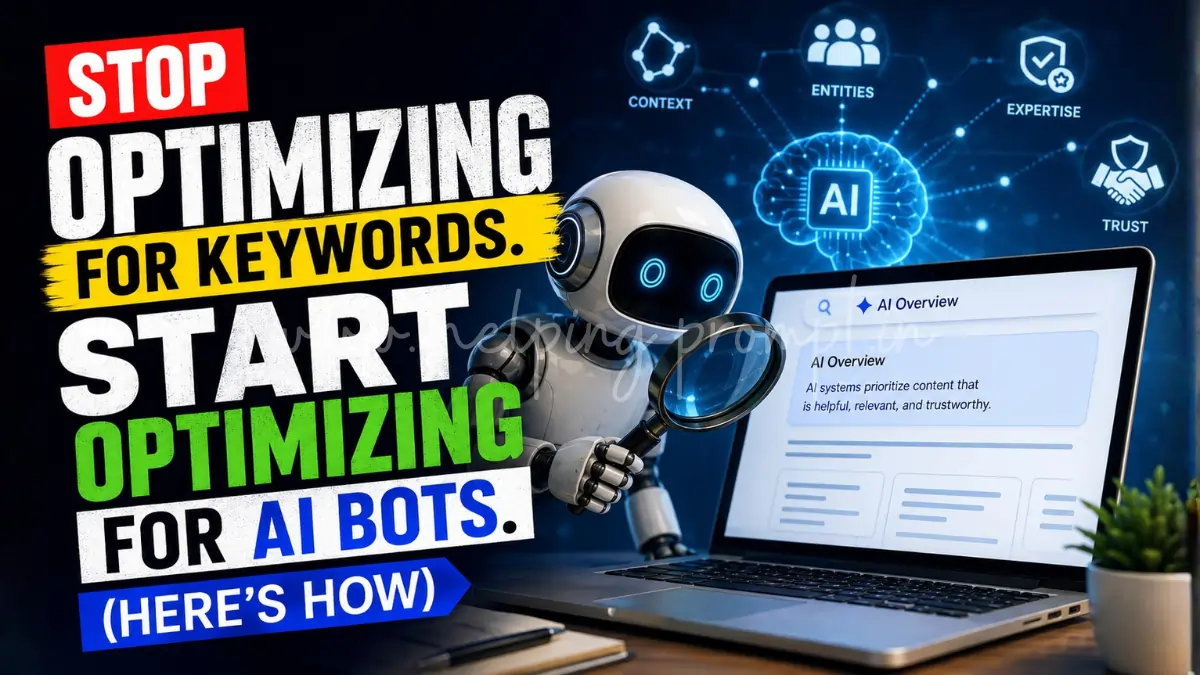
Stop Optimizing for Keywords. Start Optimizing for AI Bots. (Here’s How)
Optimizing for Keywords alone is no longer enough. AI systems now prioritize entities, context, citations, and direct answers when selecting content for AI-generated results.
Websites that organize information clearly and demonstrate expertise are more likely to appear in AI Overviews and answer engines.
For years, websites relied on Optimizing for Keywords to rank higher. That approach still matters, but it is no longer enough. AI search engines are changing how content gets discovered. Google AI Overviews, ChatGPT, Gemini, Midjourney, Gemini, Leonardo AI, DALL·E, Ideogram AI focus more on context than exact phrases. If your pages are written only for search rankings, you may lose visibility. Understanding how AI bots interpret entities, relationships, and trust signals has become essential for future traffic growth.
Quick Summary
- AI systems reward context, entities, and expertise more than exact phrase repetition.
- Structured answers increase the chances of appearing inside AI-generated responses.
- Information gain matters more than traditional ranking tactics.
Why Is Optimizing for Keywords Becoming Less Effective?
Traditional search engines depended heavily on matching phrases.
Modern AI models understand meaning rather than isolated terms.
Large language models evaluate:
- Entity relationships
- Topic coverage
- Source authority
- User intent
- Content structure
This shift rewards pages that answer questions completely instead of repeating phrases.
How Do AI Bots Actually Understand Content?
AI crawlers build connections between concepts.
For example, an article about AI search should naturally include:
- Google AI Overviews
- Gemini
- Perplexity
- Semantic entities
- Structured data
- E-E-A-T signals
These contextual connections help machines understand expertise.
Industry analysts increasingly call this approach Generative Engine Optimization.
What Signals Matter Most to AI Search Systems?
Several ranking signals now influence answer engines.
Context Depth
Comprehensive explanations outperform thin pages.
Information Gain
Fresh insights make content stand out.
Clear Formatting
Short paragraphs improve extraction quality.
Authority Signals
Author experience and citations improve trust.
According to multiple SEO studies, answer-focused pages receive higher visibility inside AI-generated summaries.
Why Does Optimizing for Keywords Alone Fail in AI Search?
Keyword density once influenced rankings.
Today, excessive repetition often reduces readability.
AI systems prefer:
- Questions and answers
- Entity-rich content
- Definitions
- Tables
- Expert opinions
- Statistics
- Unique observations
This explains why some smaller websites appear in AI Overviews despite lower domain authority.
What Is the Hidden Advantage Most Publishers Ignore?
Most creators still chase search volumes.
Few focus on extraction quality.
An experienced SEO editor can often predict AI visibility simply by asking:
“Can a language model quote this section directly?”
That question changes content strategy.
Information blocks, comparisons, definitions, and concise explanations improve answer extraction dramatically.
This approach remains underused across Indian websites.
How-To Questions
How to make content AI-friendly?
- Use question headings.
- Add semantic entities.
- Write concise answers.
- Include expert insights.
How to improve extraction quality?
- Keep paragraphs short.
- Use lists and definitions.
- Add comparison tables.
- Remove unnecessary filler.
How to build topical authority?
- Create topic clusters.
- Link related pages.
- Cover subjects deeply.
- Maintain consistent expertise.
How Can Publishers Build AI-Friendly Pages?
Think like a knowledge architect.
Instead of creating isolated articles, connect related topics.
Example:
AI Search → Semantic Entities → Structured Data → E-E-A-T → Citations → Information Gain
This creates topical authority.
AI systems understand relationships better when content clusters are interconnected.
Pro Tips
- Write answer-first paragraphs under 60 words.
- Use question-based headings for easier extraction.
- Add original insights instead of repeating common SEO advice.
Conclusion
Search is evolving from matching words to understanding meaning. AI engines prioritize expertise, structure, and information value over repetitive phrases.
Publishers who embrace entity-based content and answer-focused writing will gain an advantage. As AI Overviews expand, websites built around trust and knowledge architecture are likely to capture more organic visibility. The future belongs to content designed for both humans and machines.
FAQs
No. It still helps understand intent, but context and entities matter more.
They prioritize direct answers and trusted information instead of simple phrase matching.
Yes. High-quality explanations and unique insights often outperform larger domains.