Google AI Watermark Toggle and Claude Code Auto Mode Explained
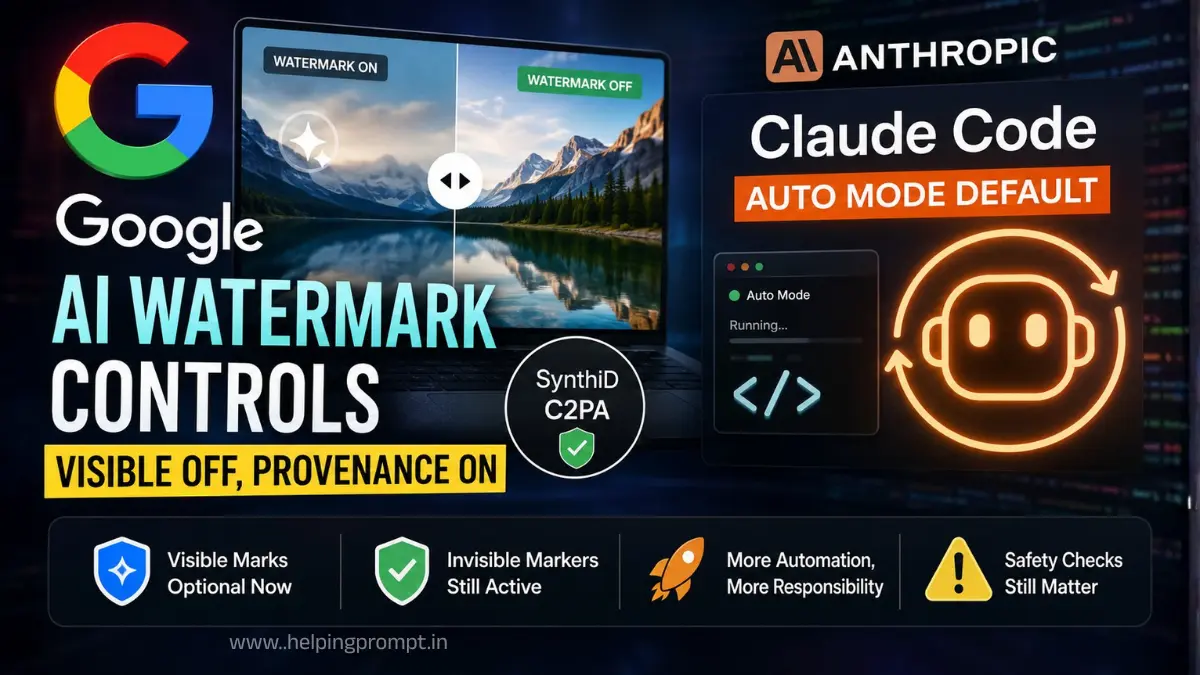
AI tools are quietly changing how users see and control machine-generated work. Google AI watermark controls now let users hide visible markers on eligible AI-generated media. However, invisible SynthID and C2PA provenance signals remain embedded for verification. At the same time, Anthropic is pushing Claude Code toward more autonomous workflows with Auto Mode. Together, these updates show a clear shift: visible warnings can become less prominent, while behind-the-scenes verification and automated safety checks become more important for users, creators, and developers.
QUICK SUMMARY
- Google lets eligible users turn off visible AI media watermarks while retaining invisible provenance markers.
- SynthID and C2PA can help verify whether supported content was generated by AI.
- Claude Code Auto Mode reduces permission prompts by using a separate safety classifier before actions run.
HOW TO
- How can users verify AI-generated Google media?
Use supported Google services such as Gemini or Search to check for available AI provenance signals.
- How should creators handle AI-generated content?
Keep source files and provenance details. Also, disclose AI involvement when transparency is important.
- How should developers use Claude Code Auto Mode safely?
Define trusted environments and keep human review for sensitive operations. Auto Mode reduces prompts but does not guarantee safety.
Google AI Watermark Controls Are Becoming Optional
Google has introduced a setting that can remove visible watermarks from AI-generated images, videos, and music. The change applies to content created through tools including Gemini and Flow. The familiar sparkle-style marker can therefore disappear from the final visible media.
However, Google says the removal is mainly visual. Invisible SynthID and C2PA metadata can remain attached to generated content. Therefore, users may not immediately see an AI label, but verification mechanisms can still exist behind the scenes.
What Google’s Invisible AI Markers Mean
SynthID is designed to identify AI-generated content through an embedded signal. C2PA, meanwhile, provides a broader provenance framework for describing where digital content came from. These systems matter because visible labels can be cropped, edited, or simply switched off.
Google says supported AI-generated media can still be checked through services such as Gemini or Search. However, that does not mean every AI image across the internet will automatically become identifiable. Verification depends on supported provenance signals being present.
The policy also creates an important user-experience change. A person viewing an image may no longer have an obvious visual clue that AI was involved. As a result, publishers and creators may need to provide additional context when authenticity matters.
Why This Matters for Indian Creators
For Indian creators, the change could make AI-generated visuals look cleaner. This may help social posts, marketing creatives, product images, and presentation assets. However, removing a visible marker does not remove the responsibility to disclose AI use when transparency matters.
Moreover, businesses using AI-generated advertising should maintain their own content records. Keeping prompts, source assets, editing history, and provenance information can strengthen editorial and brand workflows. This becomes especially useful when content is republished across multiple platforms.
Claude Code Auto Mode Pushes AI Coding Further
Anthropic is also reducing friction inside Claude Code. Auto Mode allows Claude to execute actions without repeatedly asking for permission. A separate classifier reviews tool actions and can block operations considered irreversible, destructive, outside the trusted environment, or influenced by hostile content.
That approach changes how developers interact with coding agents. Instead of approving every routine operation, developers can give Claude broader responsibility. Consequently, long multi-step coding tasks can move faster with fewer interruptions.
However, Auto Mode is not a replacement for human review. Anthropic’s documentation explicitly describes it as a research preview and says it does not guarantee safety. Current documentation also lists plan, model, provider, and administrative requirements that can change over time.
The Bigger AI Trend: Less Friction, More Hidden Verification
These two developments point toward the same direction. AI products are moving away from constant visible intervention. Instead, they increasingly rely on background systems that handle verification, provenance, and safety.
For creators, that means visible AI labels may become less reliable as a quick signal. For developers, meanwhile, permission prompts may become less frequent. Therefore, strong workflows, trusted environments, logging, and human review are becoming more important.
What Users Should Do Now
Creators should treat visible watermarks and invisible provenance as two different layers. A missing watermark does not automatically mean content is human-made. Similarly, provenance metadata should not be treated as a universal detector for every piece of online media.
Developers using autonomous coding agents should also tighten their instructions. Define trusted repositories, sensitive files, external services, and actions that require explicit approval. Anthropic’s documentation supports configuring trusted infrastructure for Auto Mode workflows.
PRO TIPS
- Creators: Keep original AI files and provenance information before publishing.
- Developers: Separate routine actions from destructive or production-level operations.
- Publishers: Add clear AI disclosure when audience transparency is important.
CONCLUSION
Google’s watermark change shows that AI transparency is moving beyond visible labels. Users can hide certain visual markers, while technologies such as SynthID and C2PA can preserve provenance signals underneath. That makes verification more technical and less obvious to everyday viewers.
Meanwhile, Claude Code’s Auto Mode shows the same broader shift toward AI systems acting with greater independence. The benefit is speed, but the trade-off is greater responsibility for workflow design and oversight. As AI agents become more capable, users should focus less on visible warnings alone and more on provenance, permissions, logging, and review.
FAQs
Yes, Google now provides a setting to disable eligible visible media watermarks. Invisible provenance markers can still remain.
No. Google says supported content can retain SynthID and C2PA markers for verification.
Google AI watermark controls make visible AI labeling optional, increasing the importance of technical provenance and verification.