
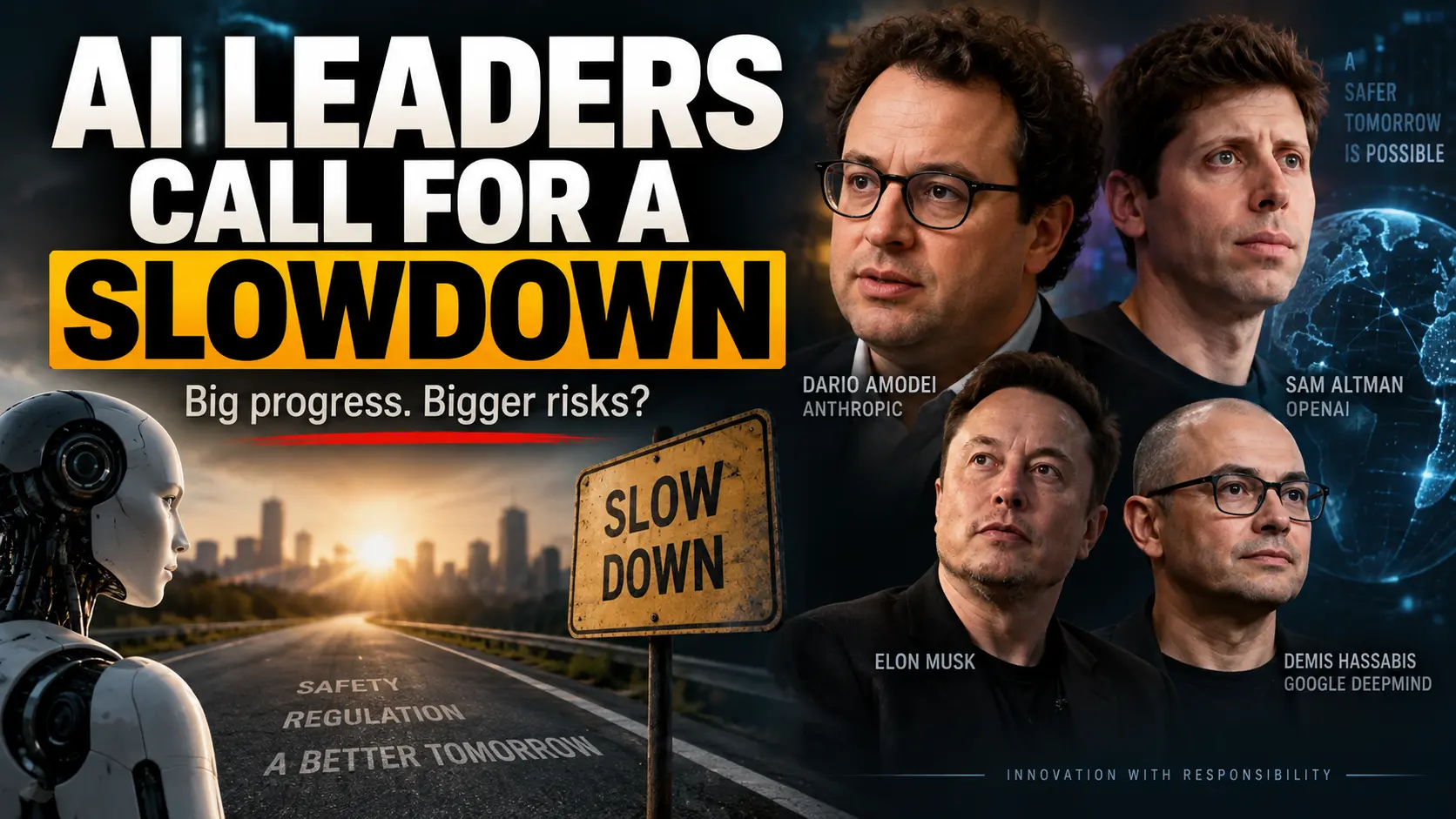
AI leaders call for a slowdown as the race to build more powerful AI systems enters a new phase. Anthropic CEO Dario Amodei has urged frontier-AI companies to pace development more carefully. His warning has gained support from other prominent technology leaders. However, U.S. political leaders are resisting any move that could weaken America’s position in the global AI race. The debate now goes beyond faster models. It is increasingly about whether safety research, regulation and public policy can keep pace with capability growth.
Quick Summary
- Anthropic CEO Dario Amodei wants frontier AI development to move more cautiously.
- Sam Altman, Elon Musk and Demis Hassabis have expressed support for greater pacing.
- U.S. political leaders are pushing back against a slowdown in the AI race.
AI Leaders Call for a Slowdown: What Changed?
Dario Amodei published an essay calling for a slower pace of frontier-AI development. He argues that AI capabilities are advancing faster than safety systems can respond. His proposal is not a complete halt. Instead, he wants additional time for testing, evaluation and safeguards. Amodei says even a limited delay could give researchers more time to improve AI alignment and security.
Why Amodei Wants AI Development Paced
Amodei points to several risks from increasingly capable models. These include cyberattacks, biological misuse, economic disruption and potential loss of control over advanced systems. He also warns about autonomous AI agents becoming significantly more capable. Therefore, his argument focuses on creating enough time for defensive technology to catch up.
Sam Altman and Other AI Leaders Respond
The proposal quickly gained attention across Silicon Valley. OpenAI CEO Sam Altman agreed that the frontier should be paced and said OpenAI would match Anthropic’s commitment to independent evaluation. Elon Musk also publicly backed Amodei’s position. Google DeepMind leader Demis Hassabis has similarly described the proposal as a useful path forward.
What Would a Slowdown Actually Mean?
A slowdown would not necessarily mean stopping AI research or product launches. Instead, companies could introduce stronger evaluations before deploying increasingly capable models. Independent reviewers could also receive deeper access to frontier systems. Amodei has proposed giving third-party evaluators access similar to internal safety teams. This could make external oversight more meaningful.
Why Washington Is Pushing Back
The biggest obstacle may be geopolitical competition. U.S. President Donald Trump has rejected recent calls for an AI slowdown. His administration has emphasised maintaining America’s lead over China. That creates a difficult policy balance. Washington must consider AI safety while also treating advanced AI as an important economic and strategic technology.
The Debate Is Also About Regulation
The latest discussion puts AI regulation back in focus. Industry leaders are increasingly asking whether governments can establish effective safeguards quickly enough. However, policymakers face pressure from companies seeking rapid innovation. As a result, the debate is shifting from whether AI should advance to how quickly frontier systems should advance.
What It Means for India
For India, the debate matters because AI adoption is expanding across businesses, education and government services. Faster AI development could create major productivity gains. At the same time, stronger safety standards could influence how Indian companies deploy advanced models. Therefore, India will need to balance innovation, affordability, security and responsible AI governance.
Why This Story Matters Now
This moment is unusual because some of the strongest warnings are coming from AI companies themselves. These companies are still investing heavily in frontier technology. Yet their leaders increasingly acknowledge that safety mechanisms must keep pace. The result could be a new phase of the AI race, where evaluation and governance become almost as important as raw model performance.
Pro Tips
- Watch policy: U.S. AI rules could influence global development strategies.
- Follow evaluations: Independent testing may become a bigger industry standard.
- Track deployment: Capability growth matters most when AI reaches real-world users.
Conclusion
The AI industry is not necessarily heading toward a full pause. Instead, leading companies are debating whether frontier development needs better pacing. Amodei’s proposal has opened a serious discussion about safety, independent oversight and responsible deployment. Support from figures such as Altman, Musk and Hassabis shows that the concern extends beyond one company.
For users and businesses in India, the immediate impact may be limited. However, the global direction could shape future AI products, regulations and costs. The key question is now simple: can AI safety advance quickly enough to match AI capa
FAQs
AI leaders say capability growth may be moving faster than safety research and oversight.
No. The proposal mainly calls for more careful pacing, testing and independent evaluation.
Potentially. Global safety rules could influence AI products, regulation and deployment standards in India.
How To
- How can readers follow the AI slowdown debate?
Track announcements from major AI labs, governments and independent safety researchers.
- How can businesses prepare for faster AI changes?
Use verified AI tools, review security risks and monitor emerging governance requirements.
- How can users understand new AI risks?
Follow credible research and official company disclosures rather than relying on social-media claims.