Deep Research AI Agents Are Changing How Knowledge Works
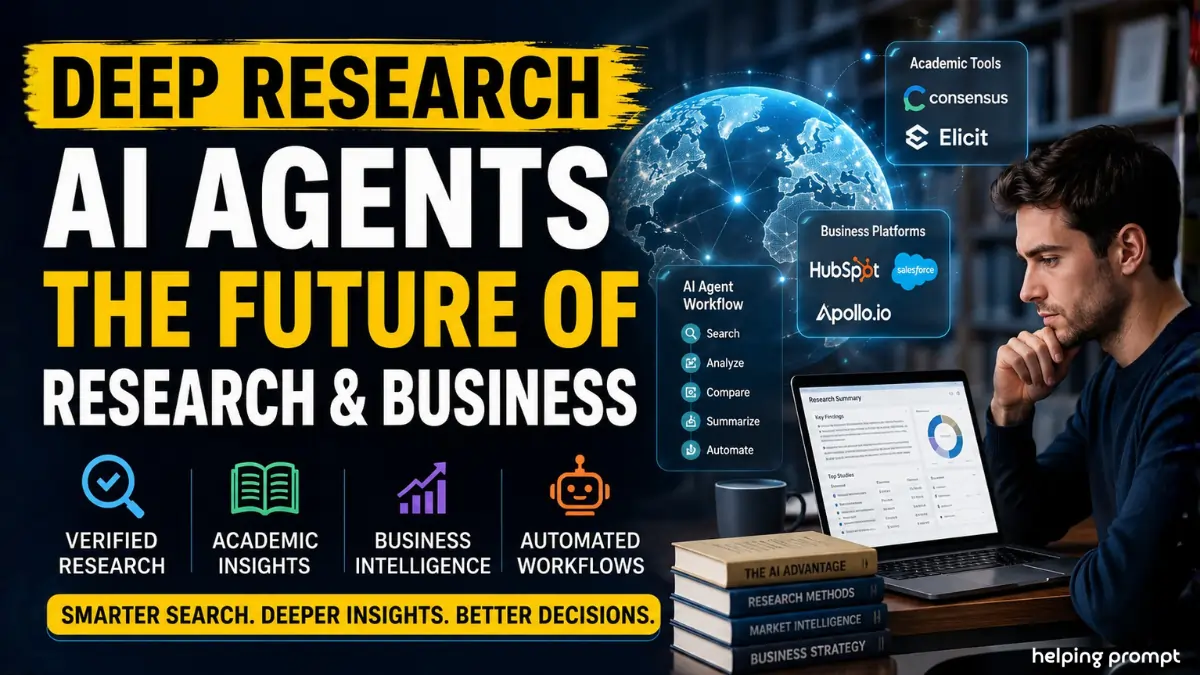
The rise of Deep Research AI Agents is changing how people collect, verify, and use information online. Instead of generic chatbots, users now prefer AI systems built for research accuracy and decision-making.
Meanwhile, companies and universities are rapidly adopting tools that combine peer-reviewed studies, financial databases, and private documents into one workflow. Platforms like Consensus, Elicit, and Google NotebookLM are leading this shift. As AI competition grows globally, these research-first systems may become the next major productivity layer.
Quick Summary
- Deep Research AI Agents now focus on verified research instead of generic chatbot replies.
- Academic tools like Consensus and Elicit are improving literature reviews and study comparisons.
- Business platforms are combining search, CRM automation, and market intelligence in one AI workflow.
Deep Research AI Agents Are Replacing Generic Chatbots
The AI industry is shifting toward specialized research systems. Earlier chatbots generated broad answers quickly, but accuracy remained a concern. Now, Deep Research AI Agents are trained to verify sources before responding.
As a result, enterprises and researchers prefer systems that reduce hallucinations. These tools also cite evidence, summarize reports, and compare conflicting information automatically. That makes them more useful for real-world decisions.
How To
- How to use Deep Research AI Agents effectively?
Upload reliable documents and ask focused questions for better evidence-backed answers.
- How to compare research studies with AI?
Use tools like Elicit to compare datasets, findings, and conclusions together.
- How to reduce AI hallucinations during research?
Choose document-grounded AI platforms that cite sources and verify information before responding.
Academic AI Platforms Are Becoming Mainstream
Academic research is one of the fastest-growing AI segments globally. Platforms like Consensus search more than 220 million peer-reviewed papers and show a “Consensus Meter” for scientific questions.
Similarly, Elicit helps users compare multiple studies together. Researchers can extract datasets, summarize findings, and identify gaps quickly. Therefore, universities now save hours during literature reviews.
Business Research AI Is Expanding Rapidly
Corporate teams are also adopting Deep Research AI Agents aggressively. Tools like Pokee AI combine search engines, LinkedIn insights, and financial databases into a single dashboard.
Moreover, these systems can take actions automatically. Some platforms update CRMs, generate slide decks, and email reports without human intervention. Consequently, AI is evolving from assistant to operational teammate.
Google NotebookLM Remains a Major Player
Google NotebookLM continues to dominate document-grounded AI workflows. The platform helps users analyze huge datasets without adding outside hallucinated information.
Students, journalists, and analysts upload PDFs, textbooks, or internal reports for synthesis. Because responses stay grounded in uploaded documents, trust levels remain higher than traditional chatbots.
Why Verification Matters in the AI Era
Users now care more about reliability than speed alone. Deep Research AI Agents succeed because they prioritize evidence-backed outputs. That shift is important for healthcare, education, finance, and policy research.
Additionally, regulators worldwide are discussing stricter AI transparency standards. Therefore, platforms with traceable sources may gain stronger adoption over the next two years.
AI Agents Are Becoming Action-Oriented
Modern AI tools are no longer limited to answering questions. Instead, they are designed to complete workflows independently. This includes summarizing reports, scheduling tasks, and generating structured documents.
Consequently, businesses see productivity gains across departments. Analysts believe autonomous AI agents may become essential workplace software by 2027.
India Could Benefit From the Research AI Boom
India’s startup ecosystem may gain significantly from this transition. Affordable AI research tools can help students, creators, and small businesses access faster insights.
At the same time, Indian enterprises are investing heavily in workflow automation. Therefore, demand for trusted research AI platforms is expected to rise sharply across sectors.
Pro Tips
- Use Deep Research AI Agents for verified academic or financial analysis.
- Upload trusted PDFs before asking complex research questions.
- Compare outputs from multiple AI platforms for better accuracy.
The Bottom Line
Deep Research AI Agents are creating a new phase in artificial intelligence. Instead of producing generic replies, these systems focus on verified knowledge, structured analysis, and automated workflows. That shift is improving trust among researchers, students, and businesses globally.
Meanwhile, competition between academic AI tools and enterprise research platforms is accelerating innovation rapidly. As more organizations demand reliable outputs, research-focused AI systems may soon become everyday productivity infrastructure. Staying updated with this trend will be important for professionals, startups, and digital creators alike.
FAQs
Deep Research AI Agents are AI systems built for verified research, analysis, and workflow automation instead of casual conversation.
Businesses use them for market intelligence, CRM automation, and faster decision-making using trusted data sources.
Yes. Google NotebookLM works mainly with uploaded documents for grounded responses.
- NotebookLM 2026 Features Transform AI Research Into Deliverable Factory
- AI in Science and Healthcare: How AI Is Changing Research Faster Than Humans
- OpenAI GPT-5.5 Launch: Faster AI for Coding, Research, and Data Tasks
- Google Tests Canvas and Connectors on NotebookLM: Smarter Research Tools Incoming
- Ultimate NotebookLM AI Prompts for Faster Smart Research
- 16 AI Keyword Research Tools (Free & Paid) to Boost SEO Rankings in 2026