

Amazon-Anthropic Deal Changes Global Race
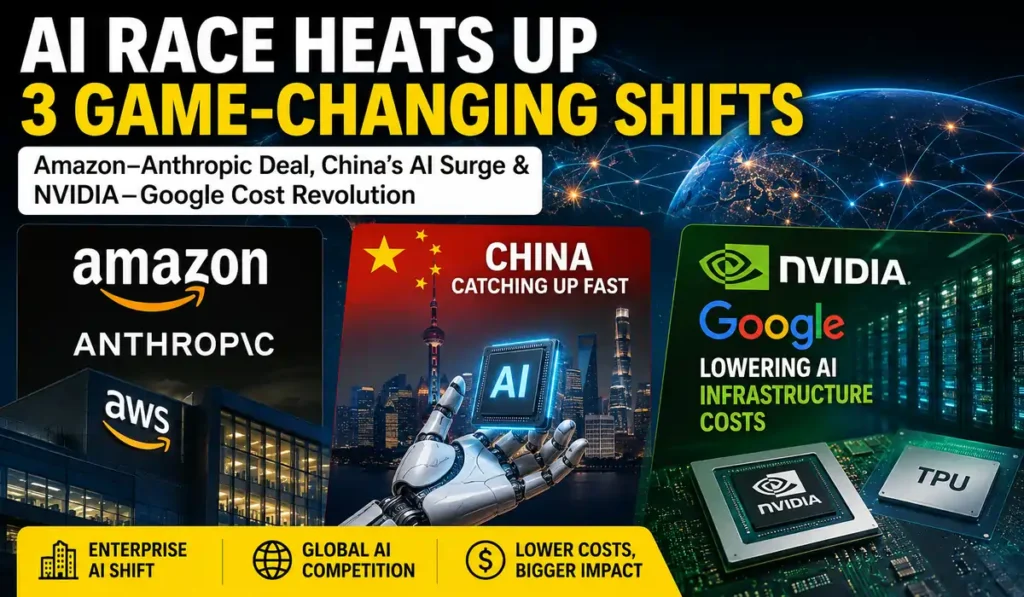
The latest AI market shifts are changing the global technology economy faster than expected. Amazon’s reported $5 billion partnership with Amazon and Anthropic has intensified the AI infrastructure race. Meanwhile, fresh Stanford AI Index findings show China rapidly catching the U.S. in AI model quality. At the same time, companies are now focusing on cheaper and scalable AI operations instead of only building larger models. Therefore, 2026 may become the year when AI competition moves from innovation hype to sustainable business execution across global markets.
Quick Summary
- Amazon and Anthropic’s mega investment could reshape enterprise AI competition globally.
- Stanford AI Index says China has nearly matched U.S. AI model performance.
- NVIDIA and Google are reducing AI infrastructure costs for long-term scalability.
AI Market Shifts Push Big Tech Into a New Phase
The global AI market is entering a more mature and competitive phase. Earlier, companies focused mainly on launching powerful AI models. However, the industry is now prioritizing profitability and infrastructure efficiency. Major firms want AI systems that are cheaper, faster, and easier to scale. Therefore, investment patterns are changing quickly across the U.S., China, and Europe.
Amazon-Anthropic Partnership Signals Enterprise AI Expansion
The reported multi-billion-dollar deal between Amazon and Anthropic is attracting strong attention from investors. Analysts believe this partnership could strengthen Amazon’s cloud AI ecosystem significantly. In addition, Anthropic gains wider infrastructure support for enterprise deployment. Because of this, competition with OpenAI and Google is expected to become even more aggressive in the coming months.
How To
- How to track AI market shifts effectively?
Follow Stanford AI reports, cloud companies, and semiconductor industry announcements regularly.
- How to prepare businesses for AI market shifts?
Focus on scalable AI tools with lower operational and infrastructure costs.
- How to benefit from AI market shifts as a startup?
Use affordable AI infrastructure platforms and prioritize practical deployment over experimental features.
Stanford AI Index Highlights China’s Rapid Growth
According to recent Stanford AI Index findings, China has sharply improved its AI model quality. While the United States still leads in private AI investment and advanced research, benchmark differences are shrinking quickly. As a result, global technology companies are preparing for a more balanced AI race. Many experts now expect stronger innovation pressure across international AI markets.
NVIDIA and Google Focus on AI Cost Reduction
The industry’s biggest challenge is no longer only model performance. Instead, companies now want affordable AI inference at scale. NVIDIA and Google have recently announced optimization efforts targeting lower computing costs. These improvements could help startups and enterprises run AI tools more efficiently while reducing hardware dependency and energy consumption.
The Rise of the “AI Last Mile” Strategy
Tech firms are increasingly discussing the “AI last mile.” This strategy focuses on real-world deployment instead of only research breakthroughs. Therefore, businesses now care more about operational efficiency, response speed, and deployment costs. Many AI startups are also redesigning products for sustainable usage rather than expensive experimental features that are difficult to monetize long term.
Why Global Investors Are Watching AI Closely
AI investments are no longer limited to Silicon Valley companies. Governments, sovereign funds, and global enterprises are actively entering the sector. Consequently, geopolitical influence is becoming deeply connected with AI infrastructure ownership. Cloud platforms, semiconductor supply chains, and data centers are now viewed as strategic national assets in several major economies.
What These AI Market Shifts Mean for Businesses
Businesses using AI tools may soon benefit from lower operating costs and better accessibility. Smaller companies could access enterprise-grade AI services without massive infrastructure spending. At the same time, faster global competition may increase innovation speed. Therefore, industries like healthcare, finance, education, and ecommerce are expected to adopt AI solutions even more aggressively during 2026.
Pro Tips
- Follow infrastructure trends, not only AI chatbot launches.
- Watch China-U.S. AI benchmark reports closely in 2026.
- Businesses should prioritize cost-efficient AI adoption strategies.
Final Thoughts
The latest AI market shifts show that the industry is entering a more practical and competitive era. Large investments, geopolitical competition, and infrastructure optimization are now driving the next phase of AI growth. Therefore, companies focusing on sustainable deployment may gain the strongest long-term advantage.
At the same time, the global AI race is becoming more balanced and unpredictable. Readers, investors, and businesses should monitor infrastructure strategies as closely as new AI models. Because in 2026, scalable execution may matter more than raw AI capability alone.
FAQs
The biggest AI market shifts include Amazon’s Anthropic investment, China’s rapid AI growth, and cheaper AI infrastructure strategies.
The partnership could strengthen enterprise AI services and increase competition against OpenAI and Google.
China has improved AI benchmark performance rapidly, according to recent Stanford AI Index findings.