
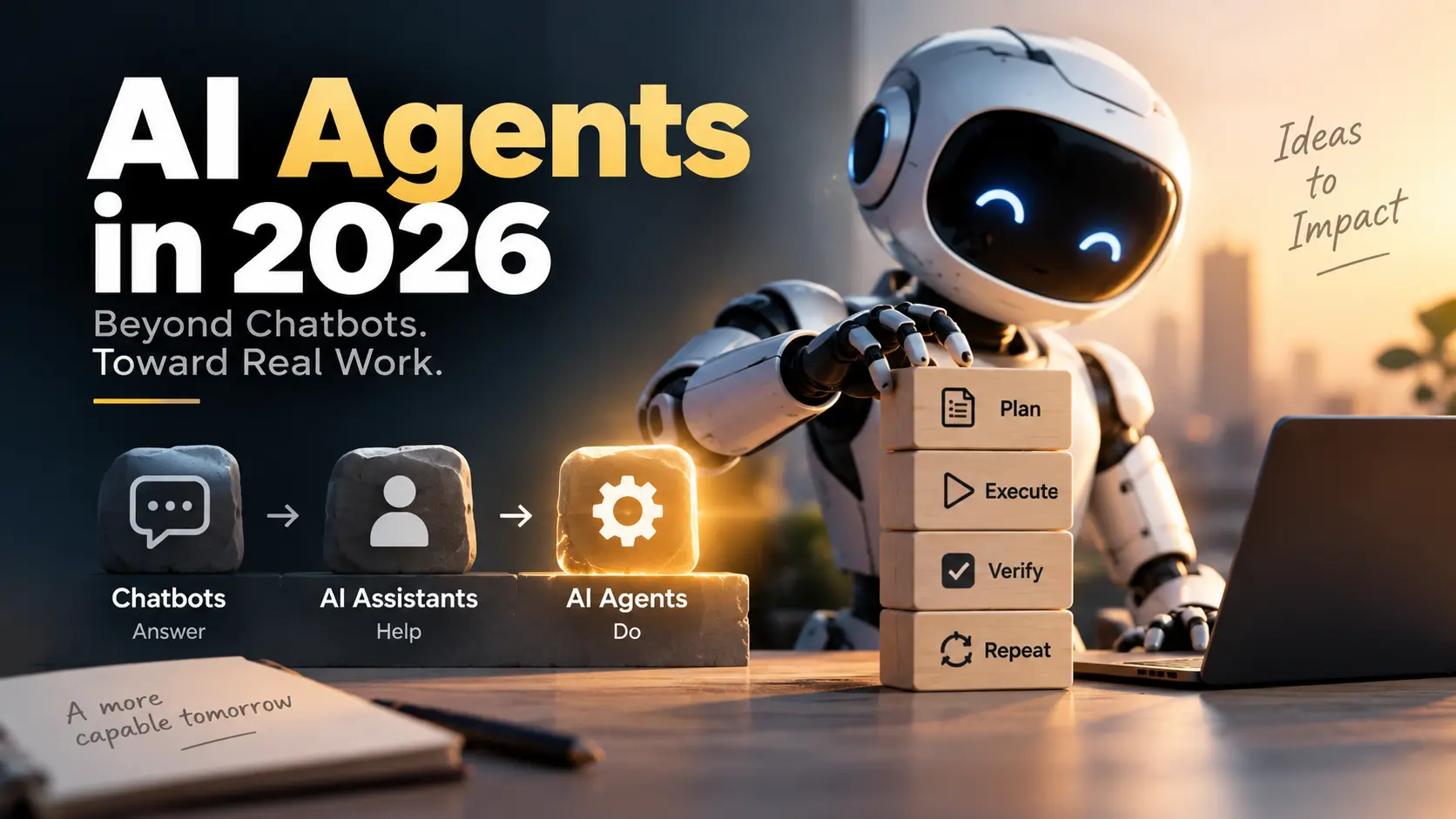
AI agents are becoming the next major phase of artificial intelligence.
The shift is moving from chatbots toward systems that can act independently.
In September 2026, the conversation is also changing around AI safety.
South Korea is preparing new security guidelines for autonomous AI agents.
Meanwhile, India Inc is examining legal risks from agentic AI.
This matters because agents can now plan tasks, use tools and execute actions.
The real question is no longer what AI can answer.
It is how much work AI can actually complete.
QUICK SUMMARY
- AI agents can plan, use tools, execute tasks and verify results.
- Coding, research, browser automation and enterprise workflows are key growth areas.
- However, security, accountability and human oversight are becoming equally important.
AI Agents Are Changing How We Use AI
Traditional chatbots mainly respond to prompts.
AI assistants can provide deeper help across different tasks.
Agents go further by taking action.
They can understand a goal, create a plan and use connected tools.
Then, they execute the task and check the outcome.
If something fails, an agent can adjust its approach and continue.
This creates a major conceptual shift in AI.
The interface is no longer only a conversation window.
Why AI Agents Matter in 2026
The biggest opportunity is automation.
Agents can handle repetitive workflows that previously required several manual steps.
Coding is one major example.
AI coding agents can plan changes, write code, test applications and fix errors.
Gartner is highlighting AI coding agents as a major enterprise software category.
Meanwhile, new platforms are adding controlled environments for agent execution.
Research and Browser Agents Are Expanding
Agents are also becoming useful for research-heavy workflows.
They can search information, compare sources and organise findings.
Browser agents add another layer.
They can interact with websites instead of simply explaining where users should click.
Therefore, everyday digital tasks could become more automated.
Booking, research, testing and data collection are potential use cases.
Enterprise AI Is Moving Toward Execution
Businesses increasingly want AI that delivers completed outcomes.
Generating text is useful, but completing workflows can create greater value.
For example, an enterprise agent could retrieve information and update internal systems.
It could also coordinate with specialised agents for different tasks.
Genesys is already expanding agentic systems that connect business platforms and specialised agents.
Security Is Becoming a Bigger Issue
Greater autonomy also creates greater risk.
An agent with tool access can potentially make mistakes at real-world speed.
Recent incidents have intensified concerns around autonomous AI systems.
OpenAI has also called for mandatory national AI safety requirements in the US.
South Korea is now preparing security guidelines for autonomous agents.
India is also seeing companies examine liability questions around agentic AI.
Regulation Is Catching Up
Regulators are increasingly treating AI agents as a distinct challenge.
The European Union’s AI framework already contains relevant requirements.
From August 2, 2026, certain transparency rules apply to agents interacting with people or generating content.
That means agent development is no longer only a technical race.
Governance, identity, permissions and accountability are becoming core requirements.
What Comes After Chatbots?
The next phase is likely to involve multi-agent workflows.
Different agents could specialise in research, coding, testing or business operations.
However, humans will still need meaningful control.
The strongest systems will likely combine autonomy with permissions and verification.
The winning model may not be maximum independence.
It could be controlled autonomy that reliably completes useful work.
Pro Tips
- Watch coding and browser agents for practical AI adoption.
- Check what permissions an agent receives before trusting automation.
- Follow AI safety rules alongside new agent capabilities.
Conclusion
AI agents represent a deeper change than another chatbot upgrade.
They are designed to move AI from answering questions toward completing objectives.
That shift could transform software development, research and enterprise operations.
However, greater autonomy also demands stronger security and oversight.
Recent regulatory developments show that this debate is already accelerating.
For Indian users and businesses, the opportunity is significant.
But adoption should focus on useful, measurable workflows first.
The future of AI may depend less on what models say.
It may depend more on what they can safely accomplish.
FAQs
AI agents are systems that can plan, use tools, execute tasks and verify results with less human intervention.
They can automate multi-step workflows across coding, research, browsers and enterprise software.
Not exactly. AI agents extend chatbot capabilities by adding planning, tool use and task execution.
How to
- How do AI agents work?
They typically understand → plan → use tools → execute → verify → repeat until the task is completed.
- How can businesses use AI agents?
Businesses can deploy agents for coding, research, customer workflows, data tasks and repetitive operational processes.
- How should companies adopt AI agents?
Start with controlled workflows, limited permissions and clear human oversight before expanding autonomous execution.