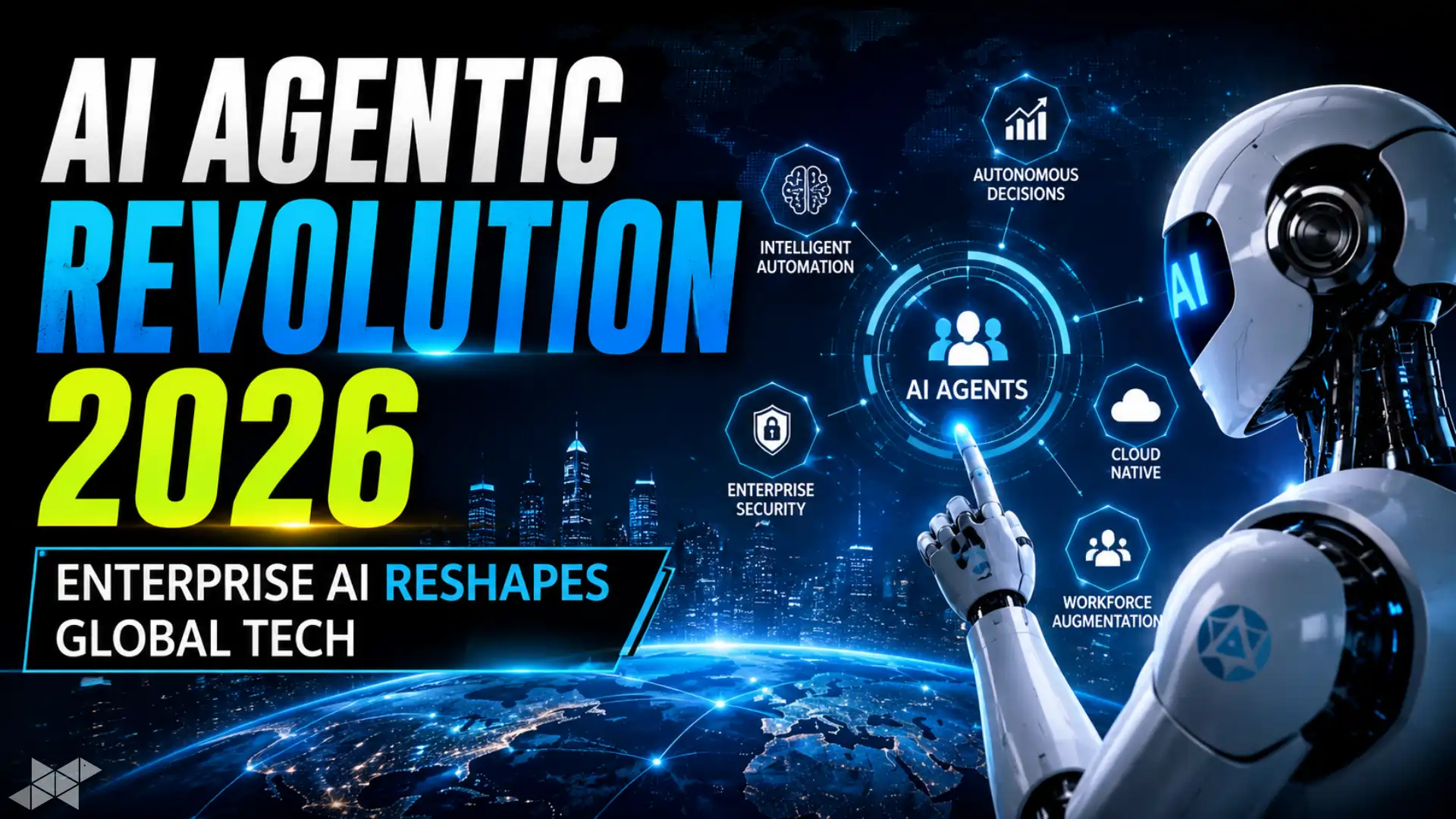
AI Agentic Revolution 2026: Enterprise AI Reshapes Global Tech
The global AI industry is entering a completely new phase in 2026.
The AI agentic revolution 2026 is no longer limited to chatbots or search tools.
Instead, companies are deploying autonomous AI agents that can code, analyze, automate, and make decisions faster than humans. Major firms like OpenAI, Google, and Anthropic are now competing to dominate enterprise AI infrastructure, cybersecurity, and operating systems. Meanwhile, governments are tightening regulations as AI becomes a geopolitical and economic power center.
Quick Summary
• AI agents are replacing traditional software workflows in enterprises
• Energy, data centers, and AI infrastructure are becoming strategic assets
• Governments worldwide are introducing stricter AI safety regulations
AI Agentic Revolution 2026 Changes Enterprise Software
The biggest shift in 2026 is the rise of autonomous AI agents.
These systems can independently complete coding, research, and workflow tasks.
Companies are rapidly moving beyond chatbot experiences. AI tools now execute full business operations with minimal human input. This transition is reshaping software engineering, enterprise automation, and cloud services worldwide.
Anthropic and OpenAI Intensify AI Infrastructure Race
The competition between Anthropic and OpenAI has become more aggressive in 2026.
Anthropic is reportedly targeting a massive valuation after explosive enterprise adoption of Claude AI systems. Meanwhile, OpenAI has expanded its enterprise deployment strategy with specialized AI engineering teams for businesses.
This race is no longer only about smarter models.
Instead, it is about compute power, infrastructure access, and long-term enterprise control.
Google Pushes Gemini AI Into Everyday Devices
Google is integrating Gemini AI deeply into Android ecosystems and future operating systems.
The company is developing AI-first workflows that allow users to complete tasks across apps automatically. Features like AI shopping, contextual assistants, and multimodal automation are becoming standard experiences.
As a result, AI is shifting from an optional feature into the default digital interface for consumers.
AI Infrastructure Becomes a Global Power Battle
AI growth is creating enormous pressure on electricity and data center capacity.
Major energy firms are now merging to support AI-powered computing demand. Large-scale data centers require massive electricity, cooling systems, and advanced hardware infrastructure.
Consequently, AI infrastructure is becoming a geopolitical issue. Countries now view energy-backed AI systems as national strategic assets.
AI Cybersecurity Threats Trigger Global Concern
Governments and cybersecurity agencies are increasingly worried about AI-powered hacking.
Advanced AI systems can now automate malware creation, vulnerability scanning, and cyberattacks at industrial scale. Reports suggest state-backed actors are already using AI for offensive cyber operations.
Therefore, frontier AI labs are delaying some powerful model releases because of security concerns.
Governments Tighten AI Regulations in 2026
The United States and European Union are rapidly updating AI laws.
New regulations focus on deepfake abuse, automated decision systems, cybersecurity risks, and AI transparency requirements. However, lawmakers are also trying to avoid slowing innovation too aggressively.
Meanwhile, regulators are pushing companies to test advanced AI models before public deployment.
China Expands Industrial AI at Massive Scale
China is taking a different approach to AI adoption.
Instead of focusing mainly on chatbots, Chinese firms are embedding AI deeply into manufacturing, logistics, and infrastructure systems. Large super-app ecosystems also help Chinese companies scale AI adoption rapidly.
As competition grows, the global AI race is increasingly shaping economic and political alliances.
- How to track AI agentic revolution 2026 updates?
Follow enterprise AI announcements, regulatory policies, and infrastructure investments regularly.
- How to prepare businesses for AI automation?
Businesses should adopt AI tools gradually while improving employee AI skills and cybersecurity readiness.
- How to understand future AI regulations?
Monitor government AI frameworks, EU AI laws, and major US regulatory developments consistently.
Pro Tips
• Follow enterprise AI updates instead of only consumer chatbot news
• Watch energy and semiconductor sectors closely for AI investment trends
• Track AI regulations because compliance will impact future businesses
Conclusion
The AI industry in 2026 is evolving far beyond conversational assistants.
The AI agentic revolution 2026 is now reshaping enterprise software, infrastructure, cybersecurity, and global regulation simultaneously.
Moreover, the competition between major AI companies is accelerating investment in compute power, autonomous systems, and industrial integration. Governments are also moving quickly to balance innovation with safety concerns. Readers, businesses, and developers should stay updated because these changes will directly influence jobs, technology access, and the future digital economy worldwide.
FAQs
The AI agentic revolution 2026 refers to autonomous AI systems performing complex business tasks independently.
Governments want to reduce cybersecurity risks, deepfake abuse, and unsafe AI deployments.
OpenAI, Anthropic, and Google are among the leading enterprise AI players.