
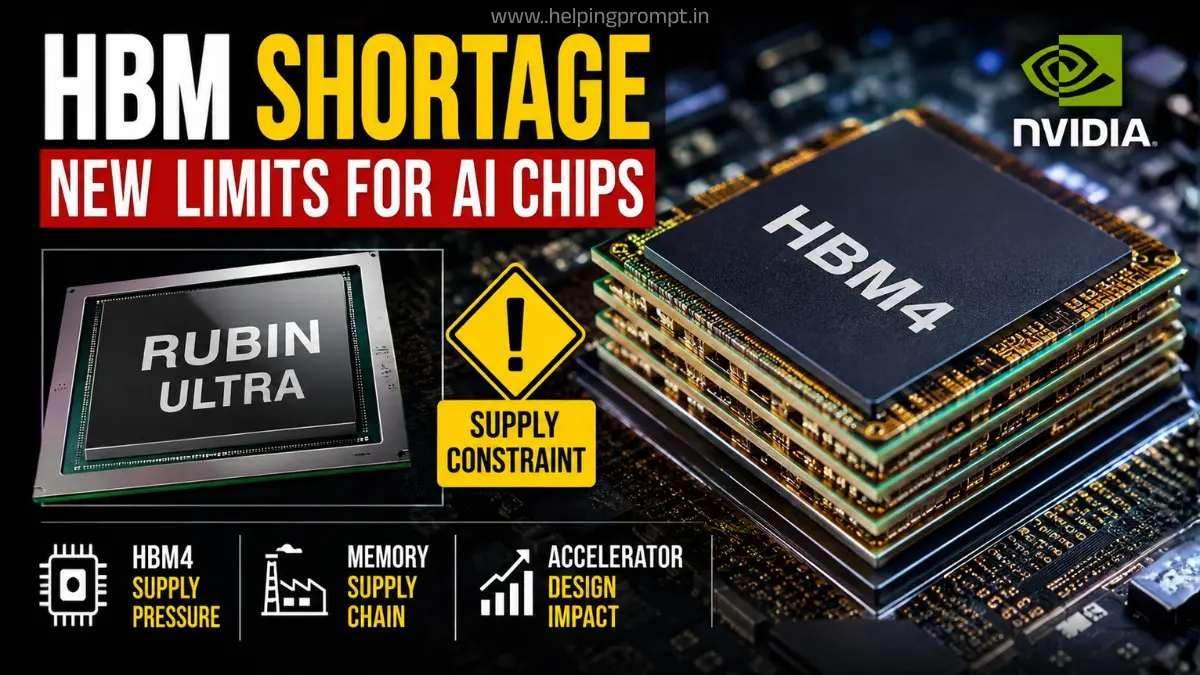
HBM Shortage Reshapes AI Chips as Rubin Ultra Faces New Limits
The HBM shortage is becoming a bigger issue for the next generation of AI chips.
Nvidia is reportedly testing lower-memory versions of its upcoming Rubin Ultra accelerator.
The reported shift comes as advanced HBM4E supply faces tighter constraints.
Earlier plans pointed toward very high memory capacity for next-generation systems.
Now, hardware limits may influence chip design itself.
For AI companies, this changes more than memory availability.
It could affect accelerator capacity, production schedules and data-center deployment costs.
QUICK SUMMARY
- Nvidia is reportedly testing lower-memory Rubin Ultra configurations amid HBM supply pressure.
- HBM4 is entering wider production, with Samsung, SK hynix and Micron qualified for Vera Rubin.
- Advanced packaging and memory capacity are becoming major limits for AI accelerator growth.
HOW TO
- How can companies reduce HBM supply risk?
Use multiple qualified memory suppliers and secure long-term capacity agreements.
Flexible accelerator designs can also reduce dependence on one configuration. - How should buyers track the HBM shortage?
Monitor HBM4 qualification, supplier capacity and advanced packaging availability.
These indicators provide better signals than chip announcements alone. - How can AI systems use memory more efficiently?
Optimise model quantisation, caching and workload scheduling.
Better software efficiency can reduce pressure on expensive accelerator memory.
Why the HBM Shortage Matters for AI Chips
Modern AI accelerators need enormous memory bandwidth.
HBM places high-speed memory close to the processor, reducing data movement delays.
However, advanced HBM requires specialised manufacturing and packaging.
Therefore, increasing AI accelerator production also requires more memory capacity.
The challenge is growing as each new accelerator uses more memory.
That creates pressure across DRAM, HBM stacks, advanced packaging and testing.
Rubin Ultra Shows the Hardware Constraint
Nvidia’s Rubin family highlights how quickly memory requirements are rising.
The upcoming Rubin Ultra has been associated with advanced HBM4E configurations.
However, recent reports say Nvidia is testing versions with significantly less memory.
Some reported designs could use 192GB or 256GB instead.
The reported changes suggest memory availability can influence architecture decisions.
Nvidia has maintained that its broader roadmap remains on track.
HBM4 Supply Is Becoming a Strategic Battle
The Vera Rubin platform is moving toward HBM4-based production.
Samsung, SK hynix and Micron have all been qualified as suppliers.
That is important because multiple suppliers can improve supply flexibility.
Still, demand remains extremely strong across AI data-center deployments.
Earlier reports also indicated SK hynix secured a large share of Nvidia’s HBM4 requirements.
This shows why memory qualification has become strategically important.
SK Hynix and the Memory Supply Chain
SK hynix remains one of Nvidia’s most important HBM partners.
The company has also been advancing its HBM4E technology for future accelerators.
In June, SK hynix announced shipments of 12-high HBM4E samples.
HBM4E is expected to target demanding next-generation AI processors.
Consequently, memory makers are racing to improve capacity and performance simultaneously.
The winner will need both technology leadership and reliable high-volume production.
HBM4 Is Not the Only Bottleneck
Memory chips are only one part of the accelerator supply chain.
Advanced packaging can also limit how many finished AI processors reach customers.
HBM stacks must connect with processor packages using sophisticated integration technologies.
This requires interposers, bonding equipment, substrates and specialised testing.
As a result, simply producing more DRAM does not solve the problem.
The entire manufacturing chain must scale together.
What This Means for Nvidia and AI Hardware
The industry is moving from a compute-first approach toward system-level optimisation.
More AI performance now depends on memory bandwidth, capacity and power efficiency.
Therefore, accelerator designers may need flexible memory configurations.
They may also prioritise architectures that deliver strong performance with fewer HBM stacks.
For Nvidia, this could become increasingly important as AI infrastructure demand expands.
Hardware availability may matter almost as much as raw chip performance.
The Bigger Picture for AI Infrastructure
The HBM shortage reflects a broader AI hardware constraint.
Demand is rising faster than specialised semiconductor capacity can expand.
At the same time, companies are investing heavily in new memory and packaging capabilities.
South Korea’s recent Nvidia-SK initiative also targets next-generation memory and AI data centers.
So, supply constraints may gradually ease, but demand is unlikely to disappear.
Instead, memory efficiency could become a central part of future accelerator design.
PRO TIPS
- Watch HBM4 qualification: Supplier approvals can directly affect accelerator production.
- Track packaging capacity: Chip output depends on more than wafer production.
- Follow memory per accelerator: Higher HBM capacity can increase supply pressure quickly.
Final Thoughts
The HBM shortage is becoming an architectural issue, not just a supply-chain problem.
Nvidia’s reported Rubin Ultra testing shows how memory availability can influence hardware decisions.
Meanwhile, HBM4 and HBM4E are pushing suppliers toward faster, denser memory systems.
For AI infrastructure buyers, the impact could be significant.
Accelerator availability, system pricing and deployment schedules may depend on memory supply.
Therefore, the next AI hardware race will involve more than compute performance.
Memory technology and advanced packaging will increasingly define what can be built at scale.
FAQs
Rapid AI accelerator demand is increasing HBM requirements.
Manufacturing and advanced packaging capacity are also difficult to expand quickly.
Large AI workloads require high memory capacity and bandwidth.
More HBM can help keep powerful accelerators supplied with data.
Supply pressure could influence accelerator configurations and production planning.
Nvidia is reportedly testing lower-memory Rubin Ultra designs.
More Posts Like This
- India’s ₹10 Trillion AI Push: Reliance, Google, Microsoft, Nvidia & TCS
- NVIDIA & Eli Lilly Launch $1B AI Lab to Speed Up Drug Discovery
- AI Takes the Driver’s Seat: NVIDIA DRIVE AV Powers the New Mercedes-Benz CLA Into Real-World Production
- Nvidia Unveils Vera Rubin Superchip at CES 2026: Showcasing Powerful AI Platforms