
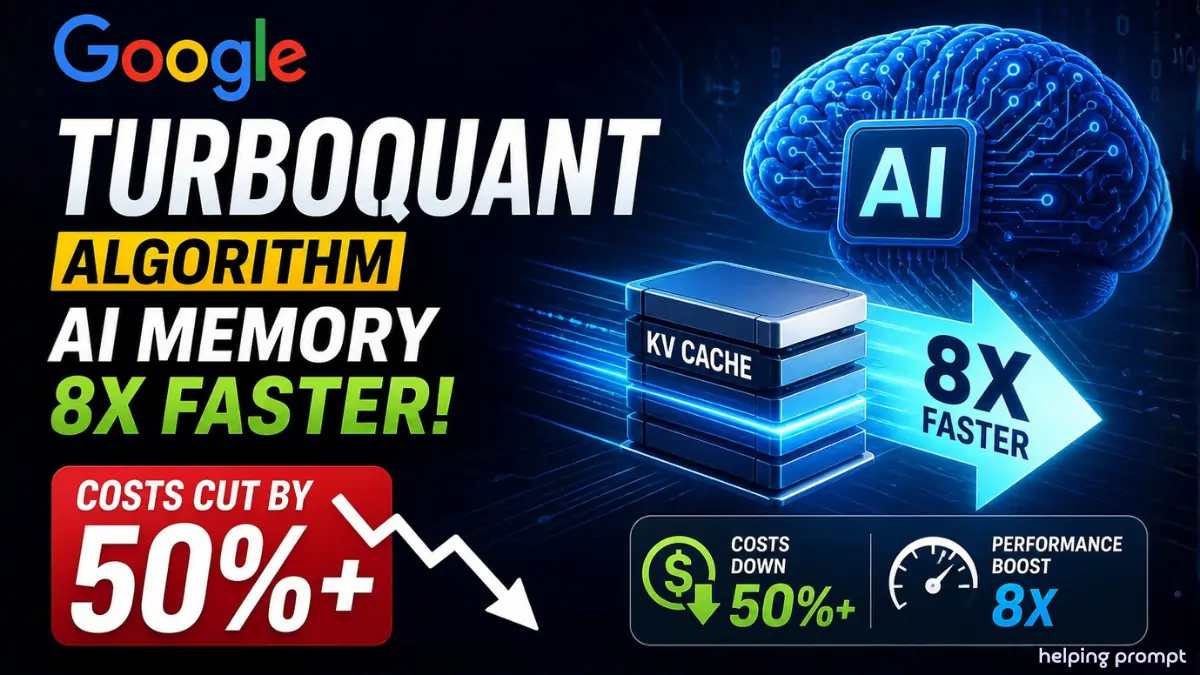
Google TurboQuant Algorithm Boosts AI Memory 8x, Cuts Costs by 50%
AI just got faster-and cheaper.
The Google TurboQuant algorithm is making headlines globally.
It solves a major AI bottleneck affecting speed and cost.
And yes, it could change how businesses use AI in 2026.
Quick Summary
- Google introduces TurboQuant for AI memory compression
- Reduces KV cache memory usage by up to 6x
- Boosts AI attention computation speed by 8x
- Cuts enterprise AI costs by 50% or more
- Works without retraining existing AI models
- Tested successfully on Llama and Mistral models
- Supports long-context AI tasks up to 100K tokens
Google TurboQuant Algorithm Explained
The Google TurboQuant algorithm targets the KV cache bottleneck.
This is where AI stores conversation memory.
As context grows, memory usage spikes sharply.
TurboQuant compresses this memory efficiently.
It uses two key techniques:
- PolarQuant for structured compression
- QJL transform for error correction
Together, they maintain accuracy without extra data overhead.

Why TurboQuant Matters for AI Performance
AI models slow down with large inputs.
Memory becomes expensive and limited.
TurboQuant solves this with smart compression.
Key benefits include:
- Faster inference on long prompts
- Lower GPU memory usage
- Better performance stability
On hardware like NVIDIA H100, it delivers up to 8x speed gains.
Real-World Testing and Results
TurboQuant passed tough benchmarks.
It handled 100,000-word tasks with perfect recall.
Tested models include:
- Llama 3.1 8B
- Mistral 7B
Accuracy remained unchanged.
Even at low-bit compression levels.
This is rare in AI optimization.
How To
- How to use Google TQuant algorithm in AI models?
Integrate it into inference pipelines without retraining your existing model.
- How to reduce AI costs using Google TQuant algorithm?
Apply it to compress memory usage and reduce GPU dependency.
- How to improve AI speed with Google TQuant algorithm?
Use it to optimize KV cache and boost attention computation speed.
Impact on AI Industry and Market
The release from Google Research is strategic.
It supports the rise of Agentic AI systems.
These systems need large memory and fast retrieval.
Market reactions were immediate:
- Memory stocks saw slight dips
- Developers started rapid adoption
- Open-source community began testing instantly
What It Means for Enterprises
TurboQuant is training-free.
So companies can use it instantly.
Major advantages:
- Reduce cloud GPU costs
- Run AI locally on existing hardware
- Expand context window capabilities
It also supports secure, on-premise AI deployment.
Pro Tips / Insights
- Focus on memory optimization, not just model size
- Test TurboQuant on existing AI pipelines first
- Combine with RAG systems for better efficiency
Conclusion
The Google TQuant algorithm marks a shift in AI evolution.
Efficiency is now as important as scale.
Businesses that adapt early will save costs and gain speed.
FAQs
It is a memory compression method that improves AI speed and reduces cost significantly.
No, tests show it maintains accuracy even at high compression levels.
Enterprises, developers, and researchers can use it freely without retraining models.