
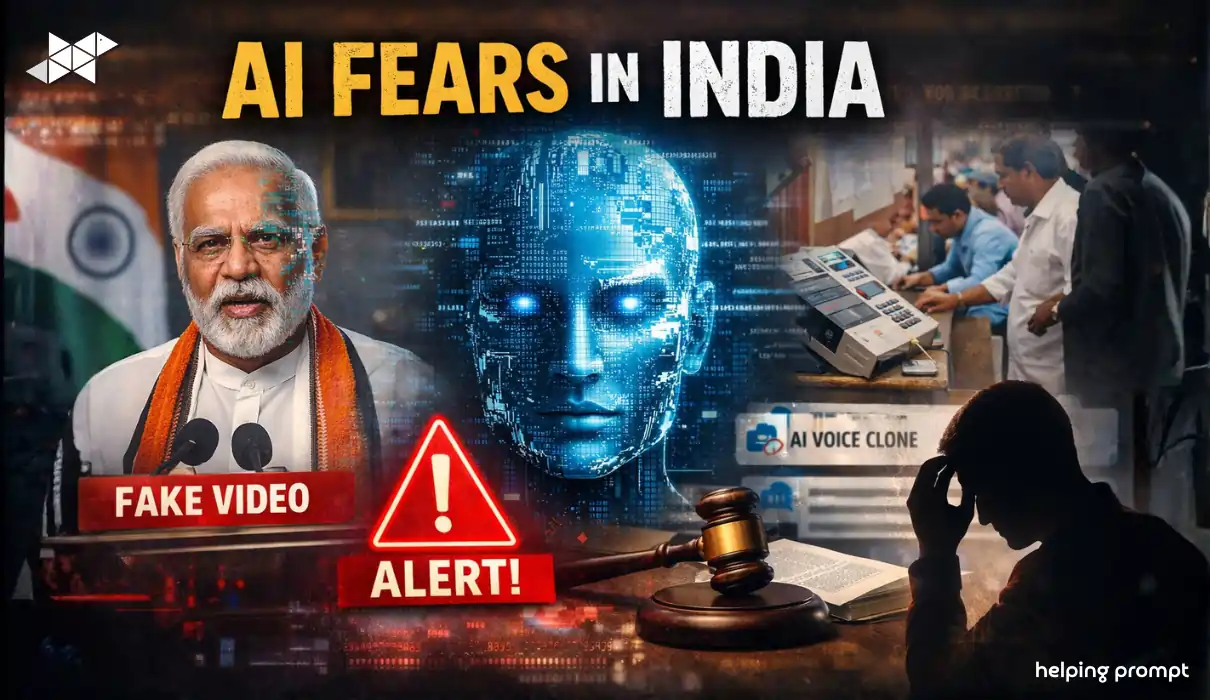
The tone around artificial intelligence in India has changed-and it happened fast. What was once discussed as a productivity tool is now being examined as a governance risk. Over the past few months, AI-generated deepfakes, cloned voices, and automated misinformation have begun surfacing in political, administrative, and public spaces. That explains why governments are scared of AI right now in India, and why a visible government response is quietly taking shape.
When AI misuse started landing on government desks
For years, artificial intelligence stayed within tech panels and startup forums. That separation has broken.
Officials are now dealing with complaints involving fake videos of leaders, AI-generated audio impersonating officers, and viral content that cannot be traced back to a human source. These are not hypothetical scenarios. They are active cases.
A digital content creator who tracks online misinformation said,
“Earlier, you could trace a rumour to a WhatsApp group or a page. With AI, the source disappears.”
That disappearance is what has unsettled authorities.

Why elections pushed AI from concern to priority
India’s election machinery runs on scale and speed. AI disrupts both.
With generative tools, a single operator can create hundreds of tailored political messages, fake endorsements, or manipulated visuals in hours. The danger isn’t just false content-it’s volume.
Election volunteers have already faced situations where voters questioned whether videos they saw were real. One field worker shared,
“When people start asking if everything is fake, trust itself becomes the casualty.”
That erosion of trust is central to why governments are scared of AI right now in India.
The government response taking shape behind the scenes
Rather than announcing sweeping bans, the government response has focused on control and accountability.
Authorities are pressing platforms to label AI-generated content more clearly. Intermediary rules are being interpreted with less flexibility. Content takedowns are happening faster, with fewer warnings.
The focus has shifted to a critical question: who is responsible when AI causes harm?
A policy observer familiar with internal discussions noted,
“Innovation is not the problem. Anonymity without accountability is.”
That thinking explains the tightening regulatory posture.

Why existing laws are struggling to keep up
Most digital laws in India were written for human behaviour. AI changes that assumption.
When content is generated automatically, intent becomes difficult to prove. When distribution is automated, enforcement arrives late. Governments are finding themselves reacting instead of preventing.
This gap-between how fast AI moves and how slowly law responds-is a major source of anxiety in policymaking circles.
Why India is avoiding blanket AI bans
Despite concerns, India has resisted calls for outright bans on AI tools. The reason is practical.
AI is already embedded in governance systems, education platforms, and healthcare initiatives. Shutting it down would disrupt essential services.
Instead, the approach is selective pressure: regulate misuse without stalling development.
A startup founder working on AI compliance said,
“The message is clear-build responsibly or be ready to answer questions.”
What users are already noticing online
Regular users may not see policy documents, but they are seeing effects.
More content warnings.
Faster removals.
Stricter platform rules.
These are early signals of a broader shift-AI is no longer treated as neutral software. It is now seen as a force that can influence public order.

AI has moved from innovation talk to governance concern in India. The current government response reflects urgency shaped by real incidents, not speculation. For now, oversight-not panic-is guiding the approach.





Leave a Reply