
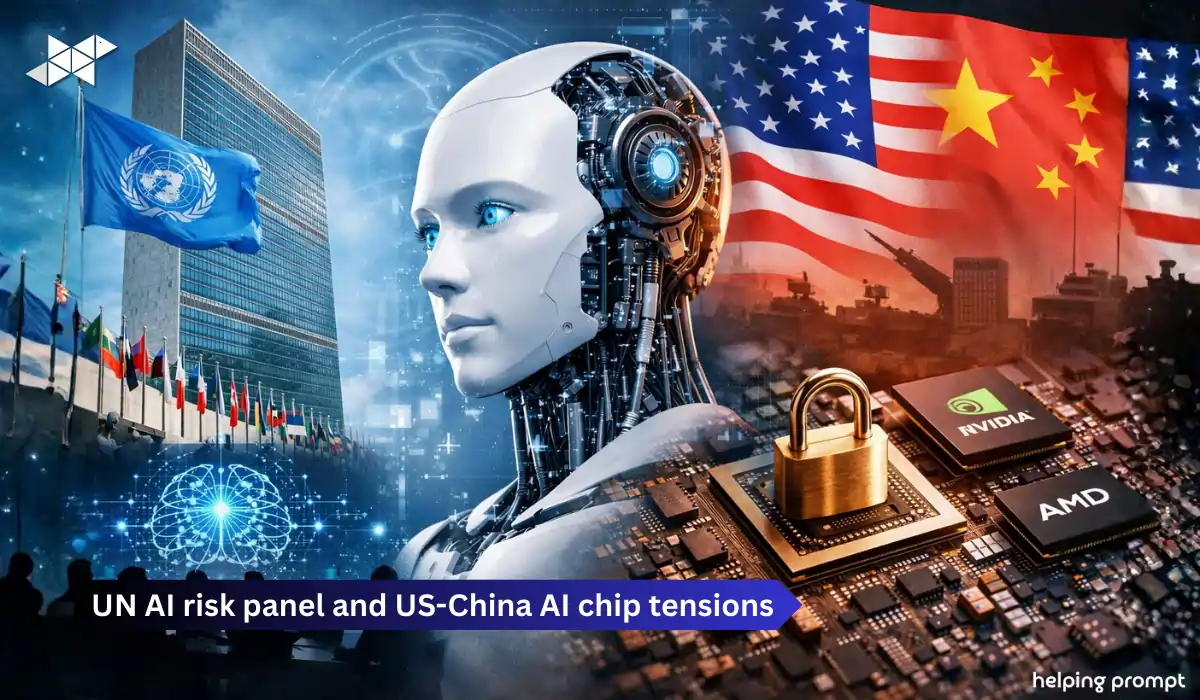
Artificial Intelligence is no longer just a tech story. It is now a global policy issue.
The United Nations has approved a 40-member scientific panel to study AI’s global impact. At the same time, Anthropic’s CEO is asking the U.S. government to block AI chip sales to China.
So what does this mean for India, businesses, and everyday users? Let’s break it down clearly.
Quick Notes
The United Nations has created a 40-member scientific panel to study AI risks and global impact.
The U.S. opposed the move, showing growing global policy differences on AI governance.
Anthropic’s CEO wants stricter controls on AI chip exports to China due to national security concerns.
Why the UN’s AI Panel Matters
The United Nations has officially approved a new scientific body to examine the societal and economic effects of AI.
This panel will include 40 experts from different countries. Their job is to:
- Study AI’s impact on jobs and economies
- Analyze risks like misinformation and deepfakes
- Suggest global safety guidelines
- Provide independent research for policymakers
Interestingly, the United States opposed the resolution. However, the majority of nations supported it.

This shows something important: AI governance is becoming a global power debate.
Unlike private research reports from companies like OpenAI or Google, this UN panel aims to deliver neutral and international findings.
For countries like India, this matters. India is rapidly adopting AI in:
- Digital governance
- Healthcare diagnostics
- Fintech platforms
- EdTech systems
Therefore, global AI standards could directly influence Indian startups and enterprises.
What Could This Panel Actually Do?
The UN panel is expected to work like climate science bodies that provide global reports.
Here’s what we may see:
1. Global AI Risk Reports
Similar to climate reports, but focused on AI misuse and automation risks.
2. Economic Impact Analysis
AI could automate certain jobs while creating new ones. The panel may provide:
- Job displacement forecasts
- Skill transformation recommendations
- Policy suggestions for developing countries
3. Ethical Framework Suggestions
While it won’t create laws, it may influence global AI regulations.
That raises a curious question:
Will countries follow global recommendations, or build their own AI rulebooks?

Anthropic CEO’s Call: Block AI Chip Sales to China
At the same time, AI geopolitics is heating up.
The CEO of Anthropic has urged the U.S. government to restrict advanced AI chip exports to China.
Why?
Because high-end AI systems rely on powerful hardware.
Most advanced AI chips are made by companies like:
These chips are essential for training large AI models.
If China gains access to the most powerful hardware, it could accelerate:
- Military AI research
- Surveillance systems
- Advanced AI development
Therefore, chip supply is no longer just business – it is national security.
AI Chips: The Real Power Behind AI
Many people think AI is only about software.
However, without specialized chips, even the best AI models cannot function at scale.
For example:
- Training large language models requires thousands of GPUs.
- AI data centers consume massive electricity.
- Chip manufacturing depends on complex global supply chains.
So when export bans are discussed, it directly affects:
- AI innovation speed
- Startup costs
- Global tech competition
India, meanwhile, is investing in semiconductor manufacturing and AI infrastructure. That makes this debate even more relevant for Indian policymakers.

What This Means for India
India sits in a strategic position.
On one hand, India collaborates with Western tech companies.
On the other hand, it maintains economic ties with China.
If global AI regulations tighten:
- Indian startups may need compliance adjustments
- Hardware imports could become costlier
- AI research partnerships may shift
However, there is also opportunity.
If India develops:
- Indigenous AI chips
- Ethical AI standards
- Strong research ecosystems
It could emerge as a trusted AI partner globally.
Bigger Question: Global Cooperation or AI Fragmentation?
Here’s the deeper issue.
Are we moving toward:
- A unified global AI governance model?
or - Separate AI ecosystems controlled by powerful nations?

The UN panel suggests cooperation.
Meanwhile, export restrictions suggest strategic competition.
Both trends are unfolding simultaneously.
That is why this moment is crucial.
Conclusion
The UN’s new AI panel signals global concern about AI’s risks and economic impact. At the same time, chip export tensions highlight rising geopolitical stakes.
AI is no longer just about innovation. It is about governance, security, and global power balance.
And India cannot afford to stay on the sidelines.







Leave a Reply