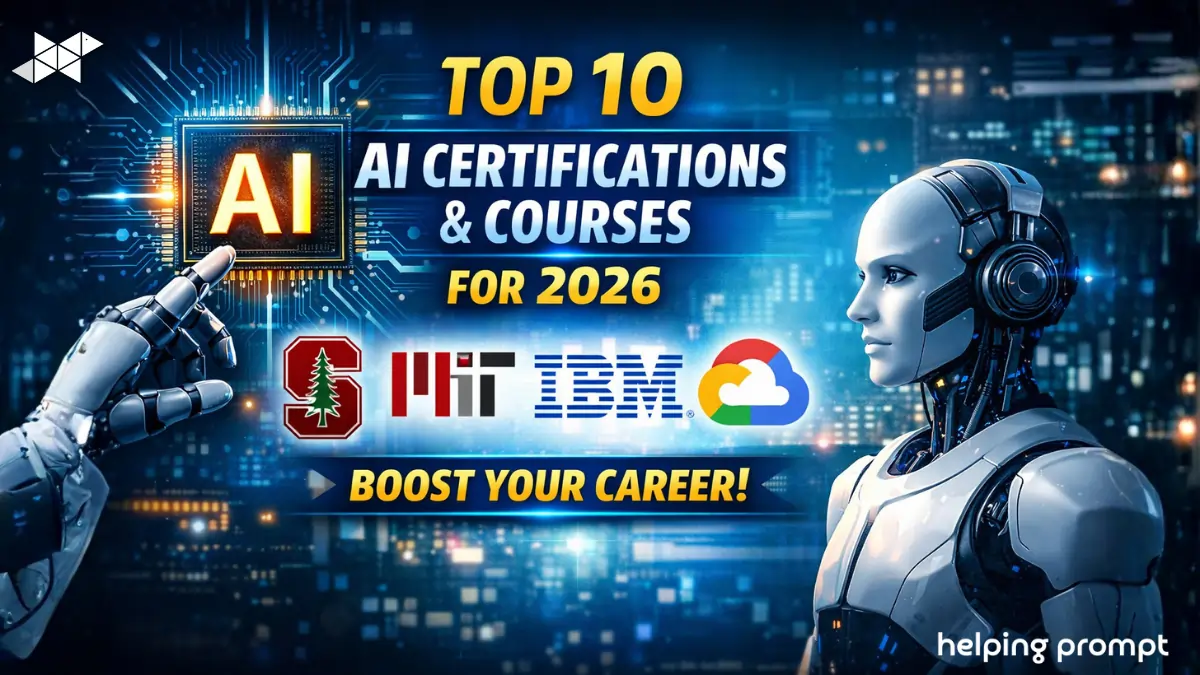
The courtroom-like seriousness around AI careers is getting louder in 2026. Whether you’re a student, a working professional, or someone planning a career switch, one thing is clear: AI skills are no longer “good to have” – they’re becoming the new baseline.
During discussions around hiring trends and real-world adoption, one message keeps coming up: companies want proof. Not just interest, but validated learning. That’s where AI certifications and structured courses are stepping in.
As one senior tech hiring manager at a recent industry session put it, “Projects matter, but certifications show commitment and structured learning.”
Why Top 10 AI Certifications and Courses Matter More in 2026
AI is expanding fast across industries-finance, healthcare, retail, security, and even everyday tools like smart home devices. Many organisations are now actively integrating AI into workflows, products, and customer service.
Certifications help because they:
- Give learners a clear roadmap instead of random tutorials
- Show employers you’ve studied industry-relevant skills
- Help you stay updated in a field that changes every few months

A career coach summed it up simply: “In AI, staying still is falling behind.”
1) Stanford University – Artificial Intelligence Graduate Certificate
If you want serious academic depth, Stanford’s AI Graduate Certificate stands out. It covers key foundations like machine learning, robotics, logic, and natural language processing (NLP).
Best for: Learners aiming for strong theory + real AI engineering basics
Needs: Maths background + programming comfort
2) MIT – Professional Certificate Program in Machine Learning and AI
MIT’s program feels more like a compact, high-intensity academic bootcamp. It’s structured like a real course experience and is taught by MIT faculty.
Best for: Technical professionals and managers in data-heavy roles
A participant described it well: “It’s demanding, but it forces clarity.”
3) UC Berkeley Executive Education – AI: Business Strategies and Applications
Not everyone wants to code models. Berkeley’s program focuses on how leaders use AI in organisations, including automation, deep learning basics, and building AI teams.
Best for: Managers, founders, and senior professionals
Focus: Strategy, real adoption, business use-cases
4) IBM AI Professional Certificate (Coursera)
One of the most beginner-friendly options, this IBM program builds step-by-step-from AI basics to building applications and chatbots.
Best for: Beginners who want job-ready direction
Highlight: Includes Generative AI and prompt engineering
5) Deep Learning Specialization – Andrew Ng (Coursera)
This course series has become a classic for deep learning. It covers neural networks, CNNs, and NLP-related concepts with hands-on learning.
Best for: Learners ready for intermediate-to-advanced deep learning
A learner review line often repeated: “This is where things start feeling real.”
6) Introduction to TensorFlow for AI (Coursera | DeepLearning.AI)
If your goal is to build AI models using TensorFlow, this course is a solid entry. It focuses on practical neural network training and computer vision basics.
Best for: Developers who want hands-on TensorFlow skills
Needs: Python + basic maths
7) Artificial Intelligence A-Z 2026: Agentic AI, Gen AI, and RL
This course is designed for people who want to explore modern AI topics like reinforcement learning, transformers, and agent-style AI systems.
Best for: Learners who enjoy building real AI projects
Includes: Multiple AI build projects, including RL-based tasks
8) Google Cloud – Introduction to Generative AI Learning Path
Google Cloud’s learning path is a beginner-friendly way to understand generative AI and large language models (LLMs), with an added focus on responsible AI.
Best for: Beginners and cloud learners
Note: Best if you plan to work with Google’s ecosystem
9) ARTiBA – Artificial Intelligence Engineer (AIE) Certification
This is more structured like a professional credential with tracks based on education and experience. It covers a wide range-machine learning, deep learning, NLP, and more.
Best for: Professionals aiming for formal AI certification credibility
A trainer explained it as: “It’s built like a career stamp, not just a course.”
10) LinkedIn Learning – Master the Fundamentals of AI and Machine Learning
This learning path is made of shorter courses taught by industry experts. It’s ideal for people who want clear fundamentals without feeling overwhelmed.
Best for: Beginners, working professionals, and project managers
Outcome: Certificate of completion
How to Choose the Right AI Course (Without Wasting Time)
Before enrolling, ask yourself:
- Do I want to build AI models or manage AI projects?
- Am I learning for a job switch, promotion, or business growth?
- Do I have time for a deep program, or do I need a quicker reminder-style learning path?
A simple line shared during a career discussion stuck with many attendees:
“Pick the course that matches your next 6 months, not your dream 6 years.”

Conclusion
The best AI certifications and courses for 2026 include options from Stanford, MIT, UC Berkeley, IBM, Google Cloud, and other globally recognised platforms. Whether you’re targeting technical mastery or business-ready AI understanding, choosing the right program can help you build stronger skills and clearer career direction.








Leave a Reply