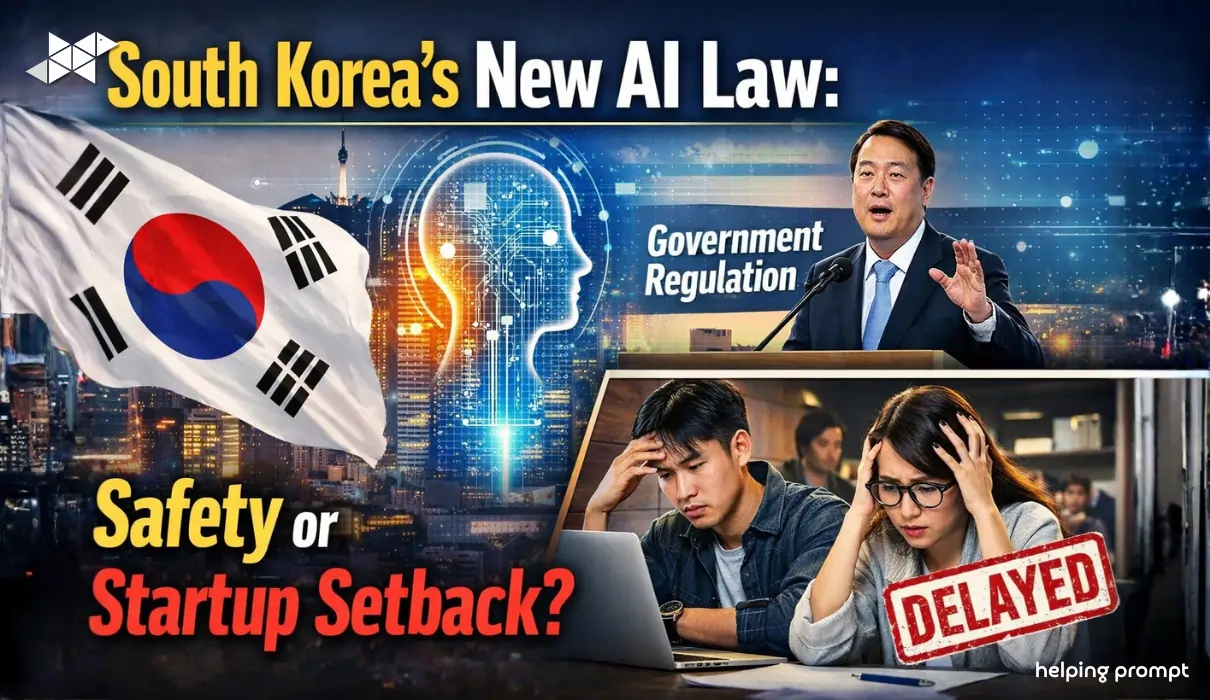
The mood inside Seoul’s tech corridors shifted this week. With one vote, South Korea placed itself at the centre of the global AI debate. Lawmakers passed what the government is calling the world’s first fully comprehensive AI law, promising safety without killing innovation. But almost immediately, startup founders began asking a quieter question: will this law protect progress, or slow it down just as the race gets seriou
Unlike older tech regulations that patched problems after they appeared, this law tries to plan ahead. It divides artificial intelligence systems by risk level and applies stricter oversight only where harm is likely.
In plain terms, a chatbot recommending movies won’t face the same scrutiny as an AI system used in hiring, healthcare, or policing. The aim, officials say, is clarity. Companies know what’s allowed, what needs safeguards, and what could be restricted.
This risk-based approach is why the South Korea AI law is being closely watched outside the country. It borrows ideas from Europe but avoids blanket bans that critics say can freeze innovation.

Government response: why Seoul says regulation can boost trust, not fear
The government has been unusually vocal since the bill passed. Senior officials insist the law is not anti-innovation, but pro-confidence.
“People won’t use AI they don’t trust,” a science ministry official said during a briefing. “Clear rules help companies scale faster because users feel safe.”
The government response also includes support measures. Public funding for AI research will continue, and smaller firms are promised guidance rather than punishment in the early stages of enforcement.
For policymakers, the message is simple: rules first, chaos later avoided.
Startup founders fear the paperwork more than the penalties
Inside startup hubs like Pangyo Techno Valley, reactions are mixed.
A founder of an early-stage AI healthcare startup put it bluntly: “We’re not scared of safety rules. We’re scared of delays. One unclear clause can cost us six months.”
Another entrepreneur working on generative AI tools said compliance costs could quietly rise. Legal reviews, audits, and documentation may not look dangerous on paper, but for small teams, time is money.
This anxiety explains why the law, despite its ambition, is being welcomed cautiously by those building fast-moving AI products.

How the law explains ‘ethical AI’ in everyday language
One reason the law has gained international attention is its plain framing of ethics. Instead of abstract ideals, it focuses on real-world harm.
Companies must explain how their AI makes decisions in high-risk areas. Bias checks are mandatory where discrimination is possible. Human oversight is required when AI outputs affect rights or safety.
No buzzwords. No moral grandstanding. Just a checklist of responsibilities tied to specific risks.
This clarity has helped observers see the law as practical rather than ideological.
UNESCO’s new AI ethics prize adds global pressure on responsibility
As South Korea’s law made headlines, another signal came from the global stage. UNESCO, along with international partners, announced a new prize to recognise responsible AI research.
The timing matters. Ethical AI is no longer just a slogan. It is becoming a currency.
A researcher involved in collaborative AI projects said the prize sends a clear message. “Innovation that ignores social impact is losing its shine. Responsibility is becoming a competitive advantage.”
Together, the law and the prize reflect a wider shift: ethics is moving from conference panels into policy and funding decisions.

Why global companies are watching South Korea closely
Multinational tech firms operating in Asia see South Korea as a test case. If the law proves workable, it could influence regulations elsewhere.
Compliance frameworks built here may be reused in other markets. Failures, on the other hand, will be studied just as closely.
For now, companies are waiting. Not for rollback, but for real-world implementation.
“How regulators behave matters more than what the law says,” one regional AI policy observer noted. “That’s where trust will be won or lost.”
South Korea has drawn a bold line between speed and safety in AI. The law is now passed. What happens next will be shaped not by headlines, but by how it is enforced on the ground.







Leave a Reply