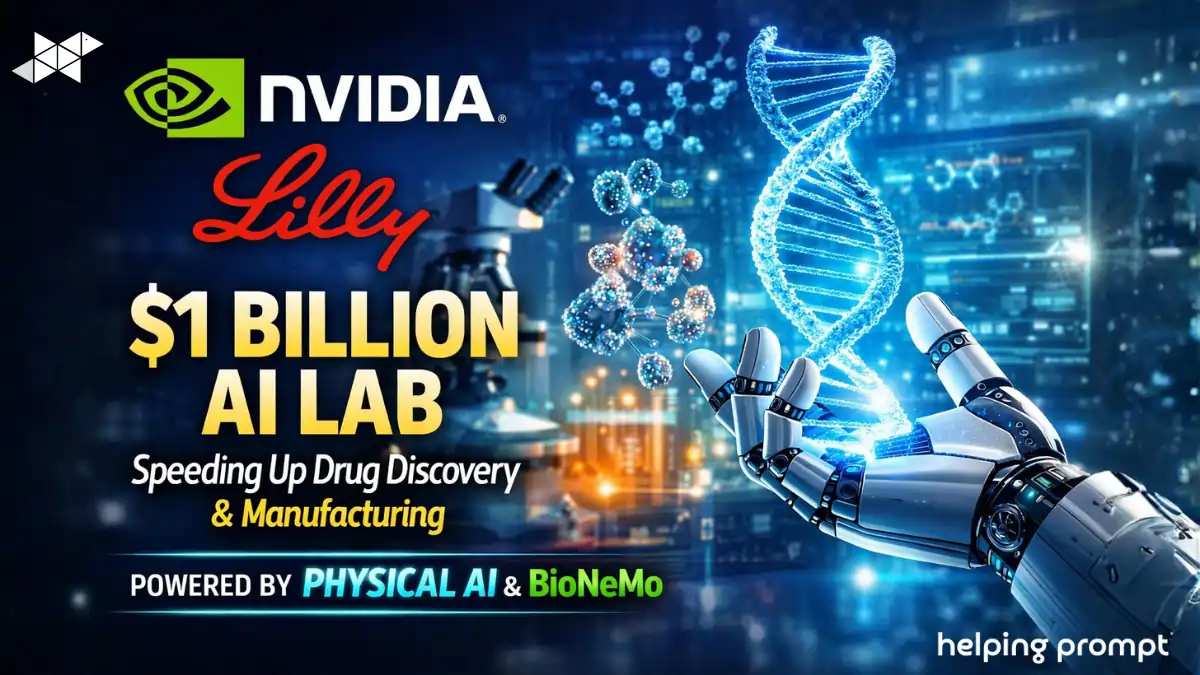
A Big AI Move in Global Healthcare: In a major move to transform medicine development, NVIDIA and pharmaceutical giant Eli Lilly have launched a joint AI co-innovation lab. Notably, the initiative signals a deeper shift in how the industry uses artificial intelligence.
More importantly, this partnership goes far beyond a short-term experiment. Over the next five years, the companies will invest $1 billion. They will deploy advanced AI systems to speed up drug research and modernize manufacturing. As a result, they expect faster development cycles and stronger production efficiency.
Meanwhile, both companies describe the lab as a turning point for AI in life sciences. Rather than using AI only for analytics, they plan to integrate it into drug discovery and large-scale production. Ultimately, this strategy could reshape how researchers move medicines from the lab to the market.
What Exactly Is the NVIDIA–Eli Lilly AI Lab?
The lab will operate as a true co-innovation hub. In practice, teams from both companies will work side by side. They will design, test, and deploy AI solutions for complex pharmaceutical challenges.
At its core, the mission is simple. The companies want to shorten drug discovery timelines and improve manufacturing efficiency. They also plan to scale production faster when demand rises. In other words, they aim to remove traditional bottlenecks that slow innovation.
More importantly, the focus extends beyond experimentation. The teams want measurable results in real workflows. As a result, AI will move from research theory into daily pharmaceutical operations. One senior official explained it clearly: “We want to move AI from theory into real pipelines that deliver medicines faster.”

The $1 Billion Plan: Why the Investment Is So Massive
A $1 billion commitment over five years signals that this partnership is not just about running pilot projects. It is designed to create long-term infrastructure for AI-powered medicine development.
Drug discovery is expensive, slow, and full of uncertainty. Companies often spend years testing molecules before reaching results that are safe enough for humans. By bringing NVIDIA’s AI capabilities into the core process, Eli Lilly is aiming to cut delays and improve decision-making at multiple stages.
During the announcement, the companies highlighted that the initiative is meant to support both discovery and manufacturing, which is important because many AI projects stop at early research stages.
What Is “Physical AI” and Why Does It Matter Here?
One of the biggest keywords used in this initiative is “Physical AI.” In simple terms, it refers to AI systems that can help understand, simulate, and improve real-world physical processes – not just text, images, or basic predictions.
In medicine, that can mean helping scientists model how molecules behave, how chemical reactions take place, or how manufacturing conditions affect quality.
A researcher close to the initiative explained it in plain words: “If AI can understand physical processes better, it can help reduce trial-and-error in both labs and factories.”
![Hyper-Realistic Diorama Poster of [City] Goes Viral: A City Cut Out Like Earth’s Puzzle Piece](https://helpingprompt.in/wp-content/uploads/2026/01/helpingprompt.in-27-1024x576.webp)
NVIDIA BioNeMo: The Platform at the Center of the Lab
A key technology powering the partnership is NVIDIA’s BioNeMo platform, which is designed for AI work in biology and drug discovery.
BioNeMo can support research teams by helping them analyze complex biological data, identify promising drug candidates, and speed up early-stage discovery.
This matters because biological systems are extremely complicated, and traditional methods can take years just to narrow down which molecules are worth pursuing.
By combining BioNeMo with large-scale computing, the companies are aiming to make early research faster and more targeted.
Why This Partnership Could Change How Drugs Are Made
This initiative is not only about discovering new medicines. It also targets how drugs are manufactured, which is a major part of healthcare delivery.
Even after a drug is discovered, manufacturing at scale can take time and requires strict quality control. AI can potentially help optimize production workflows, detect issues early, and reduce waste.
One industry observer summed up the significance by saying, “Discovery gets headlines, but manufacturing decides how quickly patients actually get medicines.”
A Clear Shift: AI Moves Deeper Into Life Sciences
Over the past few years, AI has entered healthcare in many ways, from medical imaging to hospital automation. But this lab shows a deeper trend: AI is now being built into the core engine of pharmaceutical innovation.

With a five-year roadmap and a $1 billion budget, NVIDIA and Eli Lilly are betting big on AI. They no longer see it as a support tool. They see it as the foundation of future medicine development.
The two companies have launched a joint AI co-innovation lab. The goal is clear. They want to bring “Physical AI” and the BioNeMo platform into real drug discovery and manufacturing workflows.
This long-term partnership reflects serious commitment. Together, they aim to speed up how scientists discover, develop, and produce new medicines.







Leave a Reply