
NotebookLM Protocol Workflow: The Smart Upgrade for Deep Work
AI users are shifting from prompts to systems-and it’s changing everything.
The rise of structured workflows is now a major AI trend.
NotebookLM protocols workflow is leading this transformation in smarter research.
Explore tools like NotebookLM to build repeatable thinking systems.
Why NotebookLM Protocol Workflow Changes Everything
Most users ask questions.
Smart users build systems.
NotebookLM protocols workflow replaces random prompts with structured thinking.
This shift improves clarity, speed, and decision-making.
The Core Shift: Prompts vs Protocols
A prompt gives one answer.
A protocol builds a repeatable process.
Instead of guessing every time, you follow steps.
This creates consistency across all projects.
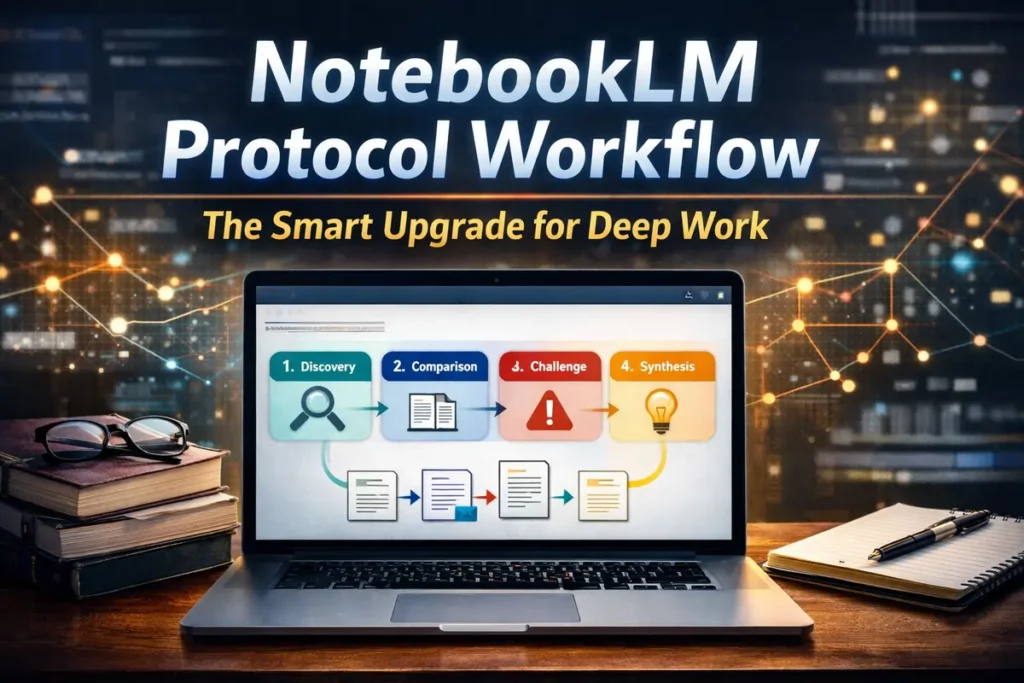
The 4-Phase NotebookLM Protocol Workflow
1. Discovery
Understand structure, claims, and patterns first.
Avoid jumping to conclusions early.
2. Comparison
Compare multiple sources side by side.
Spot similarities and contradictions fast.
3. Challenge
Question assumptions.
Test weak arguments and missing evidence.
4. Synthesis
Combine insights into stronger conclusions.
Build clarity from tested ideas only.
How To
Time needed: 1 minute
- How to start NotebookLM protocols workflow?
Begin with discovery by mapping key ideas from your source.
- How to improve NotebookLM protocols workflow?
Add comparison and challenge phases before final synthesis.
- How to scale NotebookLM protocols workflow?
Reuse the same structure across different projects and documents.
- How to avoid mistakes in NotebookLM protocol workflow?
Never skip the challenge phase; test every assumption.
- How to master NotebookLM protocols workflow?
Practice consistently and refine each phase over time.
NotebookLM Protocol Workflow Prompts
"Act as a structured AI research assistant using NotebookLM protocol workflow. Begin with discovery by mapping key claims, themes, and structure of the uploaded source. Then move into comparison with another document, identifying overlaps and contradictions. Follow with a challenge phase testing assumptions and gaps. End with synthesis of validated insights. Follow Trending Updates, Future Applicable, Follow Real Study Data."
"Use NotebookLM protocol workflow to analyze complex research documents. Start with discovery extracting arguments, then compare with external sources for alignment. Challenge hidden assumptions and missing evidence. Finally synthesize a refined conclusion. Ensure outputs are structured, repeatable, and consistent across sessions. Follow Trending Updates, Future Applicable, Follow Real Study Data."
"Apply NotebookLM protocol workflow for deep reading. First identify core claims and structure, then compare with at least one contrasting perspective. Challenge logical weaknesses and unsupported conclusions. Conclude with synthesis that integrates only validated insights. Maintain clarity, consistency, and analytical depth. Follow Trending Updates, Future Applicable, Follow Real Study Data."
"Execute NotebookLM protocol workflow for decision-making analysis. Discover key points and intent, compare alternative viewpoints, challenge biases and incomplete logic, and synthesize a final actionable insight. Ensure the workflow is repeatable across multiple datasets and documents. Follow Trending Updates, Future Applicable, Follow Real Study Data."
"Simulate expert-level thinking using NotebookLM protocol workflow. Begin with structured discovery, proceed to comparison across multiple inputs, critically challenge all assumptions, and synthesize only evidence-backed conclusions. Ensure outputs improve consistency, reduce randomness, and support long-term workflows. Follow Trending Updates, Future Applicable, Follow Real Study Data."
Quick Settings Guide
- Use NotebookLM protocol workflow for every research task
- Break work into discovery → comparison → challenge → synthesis
- Save prompts as reusable workflow templates
- Upload multiple sources for deeper comparison
- Reuse structured outputs across projects
Pro Tips
- Always separate thinking stages clearly
- Reuse workflows, not random prompts
- Challenge outputs before trusting them
Conclusion
The real power of AI is not speed, but structure.
NotebookLM protocol workflow transforms scattered prompts into a reliable thinking system.
As you adopt this method, your work becomes more consistent, analytical, and scalable across projects.
Instead of repeating effort, you refine a system that improves over time. Start small, test each phase, and evolve your workflow into a powerful intellectual asset.
FAQs
NotebookLM protocols workflow is a structured method using phases like discovery and synthesis for better results.
It improves consistency, reduces randomness, and builds repeatable thinking systems.
Anyone doing research, writing, or analysis can benefit from NotebookLM protocols workflow.