
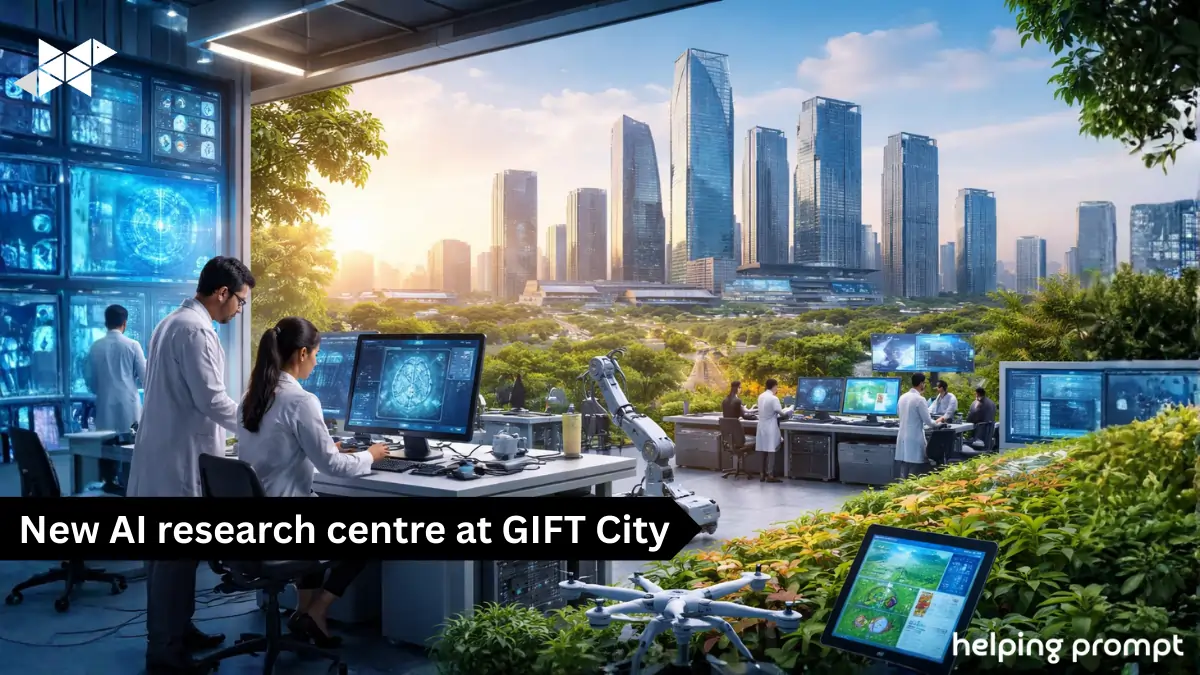
I was present at the launch inside the glass-lined campus of GIFT City (Gujarat International Finance Tec-City), where policymakers, researchers, and industry leaders gathered for what many called a quiet but important moment for Indian technology. A new AI research centre has formally begun operations, aiming to turn ideas into usable products rather than just papers.
The centre is being run by the Indian AI Research Organisation (IAIRO) under a public-private partnership model, with the stated goal of building practical artificial intelligence tools for India’s real-world problems.
What the New Centre Is Designed to Do
According to officials at the event, the research hub will focus on three clear areas: core AI research, product development, and cross-sector collaboration. Instead of operating in isolation, the centre plans to work directly with startups, universities, and established companies.
One senior official explained, “This is not meant to be an ivory-tower lab. The idea is to build AI that can be deployed, tested, and improved in Indian conditions.”
The centre includes shared labs, testing spaces, and collaborative work zones designed to bring researchers and industry engineers under one roof.

Public-Private Partnership at the Core
The public-private structure drew attention during the launch. Government representatives stressed that such partnerships help move faster while maintaining public interest goals.
“Government alone cannot scale AI innovation,” a policymaker said. “Industry brings speed, academia brings depth, and the public sector ensures direction. This centre is where all three meet.”
Private partners are expected to contribute funding, infrastructure, and domain expertise, while public institutions provide policy support and long-term stability.
Focus on Healthcare and Agriculture
Two sectors were repeatedly mentioned during the briefing: healthcare and agriculture. Officials said early projects will include AI systems for disease detection, medical data analysis, crop monitoring, and yield prediction.
A researcher involved in the programme shared, “In healthcare, even small accuracy gains can save lives. In agriculture, timely AI insights can change a farmer’s season.”
By prioritising these sectors, the centre aims to address areas that affect millions of Indians rather than focusing only on consumer tech.

Why GIFT City Was Chosen
GIFT City’s growing reputation as a financial and technology hub was a key reason for the location. Its regulatory framework, modern infrastructure, and proximity to talent pools were cited as advantages.
An industry executive at the launch noted, “GIFT City allows experimentation with global standards while staying rooted in India. That balance is important for AI development.”
The location is also expected to attract international collaborators looking for a stable base in India.
Collaboration Over Competition
One consistent message throughout the event was collaboration. IAIRO officials said the centre will host joint research programmes, open calls for startups, and shared datasets where possible.
“We don’t want ten teams solving the same problem in isolation,” an IAIRO representative said. “Collaboration saves time and improves outcomes.”
This approach aligns with India’s broader push to build open, inclusive AI ecosystems.

With the launch of the IAIRO-led AI research centre at GIFT City, India takes another step toward building practical, collaborative, and sector-focused artificial intelligence rooted in local needs.







Leave a Reply