
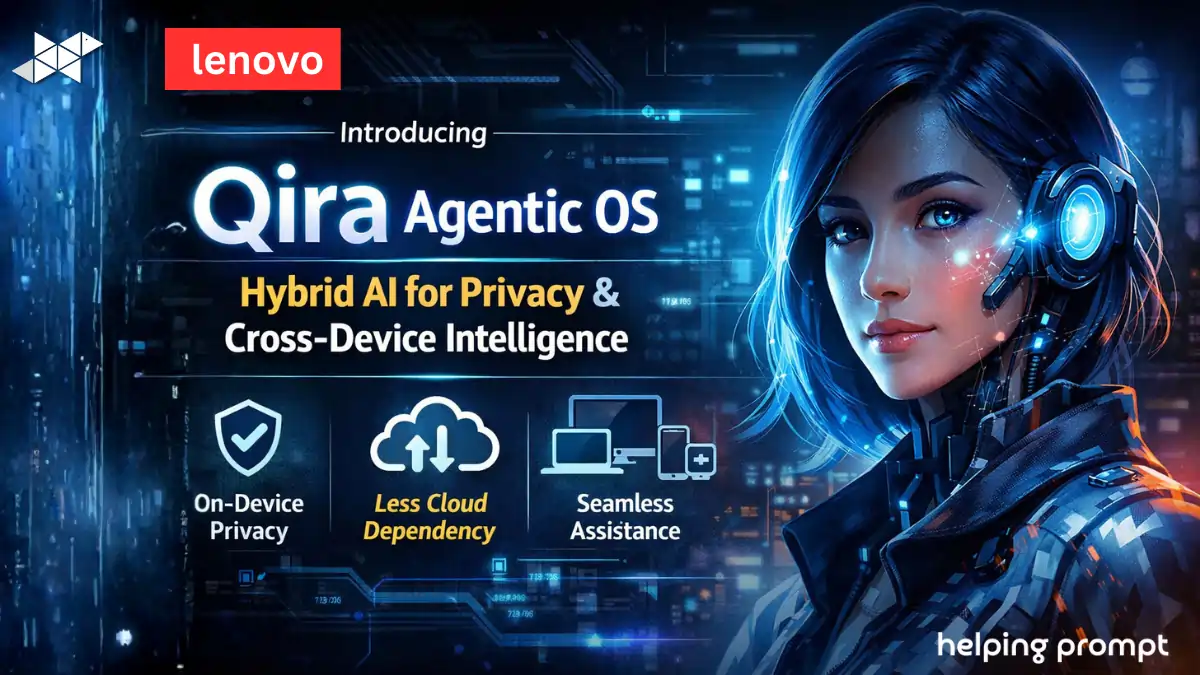
Lenovo is stepping deeper into the fast-moving AI race, but with a clear message: smarter assistance doesn’t have to mean giving up privacy. The company has revealed a new hybrid AI platform built around an on-device “agentic” operating system called Qira, designed to work across devices while reducing dependence on cloud processing.
At its core, Lenovo’s pitch is simple-AI should feel faster, more personal, and more secure, especially when users are switching between laptops, phones, and other connected devices.
What Lenovo’s “Qira” is really trying to solve
Lenovo’s new platform is built for a common frustration: today’s AI often depends heavily on the cloud, meaning users must send requests and data online to get results. That can slow things down, raise privacy concerns, and limit how useful AI feels in daily work.
With Qira, Lenovo is pushing a hybrid AI model, where tasks can be handled on the device itself whenever possible-keeping sensitive data closer to the user.
In Lenovo’s approach, the system isn’t just answering questions. It aims to behave more like a proactive assistant that can understand context and help users complete tasks more smoothly.

“Agentic OS” explained in simple terms
The word “agentic” can sound technical, but the idea is easy to understand.
An agentic AI system is designed to do more than respond. It can:
- understand your intent,
- break tasks into steps,
- and assist automatically across apps or devices.
Instead of a user repeatedly giving instructions, the AI is meant to “act” more intelligently-while still being controlled by the user.
As Lenovo presented it, Qira is built to make AI feel less like a chatbot and more like a helpful digital partner.
Privacy-first AI: Lenovo’s strongest selling point
Privacy has become one of the biggest concerns in AI adoption, especially for professionals, businesses, and everyday users who don’t want personal data constantly travelling to cloud servers.
Lenovo’s platform highlights privacy by reducing cloud dependency, focusing more on on-device intelligence.
A key message from the reveal was clear:
“The goal is to reduce cloud dependency and make AI assistance more private and seamless.”
This direction aligns with a growing trend in tech-companies are trying to bring more AI processing directly onto devices to improve speed and trust.
![Hyper-Realistic Diorama Poster of [City] Goes Viral: A City Cut Out Like Earth’s Puzzle Piece](https://helpingprompt.in/wp-content/uploads/2026/01/helpingprompt.in-27-1024x576.webp)
One brain across devices: the cross-device promise
Another major focus of Lenovo’s hybrid AI push is cross-device intelligence. In real life, users don’t work on just one screen. A typical day may involve:
- reading on a phone,
- drafting on a laptop,
- presenting on a different device,
- and managing files across platforms.
Lenovo’s Qira-based platform is aiming to make this experience smoother by enabling AI assistance that works across devices, without forcing users to start over each time they switch screens.
The promise is an AI experience that feels connected, consistent, and aware-without being intrusive.
A move away from “cloud-only” AI
Cloud AI will still matter, but Lenovo’s reveal signals a push toward balance.
Hybrid AI, as Lenovo positions it, means:
- on-device AI for privacy and speed,
- cloud support when needed for heavier tasks,
- and a more seamless experience overall.
In short, Lenovo is betting that the future isn’t cloud-only-it’s cloud + device working together.

Conclusion
With the launch of its hybrid AI platform and the on-device agentic OS Qira, Lenovo is making a clear play for privacy-first, cross-device intelligence-aiming to deliver faster, smarter, and more proactive assistance with less cloud dependency.







Leave a Reply