
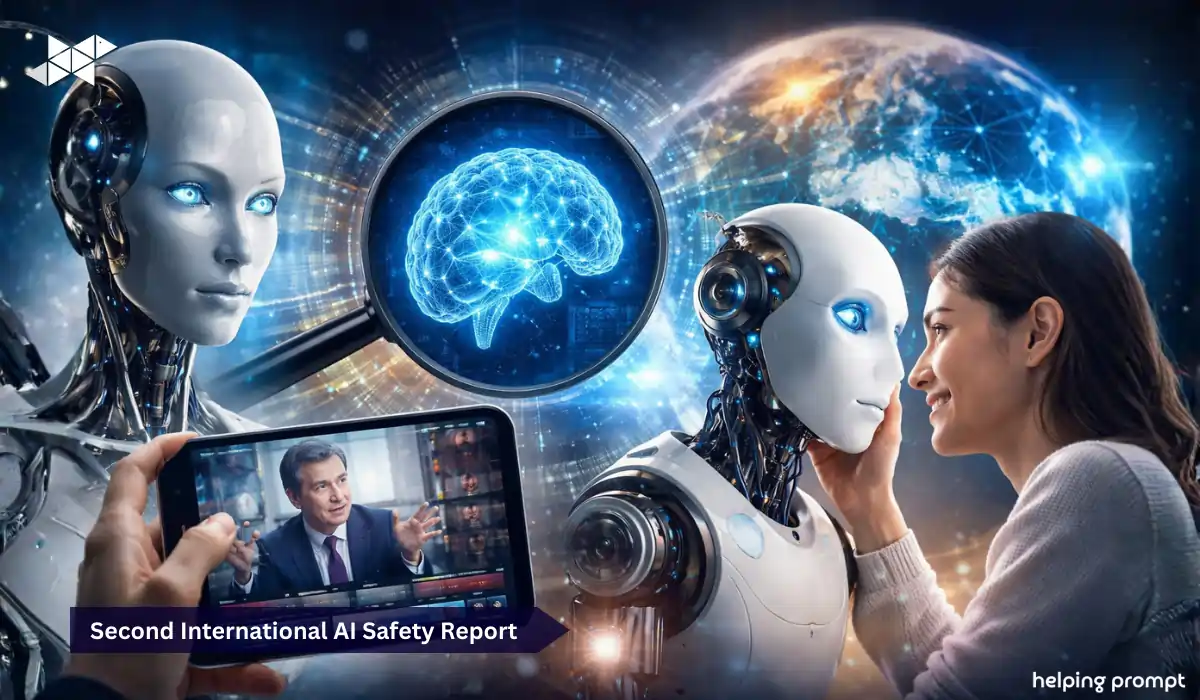
Artificial Intelligence is moving faster than most laws and safety systems.
A second International AI Safety Report has now raised fresh concerns.
It highlights how quickly AI capabilities are growing – and where risks are piling up.
From deepfakes to emotional attachment, the conversation around AI safety is getting serious.
Quick Summary
AI systems are becoming more powerful, faster than global safety rules
Deepfakes and AI companions are creating new social and security risks
Governments face big challenges in building common AI safety frameworks
What Is the Second International AI Safety Report?
The second International AI Safety Report is a global assessment of how AI technologies are evolving and what risks they bring.
It builds on the first report but goes deeper into real-world impacts.
This time, the focus is not just technical safety, but also social and psychological effects.
Importantly, the report looks at AI as it is being used today – not future sci-fi scenarios.

Why Is This Report Important Right Now?
AI adoption is exploding across sectors.
At the same time, safety rules are struggling to keep pace.
For example:
- AI-generated deepfake videos are already influencing elections
- Chatbots are becoming emotional companions for some users
- Businesses deploy AI tools without clear accountability
Therefore, this report acts as a warning bell rather than a prediction.
How Fast Are AI Capabilities Growing?
The report notes that AI systems are improving in three key areas:
- Reasoning power: Models can handle more complex tasks
- Autonomy: AI agents can act with minimal human input
- Realism: Text, voice, and video outputs are harder to distinguish from humans
As a result, misuse becomes easier and detection becomes harder.

Deepfake Risks: A Growing Threat
One of the strongest warnings is about deepfakes.
Deepfakes are no longer limited to celebrities.
They now target:
- Politicians
- Journalists
- Ordinary citizens
In India, this raises concerns around:
- Election integrity
- Online fraud
- Reputation damage
Moreover, legal remedies are still slow and fragmented.
AI Companions and Emotional Attachment
Another key finding is emotional bonding with AI companions.
Many users treat AI chatbots like friends or therapists.
While this feels harmless, the report highlights risks such as:
- Over-dependence
- Manipulation through personalised responses
- Lack of transparency about data use
Therefore, emotional safety is now part of AI safety discussions.
Where Does Governance Fall Short?
Global AI governance remains uneven.
Some countries focus on innovation.
Others prioritise regulation.
However, there is no shared global safety baseline.
Challenges include:
- Different legal systems
- Conflicting economic interests
- Limited technical expertise in policymaking
As a result, enforcement gaps continue to grow.

When Can We Expect Stronger AI Safety Frameworks?
The report suggests that short-term progress is possible.
In the next 1–2 years, we may see:
- Minimum safety standards for AI models
- Better deepfake detection tools
- Clearer responsibility for AI harm
However, long-term global coordination will take much longer.
How Can Users and Businesses Stay Safe Today?
Until regulations mature, practical steps matter.
For users:
- Verify suspicious videos or audio
- Avoid sharing sensitive data with AI tools
For businesses:
- Audit AI systems regularly
- Use explainable AI models where possible
- Keep human oversight in critical decisions
Small steps can reduce big risks.

Conclusion
The second International AI Safety Report makes one thing clear: AI risks are no longer theoretical.
Deepfakes, emotional attachment, and weak governance need urgent attention.
The future of AI depends not just on innovation, but on responsible safety frameworks.






Leave a Reply