
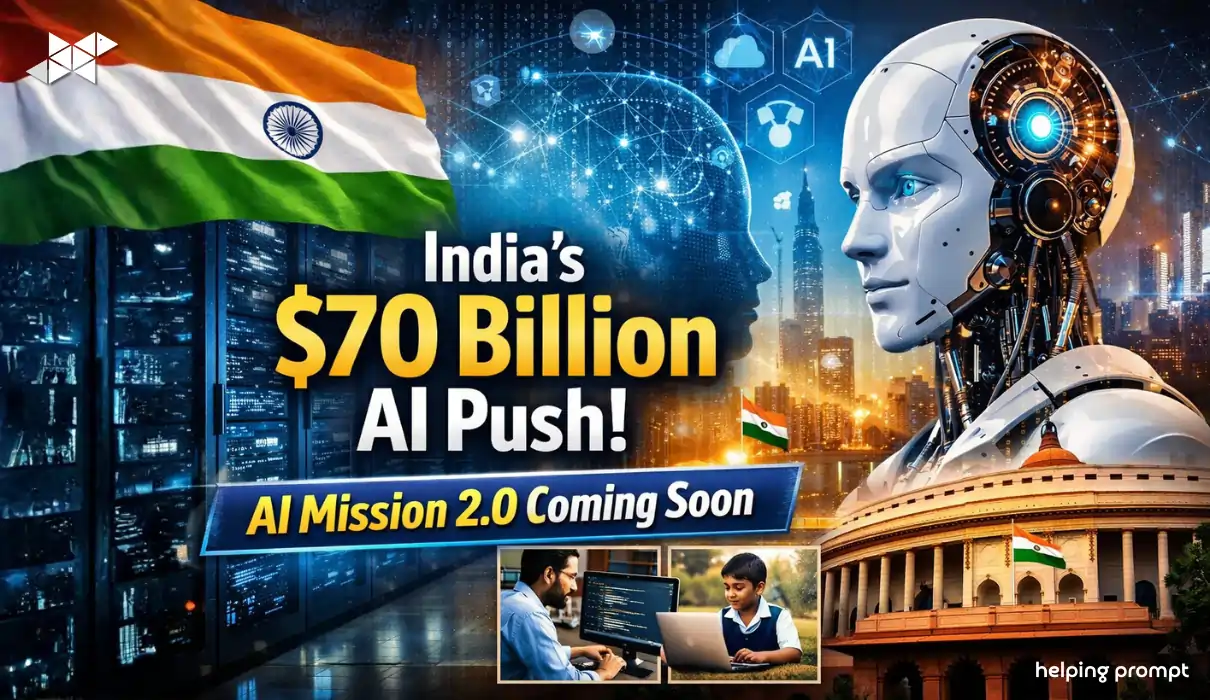
India’s artificial intelligence story took a sharp turn this week. A massive $70 billion investment in AI computing infrastructure has put the country on a faster track, and the government has now confirmed that AI Mission 2.0 is coming within the next five to six months. The focus is no longer just innovation labs or big tech. This time, the push is about who gets access – and how widely AI is used across India.
A $70 Billion Signal That India Is Serious About AI
The size of the investment alone has changed the conversation. Until now, India’s AI growth was often discussed in terms of talent and startups. Infrastructure was the missing piece.
This $70 billion infusion is aimed at building large-scale AI computing capacity – high-performance data centres, advanced chips, and cloud systems that can handle complex AI workloads. These are the backbone systems required to train large AI models and run them at scale.
In simple terms, this means India will no longer have to depend heavily on foreign infrastructure to power its AI ambitions.
A Bengaluru-based AI developer summed it up plainly:
“Talent was never the problem. We just didn’t have enough serious computing power at home. This changes that.”

Why AI Mission 2.0 Is Being Watched Closely
The government’s announcement that AI Mission 2.0 will roll out in about five to six months has drawn attention because of its stated goal – democratising AI access.
Officials say the mission is designed to ensure that AI tools and infrastructure are not limited to a handful of big companies or elite institutions. Instead, startups, researchers, MSMEs, and even state governments are expected to benefit.
The focus areas include healthcare, agriculture, education, governance, and language technology. For many smaller players, access to affordable AI computing has been a long-standing barrier.
A Delhi-based startup founder working on health diagnostics said,
“Right now, we spend more time worrying about cloud costs than product quality. If Mission 2.0 fixes that, it’s a big relief.”
What ‘Democratising AI’ Actually Means on the Ground
The phrase sounds abstract, but people in the ecosystem say it has a clear meaning.
First, shared AI computing resources. Instead of every company building its own expensive setup, Mission 2.0 is expected to offer common platforms where approved users can run AI models at lower cost.
Second, support for Indian languages and local use cases. Many global AI tools still struggle with regional languages and India-specific data. Government-backed infrastructure could help fix that gap.
Third, access beyond metro cities. Smaller universities, rural innovators, and state-level departments often lack the budgets for advanced AI tools. Mission 2.0 aims to level that field.
An academic researcher from a central university noted,
“We have ideas and datasets, but no machines to run serious models. This could finally bridge that gap.”

How This Fits Into India’s Broader AI Landscape
India’s AI journey has often been described as high on potential but uneven in execution. Startups have grown fast, but infrastructure lagged behind countries like the US and China.
This new investment directly targets that weakness. Combined with AI Mission 2.0, it signals a shift from pilot projects to long-term capacity building.
Government officials have also stressed that this is not about replacing jobs or rushing automation. The emphasis is on productivity, public services, and homegrown innovation.
Importantly, the government’s response suggests a coordinated approach – investment, policy, and access moving together instead of in silos.
What Users and Builders Are Saying Right Now
Among developers and creators, the mood is cautious but hopeful. Many have seen ambitious tech missions stall before. But the scale and clarity of this announcement have made people pay attention.
A content creator experimenting with AI tools for regional media said,
“If this really reaches smaller creators and not just corporates, it will change who gets to build with AI in India.”
For now, most are waiting for detailed guidelines, timelines, and eligibility rules. The next five to six months will be closely watched.

India’s $70 billion AI infrastructure push, backed by the government’s upcoming AI Mission 2.0, marks a decisive moment. The promise is clear: broader access, stronger foundations, and a more inclusive AI ecosystem. How it unfolds will matter as much as the announcement itself.






Leave a Reply