
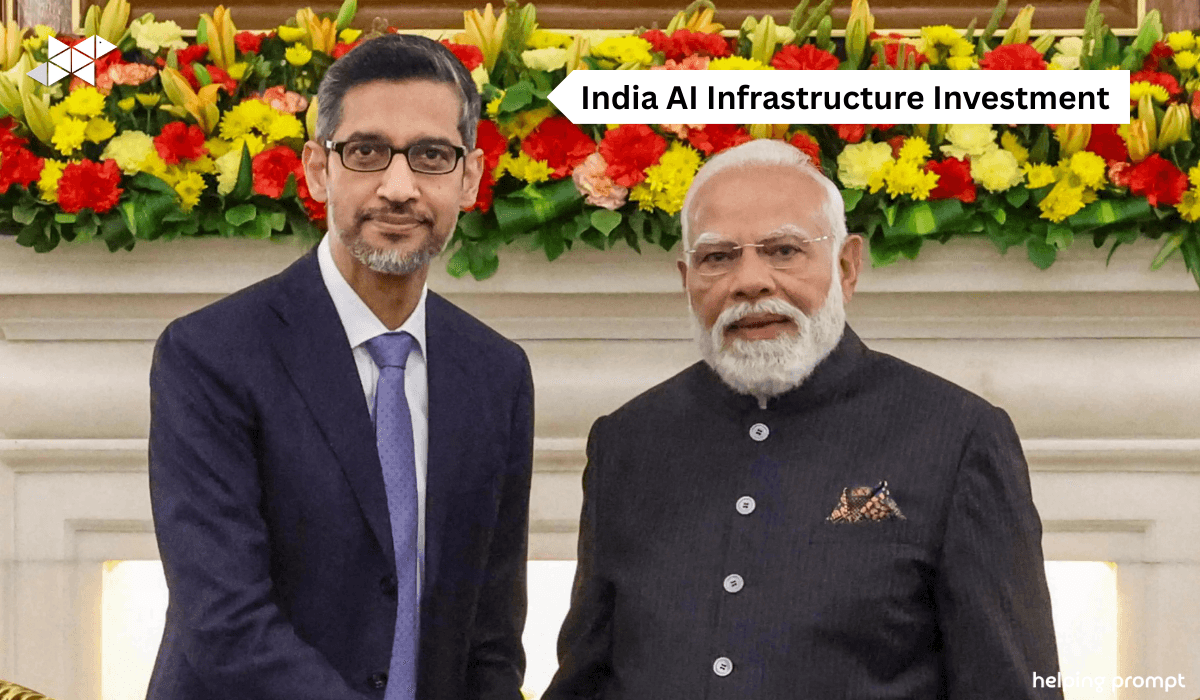
India AI infrastructure investment: India is quietly building something massive in artificial intelligence.
Not just apps. Not just chatbots. But full-scale AI infrastructure.
From ₹10 trillion commitments to billion-dollar data centres, global tech giants are placing long-term bets on India. The big question is: what does this mean for Indian users, startups, and digital creators?
Quick Notes
India is seeing over $180+ billion in AI and data infrastructure commitments.
Big players like Reliance, Google, Microsoft, Nvidia, and TCS are expanding AI compute power locally.
This could make India a global AI hub, not just a software outsourcing market.
Why India Is Becoming an AI Investment Magnet
India has three big advantages:
- 800M+ internet users
- Fast-growing digital payments and cloud adoption
- Strong engineering talent pool
Therefore, global companies now see India as both a market and a manufacturing base for AI.
Let’s break down the major announcements.

Reliance Industries’ ₹10 Trillion AI Compute Vision
Reliance Industries, led by Mukesh Ambani, pledged around ₹10 trillion (~$120 billion) over the next seven years.
What’s the plan?
- Build a sovereign AI compute ecosystem
- Set up large-scale AI-ready data centres
- Integrate AI across mobile networks and digital platforms
- Strengthen AI capabilities within Jio services
This is not just expansion. It is a shift toward India-controlled AI infrastructure.
Why does that matter?
Because currently, most advanced AI compute power is concentrated in the US and China. However, Reliance wants India to own critical AI backbone infrastructure.
If successful, this could power:
- Smarter telecom networks
- AI-driven e-commerce
- Voice-based services in Indian languages
That changes the game for startups and developers.
Google’s $15 Billion AI and Connectivity Push
Google announced a $15 billion investment in India.
Key focus areas:
- Building an AI hub in India
- Expanding subsea cable infrastructure
- Supporting AI startups and research
This is part of Google’s broader America-India tech collaboration efforts.
Why subsea cables?
Because AI runs on data. And data needs fast, reliable international connectivity. Faster cables mean:
- Better cloud performance
- Lower latency for AI apps
- Stronger global integration
As a result, Indian AI startups could compete globally without infrastructure limitations.

Microsoft’s $50 Billion Long-Term AI Expansion
Microsoft committed roughly $50 billion over the current decade toward AI infrastructure and cloud expansion.
Their focus:
- Expanding Azure cloud capacity
- Strengthening AI compute resources
- Supporting AI skills development
This signals something important.
Microsoft sees India not just as a consumer market, but as an AI growth centre.
Moreover, skills development investment means:
- More AI training programs
- More enterprise AI adoption
- More job opportunities in cloud + AI roles
For Indian professionals, this could mean higher demand for AI engineers, cloud architects, and data specialists.
Nvidia & Yotta’s AI Compute Hub
Yotta Data Services invested around $2 billion to build a major AI compute hub.
The infrastructure uses advanced chips from Nvidia.
Why is this important?
Because Nvidia GPUs power most advanced AI models globally. Therefore, having such chips locally means:
- Faster AI model training
- Lower dependency on foreign compute clusters
- Competitive advantage for Indian enterprises
India is gradually moving from IT services to AI infrastructure ownership.
That is a big shift.

Tata Consultancy Services & OpenAI Collaboration
Tata Consultancy Services (TCS) signed OpenAI as an anchor customer for new data centre infrastructure.
This move does two things:
- Strengthens India’s AI ecosystem credibility
- Attracts global enterprise confidence
When major AI labs collaborate with Indian infrastructure players, it sends a clear signal:
India is ready for large-scale AI operations.
What This Means for Indian Users
This is not just corporate news.
It affects:
- Faster AI apps on smartphones
- Better voice assistants in regional languages
- Smarter fintech tools
- AI-powered healthcare and agriculture solutions
Additionally, creators and bloggers may see:
- Improved AI tools in Google and Microsoft ecosystems
- Faster cloud services
- Lower AI API costs over time
The long-term outcome? India could become a net exporter of AI solutions, not just services.
The Bigger Picture: India’s AI Sovereignty
Until now, most AI innovation depended heavily on foreign cloud providers.
However, these investments show a clear pattern:
- Local data centres
- Local compute clusters
- Local AI training capabilities
This strengthens digital sovereignty.
And that is strategically important for a country handling massive population-scale data.
Conclusion
India is entering its AI infrastructure investment era. The money is large. The intent is serious.
If execution matches ambition, India may soon stand alongside global AI leaders – not as a user, but as a builder.







Leave a Reply