
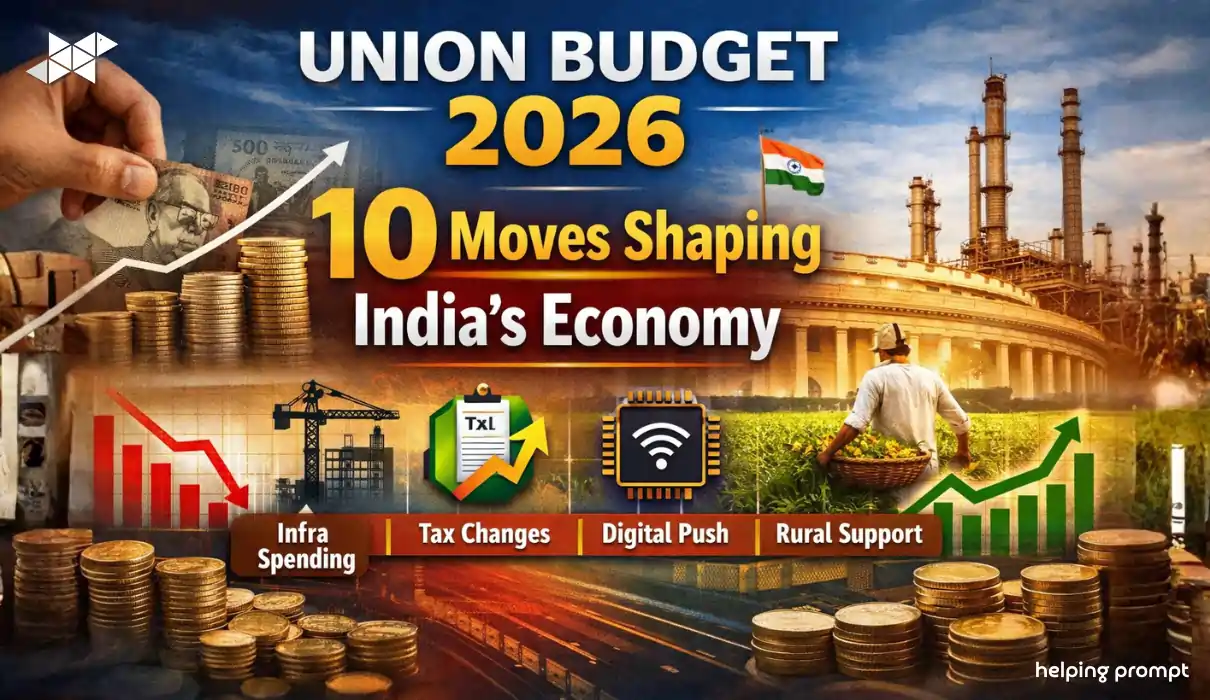
The Union Budget 2026 landed with a clear message: steady growth over flashy promises.
What stood out was not one big announcement, but a series of calculated moves aimed at stability.
For households, businesses, and states, this budget quietly resets expectations.
A Budget Focused on Control, Not Noise
This year’s budget arrives at a time when inflation is easing but global uncertainty hasn’t gone away.
The government appears to be playing safe – tightening some screws while opening others.
Union Budget 2026 matters because it signals how India plans to grow without losing fiscal balance.
Where the Money Is Going and Why It Matters
Instead of spreading allocations thin, the focus is sharper.
Capital spending, manufacturing, and targeted welfare dominate the fine print.
The idea seems simple: spend where returns are visible, cut where leakages persist.
10 Key Moves That Define Union Budget 2026

1. Capital Expenditure Gets Another Push
Public infrastructure spending sees another meaningful rise.
Roads, railways, and logistics remain central to the growth strategy.
2. Fiscal Deficit Stays on a Tighter Path
The government sticks to gradual deficit reduction.
Markets will read this as a signal of discipline, not austerity.
3. Manufacturing Incentives Extended
PLI-style incentives continue for select sectors.
The aim is clear: make India more competitive without blanket subsidies.
4. Middle-Class Tax Relief, But Limited
Some rationalisation in personal income tax slabs is visible.
Relief exists, but it’s measured – not a giveaway budget.
5. Focus on Jobs Over Doles
More funds are channelled into skill development and employment-linked schemes.
The shift is from short-term support to long-term employability.
6. MSMEs Get Easier Credit Access
Credit guarantee coverage is expanded.
This could ease cash flow stress for small businesses still recovering.
7. Green Energy Spending Rises Quietly
Renewables, storage, and green mobility see incremental funding.
It’s not dramatic, but it’s consistent.
8. Digital Governance Gets Funding Boost
Tech-led governance, AI-backed services, and digital public infrastructure gain support.
Efficiency, not buzzwords, seems to be the focus.
9. Agriculture Support Turns More Targeted
Instead of higher subsidies, the push is towards irrigation, storage, and agri-tech.
Farmers may feel the impact over time, not instantly.
10. States Get More Flexibility
Higher borrowing room for states linked to reforms.
This encourages fiscal responsibility without central micromanagement.

What This Means for Ordinary Indians
For most families, Union Budget 2026 won’t feel dramatic overnight.
There’s no sudden tax windfall or sharp price shock.
But better infrastructure, steadier inflation control, and job-linked spending could slowly improve day-to-day economics.
For small businesses, easier credit and stable policy matter more than flashy announcements.
How Experts Are Reading This Budget
Economists see this as a “continuity budget.”
The government is clearly prioritising credibility – with investors, rating agencies, and states.
The real test will be execution.
Allocations alone don’t create growth; delivery does.

What to Watch Next
The months ahead will show how quickly projects move from paper to ground.
Private investment response and state-level spending will be crucial signals.
Union Budget 2026 doesn’t try to impress.
It tries to hold the line – and in today’s economic climate, that may be the bigger story.






Leave a Reply