
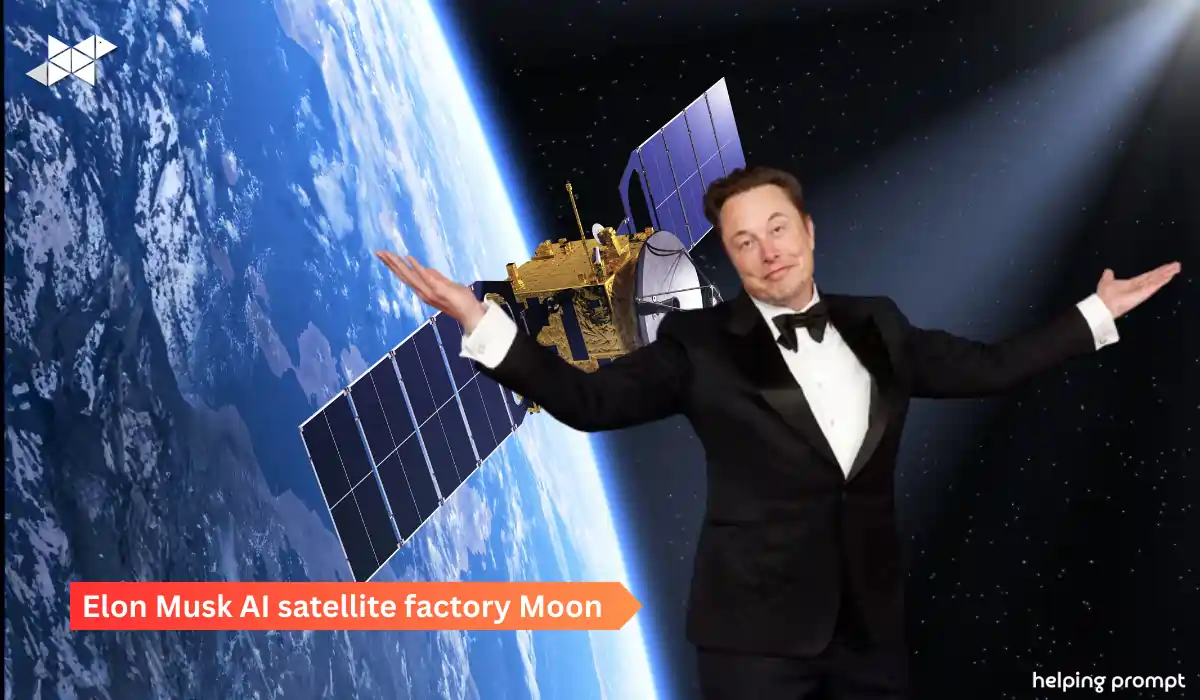
Space technology is entering a new phase.
Elon Musk has announced a bold idea – building an AI-powered satellite factory on the Moon.
If this becomes real, it could change how satellites are made, launched, and used for global AI computing.
Quick Summary
Elon Musk proposes a Moon-based AI satellite factory.
The goal is to build advanced AI computing satellites in space.
This could reduce launch costs and boost global AI infrastructure.
Why Elon Musk Wants a Satellite Factory on the Moon
Elon Musk has always talked about making humans a multi-planetary species. Through SpaceX, he already reduced rocket launch costs.
Now, the idea goes further.
Instead of launching heavy satellites from Earth, Musk suggests:
- Sending raw materials to the Moon
- Using AI-powered robotic systems
- Manufacturing satellites directly in lunar orbit
Because the Moon has lower gravity, launching satellites from there requires less fuel. As a result, costs could drop significantly.
But here’s the bigger question – why combine AI and satellites in space?

What Are AI Computing Satellites?
AI computing satellites are not normal communication satellites.
They are designed to:
- Process AI tasks in orbit
- Handle large data from Earth observation
- Support global internet infrastructure
- Enable faster real-time AI analysis
For example:
Imagine agricultural monitoring in India.
Instead of sending raw data to ground data centres, satellites could process crop health data directly in space using AI models. This means faster insights for farmers.
Similarly, disaster management systems could get real-time AI alerts without delay.
Why the Moon? The Strategic Advantage
The Moon offers unique advantages:
1. Lower Gravity
Launching from the Moon requires less energy than from Earth.
2. Space-Based Manufacturing
Factories in space avoid Earth’s atmospheric limits.
3. Solar Energy Availability
Satellites can use uninterrupted solar energy in lunar orbit.
Moreover, building in space avoids some Earth-based regulatory and environmental constraints.
However, setting up a factory on the Moon is not simple. It requires advanced robotics, autonomous AI systems, and long-term sustainability planning.
How SpaceX Could Make This Possible
SpaceX is already developing reusable rockets like Starship for heavy payload transport.
If Starship becomes fully operational:
- Heavy AI hardware could be transported to the Moon
- Autonomous robots could assemble satellite components
- AI systems could manage operations remotely
In addition, Musk’s other company Tesla has deep experience in AI-driven automation and robotics. That expertise may support lunar manufacturing.
Still, many experts wonder:
Will space radiation affect AI chips?
How will repairs be managed?
What about international space laws?
These questions make the project both exciting and complex.
What This Means for India and Global Tech
India is rapidly growing in space and AI sectors.
With organizations like ISRO expanding satellite programs, global competition in space-based computing could increase.
For Indian startups:
- New satellite AI partnerships may emerge
- Demand for space-grade semiconductor chips could rise
- Space-tech investments may accelerate
Therefore, this Moon factory concept is not just science fiction. It could influence global AI infrastructure in the next decade.
Challenges That Cannot Be Ignored
Although the idea sounds futuristic, major challenges remain:
- High initial investment
- Radiation-proof AI chips
- Lunar infrastructure development
- Legal and geopolitical approvals
Moreover, global cooperation will likely be required.
Still, Musk’s history shows that ambitious ideas sometimes turn into real projects.
The Bigger Picture: AI Infrastructure Beyond Earth
The world’s AI demand is growing fast.
Data centres on Earth consume massive electricity and water.
Therefore, space-based AI computing may become a long-term solution.
If satellites can process AI workloads in orbit:
- Earth data centres may reduce pressure
- Latency could improve
- Global AI access may expand
This makes the Moon factory idea more than a publicity statement. It connects directly to the future of AI infrastructure.
Final Thoughts
Elon Musk’s Moon satellite factory plan is ambitious and technically challenging.
However, if executed well, it could reshape space technology and AI computing.
The real question is not if space manufacturing will happen – but when.







Leave a Reply