
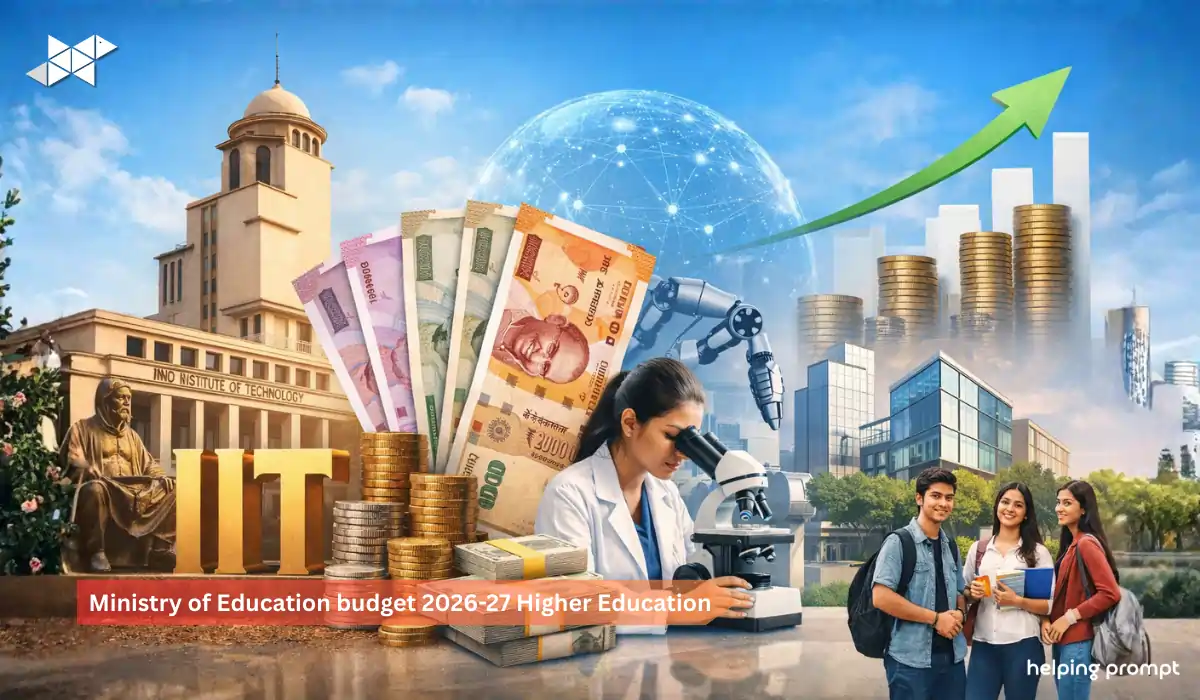
In the Union Budget 2026-27, the Indian government has increased funding for higher education under the Ministry of Education. The move aims to strengthen universities, research, industry-ready skills, and inclusive access for students across India.
This article breaks down the latest official numbers and initiatives for India’s Department of Higher Education – what’s allocated, what’s new, and what it means for students and institutions.
Quick Summary
Rs. 55,727.22 crore allocated to the Department of Higher Education – an 11.28% rise over FY 2025-26.
Focus on IITs, Central universities, UGC, research schemes and new AI & global institution support.
New structural initiatives like University Townships and industry-linked education committees are proposed.
What is the Higher Education Budget for FY 2026–27?
The Department of Higher Education – a part of the Ministry of Education – received Rs. 55,727.22 crore in the 2026–27 Budget Estimates. This includes both scheme and non-scheme (regular) funding.
Key comparison:
- FY 2025-26 allocation: ~Rs. 50,077.95 crore
- FY 2026-27 allocation: ~Rs. 55,727.22 crore
- Increase: ~Rs. 5,649 crore (≈11.3%)
In simple terms, higher education got one of the strongest growth rates compared with other sectors in the Ministry this year.
Perfect Holi Colors Without Skin Damage: AI Holi Prompts for Couple
Why This Increase Matters
India’s higher education segment is being repositioned from a traditional social sector spend to a strategic economic investment.
- Funding boosts research, innovation and skills development.
- It aligns education with industry requirements and jobs.
- It supports inclusive access, especially for women and rural students.
This means students can expect more opportunities and real-world readiness from public institutions.
Major Allocations: Where the Money Goes
Here’s a clear snapshot of how the budget is distributed in Higher Education:
Universities and Governing Bodies
- Central Universities: Rs. 17,440 crore (+4.5%)
- University Grants Commission (UGC): Rs. 3,709 crore (+11%)
- IITs: Rs. 12,123 crore (+6.8%)
- NITs: Rs. 6,260 crore (+10%)
- Deemed & IIM support: Small but growing allocations.
(All increases versus FY 2025–26)
New & Priority Schemes
- PM-One Nation One Subscription: Rs. 2,200 crore
- PM Research Chair: Rs. 200 crore (new)
- AI for Education CoEs: Rs. 100 crore (new)
- World-Class Institution support: Rs. 900 crore (+89%)
- MERITE (technical research): Rs. 300 crore (+36%)
(Increased investments to support global competitiveness)
Holi Couple AI Image Prompt: Create Cinematic Photos With Exact Face Match
Key Initiatives: What’s New and Practical
1. University Townships
The government plans five University Townships, linking higher education with industry corridors. These hubs aim to combine research, practical skills, housing, and jobs in the same ecosystem.
Example: A student in a technology program might train alongside industry experts in the same township.
2. Education-to-Employment Committee
A high-powered standing committee will advise how to align academic programs with real job market needs and emerging technologies – including AI skills.
This will help universities update courses based on what employers and industries actually want.
3. Focus on Inclusion & Infrastructure
- Girls’ hostels, regional innovation centres, and skill labs are proposed.
- More funding goes to research incentives and global collaborations.
These steps aim to boost equitable access and safety, especially for female and rural students.
When Does It Take Effect?
The FY 2026–27 budget comes into force from 1 April 2026 and will guide government spending until 31 March 2027.
Official releases and more detailed implementation plans will follow from the Ministry of Education throughout 2026.
Where This Helps Most
- Students: More scholarships, modern labs, skill-linked learning.
- Universities: Better infrastructure and research funding.
- Young professionals: Improved alignment with job markets.
- Women learners: Enhanced hostel and regional access support.
Final Conclusion
The Department of Higher Education is getting a meaningful budget increase in FY 2026–27 with a clear strategy – to make Indian higher education more industry-aligned, inclusive, and globally competitive. Funding growth, new schemes, and policy focus show how education is becoming a core part of India’s long-term growth strategy.







Leave a Reply