
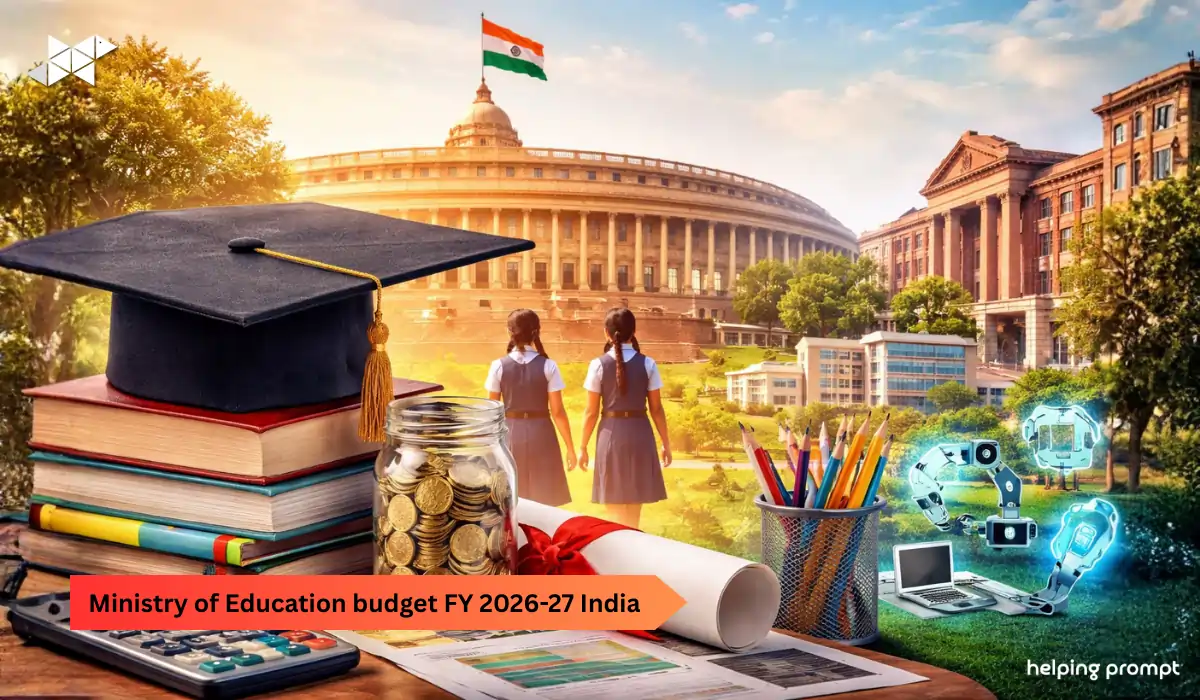
The Ministry of Education’s budget for FY 2026-27 has just been announced in India’s Union Budget. Notably, it is one of the largest allocations yet and holds significant implications for students, teachers, and educational institutions. So, what does this mean in practical terms? Let’s now break down what’s new, what has changed, and how it may directly impact you.
Quick Summary
A total allocation of ₹1.39 lakh crore has been approved.
Greater focus has been placed on skills, infrastructure, and girls’ education.
Higher education funding has been increased significantly.
Why This Budget Matters
What Is the Ministry of Education Budget?
The Ministry of Education (MoE) budget is the annual funding set aside by the Government of India to run and improve school education, literacy programs, and higher education systems across the country. It covers everything from teacher salaries to infrastructure and new initiatives.
Holi Couple AI Image Prompt: Create Cinematic Photos With Exact Face Match
Key Allocations and Changes (FY 2026-27)
Bigger Pie for Education
- Total Budget: ₹1,39,289.48 crore – which is a clear increase over last year’s ₹1,28,650 crore.
- Growth Rate: ~8.27% increase in the education allocation compared to FY 2025-26.
This shows the government’s intent to strengthen education, particularly skills and employment-linked learning.
Department-Wise Breakup
| Department | Allocation (FY 2026-27) | Change vs Last Year |
|---|---|---|
| School Education & Literacy | ₹83,562.26 crore | +6.35% |
| Department of Higher Education | ₹55,727.22 crore | +11.28% |
Higher education saw a bigger percentage jump, reflecting greater emphasis on colleges, universities, and research.
Create a Wholesome Pixar-Style 3D Kids Walk AI Prompts With Perfect Face Match (Step-by-Step Guide)
What’s New in FY 2026-27 Education Budget
1. Focus on Girls’ Education
- Girls’ Hostels: Proposal to build at least one girls’ hostel per district to improve access and safety.
This is a key initiative to reduce dropout rates and improve attendance, especially in rural and semi-urban areas.
2. Skills and Job-Linked Learning
- The budget is often called a “Yuva Shakti Driven Budget”, meaning it aims to bridge education and employment.
- There’s clear support for skill development, digital learning, and vocational programs – all crucial for India’s youth workforce.
3. Infrastructure and Innovation
- Funding to strengthen school facilities and modern labs.
- Support for AI, digital content creation labs, research collaborations, and skill-based courses.
This supports future-ready education linked to emerging sectors.
4. Higher Education Gets More Power
- Increased funding for universities, especially for research, training and global competitiveness.
- Supports scholarships, research labs, and upgradation of institutions.
This shift means higher education is viewed as strategic capital, not just social expenditure.
Create a Cinematic Cartoon 3D Couple Portrait AI Prompts
How It Helps Students (Real Examples)
- A student in a rural district may now access safe hostel facilities nearby.
- Colleges can upgrade computer labs to support AI and digital skills.
- Universities might receive additional funding for research partnerships.
By reducing barriers and expanding opportunities, these changes will therefore link classroom learning directly with employment.
- School improvements: Better classrooms, training, and learning tools.
- Higher education support: Grants for universities and research.
- Skill development schemes: Vocational courses and youth programs.
- Girls’ hostels: Safe accommodation facilities.
These focus areas show a balance between equity and innovation.

Conclusion
India’s education budget for FY 2026-27 reflects a clear push towards skills, inclusion, and infrastructure. The increased allocation and strategic focus aim to support students from school to university and beyond.
This budget is a step forward – not just in numbers – but in shaping future-ready education for India’s youth.







Leave a Reply