
At most nutrition clinics, the first question is simple: “What did you eat?”
But for millions of Indians, the honest answer is also complicated: “A little of everything… mixed together.”
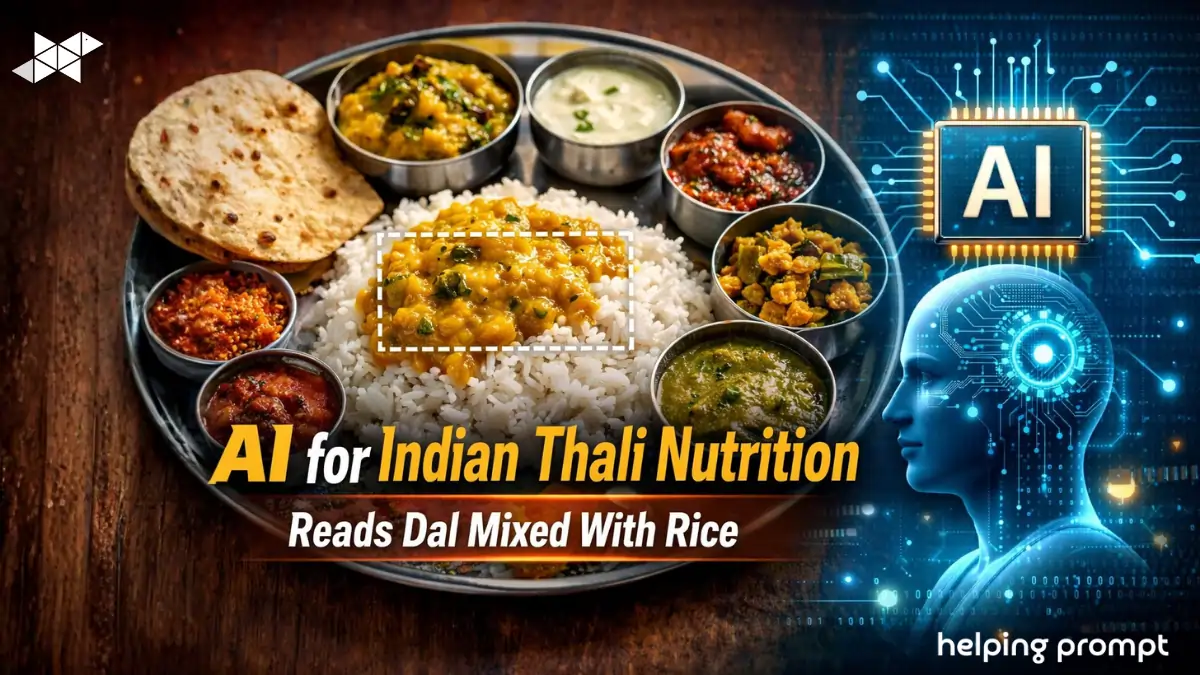
That’s exactly the problem a team of researchers at IIIT Hyderabad is trying to solve with a new set of AI tools built for Indian meals, not Western plates. In a specialized update shared by the researchers, the AI can study the textures, layers, and mixed portions of an Indian thali-even when foods overlap, like dal poured over rice.
In short, it aims to understand what most food apps struggle with: real Indian eating.
Why Most Food Apps Get Indian Meals Wrong
Most popular food-tracking apps were designed around meals that look “separated” and “clean” on a plate-like grilled chicken next to salad.
But Indian meals don’t follow that pattern. A thali can include:
- Rice + dal mixed
- Sabzi touching roti
- Chutney spread on the side
- Pickle, curd, papad, and more in small portions
When everything overlaps, the camera often fails to identify ingredients correctly. The result is an inaccurate nutrition estimate.
As one researcher explained during the update, “Indian thalis are complex because the food is often mixed and layered, not separated.”

The Real Breakthrough: AI That Understands “Mixed Food”
The standout feature of this IIIT Hyderabad work is its ability to decode mixed textures, not just recognize food names.
For example:
- Dal + rice is not treated as one single item
- The AI tries to separate components visually
- It estimates intake more realistically, based on what’s actually on the plate
That’s a big leap for daily nutrition tracking in India, where meals are rarely plated in neat sections.
A key line from the research update summed it up well: “Unlike Western-centric apps, this AI can decode mixed foods like dal over rice.”
Built Around Indian Culture, Not Imported Food Labels
What makes this approach stand out is its cultural fit.
Instead of forcing Indian food into Western categories, the AI is being shaped around what people here actually eat-thalis, home-cooked combinations, and mixed servings.
This matters for everyday users, including:
- People tracking calories or macros
- Diabetics monitoring carbs
- Families trying portion control
- Fitness-focused users who eat home meals
The goal is simple: make nutrition tracking feel natural in an Indian kitchen.
Why This Matters Beyond Fitness and Weight Loss
Nutrition tracking isn’t only about “dieting.” In India, it often connects directly to health management.
When the AI can correctly read a thali, it can help users understand:
- How much carbohydrate is in the meal
- Whether protein intake is low
- How balanced the plate really is
- What portion sizes look like in reality
It also reduces guesswork, because many people don’t measure food in grams-they measure it in katoris, spoons, and “thoda sa.”

Conclusion
IIIT Hyderabad’s new AI tools take a practical step toward solving a uniquely Indian challenge: accurately tracking nutrition from a mixed, layered thali. By reading textures and overlaps-like dal over rice-the system moves closer to understanding Indian meals the way Indians actually eat them.





![Hyper-Realistic Diorama Poster of [City] Goes Viral: A City Cut Out Like Earth’s Puzzle Piece](https://helpingprompt.in/wp-content/uploads/2026/01/helpingprompt.in-27-300x169.webp)

Leave a Reply