
In the fast-moving world of artificial intelligence, the real fight is no longer only about apps or chatbots. It is about the machines behind them – the chips, servers, and supply chains that decide who can build faster, smarter AI.
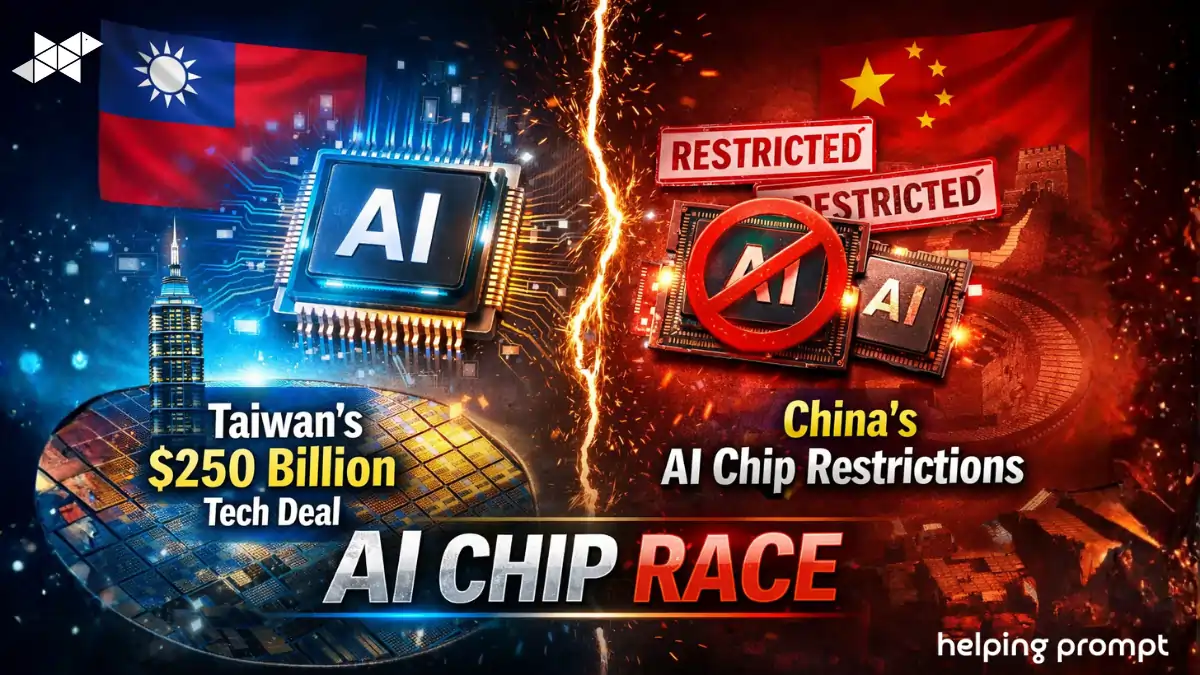
This week, fresh developments around Taiwan and China signalled a sharper turn in the global AI arms race. Taiwan’s massive $250 billion technology deal has grabbed global attention, while China’s new restrictions on certain AI chips are adding pressure to an already tense hardware battle.
Together, these moves are reshaping how countries and companies plan their AI future – and who gets to lead it.
Why Taiwan’s $250 Billion Deal Is Being Watched Worldwide
Taiwan is not just another player in global tech. It is widely seen as one of the most critical hubs for advanced chip manufacturing and high-end hardware supply.
Now, with a $250 billion tech push, Taiwan is sending a loud message: it wants to strengthen its position in the AI era, not just maintain it.
A senior industry observer at the event described the mood clearly:
“This is not a routine investment cycle. This is a long-term signal that Taiwan wants to stay central to global AI growth.”
The scale of the deal matters because AI development is becoming more hardware-hungry every month. Bigger models need more computing power, and computing power needs advanced chips.

China’s AI Chip Restrictions: What Changed
On the other side, China’s tightening stance on certain AI chips is adding another layer to the race.
Restrictions on AI chips do not just impact labs and research teams. They affect:
- how quickly AI products can be built,
- how much they cost to run,
- and which companies can scale up confidently.
One analyst put it bluntly:
“When chip access gets tighter, AI growth doesn’t stop – it becomes selective.”
In simple terms, if hardware supply becomes limited, only the best-funded and best-connected players can keep expanding at full speed.
The Real Battlefield: AI Hardware, Not Just AI Software
AI headlines often focus on new tools and viral features. But behind every AI breakthrough is a hard truth: software cannot outrun hardware forever.
This is why Taiwan’s investment push and China’s chip controls are being treated as more than business decisions. They are shaping the global AI power map.
Key reasons hardware is now the core battleground:
- AI models need massive computing power
- Data centres require specialised AI chips
- Advanced chip production takes years to scale
- Supply chains are becoming strategic assets

As one executive said during discussions:
“In the AI age, chips are not just products – they are leverage.”
How Global Companies May Feel the Impact
These developments are likely to influence how global tech companies plan their next moves.
Many firms are already rethinking:
- where they source AI chips from,
- how they secure long-term supply,
- and how they protect themselves from sudden restrictions.
For companies building AI tools, the biggest fear is simple: demand rises, but chip availability tightens.
That gap can slow down launches, increase costs, and make AI development less predictable.
Conclusion
Taiwan’s $250 billion tech deal and China’s AI chip restrictions are not isolated moves. Together, they reflect a deeper shift in the global AI race – where control over hardware is becoming just as important as innovation in software.
As AI competition intensifies, the world is watching one key question: who will secure the chips needed to power the next generation of intelligence?






![Hyper-Realistic Diorama Poster of [City] Goes Viral: A City Cut Out Like Earth’s Puzzle Piece](https://helpingprompt.in/wp-content/uploads/2026/01/helpingprompt.in-27-300x169.webp)

Leave a Reply