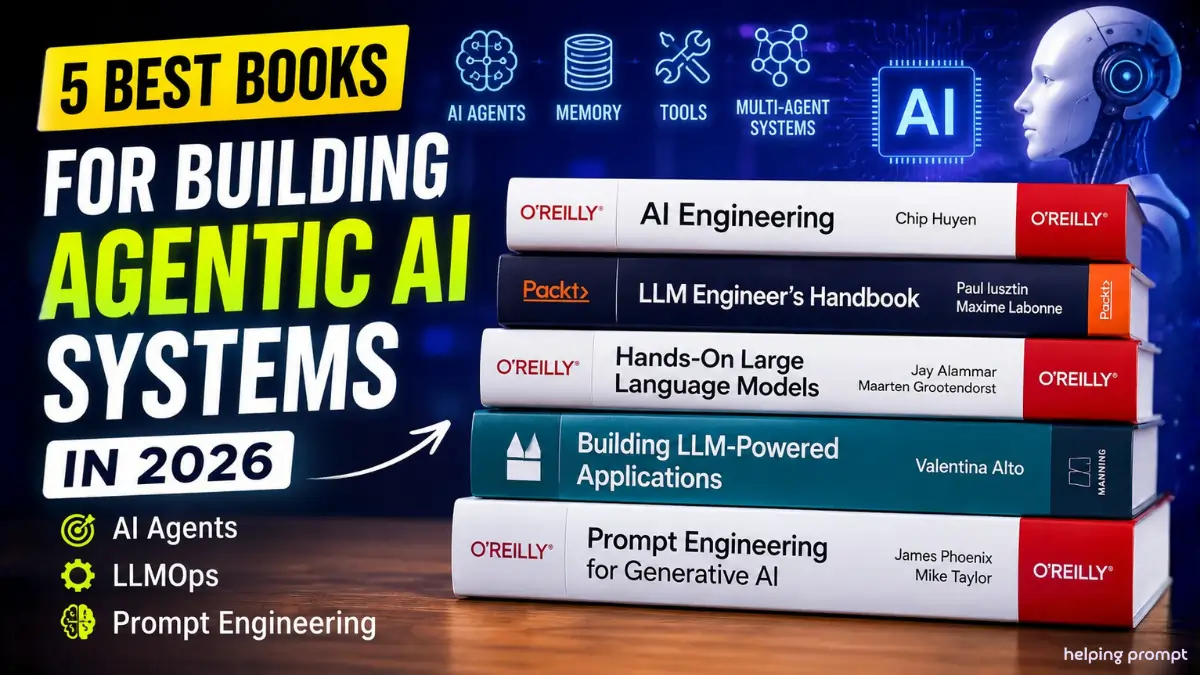
5 Best Books for Building Agentic AI Systems in 2026 Explained
Agentic AI is evolving faster than most developers expected.
In 2026, companies are moving beyond simple chatbots toward autonomous AI systems with memory, planning, and tool execution.
That shift has increased demand for practical learning resources.
The best books for building agentic AI systems now focus on deployment, evaluation, and production-ready workflows instead of theory alone.
From multi-agent orchestration to prompt debugging, these books help developers build reliable AI products that actually scale.
If you want stronger AI engineering skills this year, these titles deserve attention.
# Quick Summary
- The best books for building agentic AI systems now focus on real deployment challenges.
- Topics include LLMOps, AI agents, prompt engineering, memory, and evaluation frameworks.
- These books are useful for developers, startups, AI engineers, and product teams in 2026.
# Best Books for Building Agentic AI Systems in 2026
The demand for AI agents has grown sharply after major upgrades in enterprise AI workflows.
Developers now need systems that can reason, plan tasks, and interact with external tools reliably.
That is why the best books for building agentic AI systems focus heavily on production engineering.
They explain how modern AI systems behave under real-world pressure, not just inside demos.
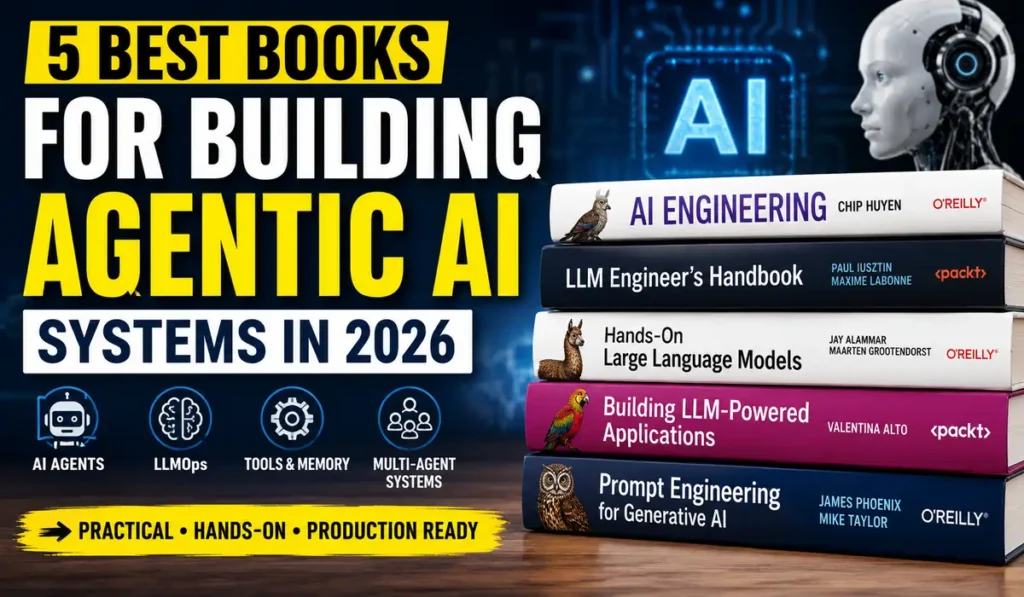
# AI Engineering by Chip Huyen
AI Engineering has become one of the strongest practical books for modern AI development.
The book explains evaluation pipelines, agent frameworks, deployment strategies, and performance tradeoffs clearly.
One standout area is agent evaluation.
Testing non-deterministic systems remains difficult, especially when AI agents make autonomous decisions.
The book also explains cost control, latency management, and human oversight.
That makes it highly useful for startups building production AI workflows in 2026.
# LLM Engineer’s Handbook by Paul Iusztin and Maxime Labonne
This book is widely recommended among AI engineers working with large-scale systems.
It covers the full LLMOps pipeline with strong technical depth and practical architecture examples.
Readers learn about retrieval-augmented generation, observability, and debugging autonomous workflows.
Those areas matter more as AI agents become increasingly independent.
The handbook also discusses inference costs and optimization strategies.
That makes it valuable for teams handling large AI workloads daily.
# How To
- How to choose the best books for building agentic AI systems?
Pick based on your skill gap like prompt engineering, deployment, or AI infrastructure.
- How to start learning agentic AI in 2026?
Begin with LLM basics, then move toward agents, memory systems, and multi-agent orchestration.
- How to apply these books in real projects?
Build small AI workflows alongside reading to understand deployment and debugging faster.
# Hands-On Large Language Models by Jay Alammar and Maarten Grootendorst
This book is ideal for developers who want stronger foundational understanding.
It explains embeddings, attention mechanisms, semantic search, and tokenization visually and clearly.
Understanding these concepts helps developers build smarter AI agents with better reasoning ability.
The visual explanations also improve communication between engineering and product teams.
Even experienced developers benefit because agentic AI often fails without strong model understanding.
That makes this book especially relevant in modern AI product development.
# Building LLM-Powered Applications by Valentina Alto
This book focuses heavily on hands-on AI product building.
It covers LangChain workflows, memory systems, prompt engineering, and multi-agent collaboration patterns.
Developers can quickly learn how to structure AI agent loops and manage failures gracefully.
That practical approach makes it useful for fast-moving product teams.
The multi-agent architecture chapters are particularly important in 2026.
Many enterprise AI systems now rely on specialized collaborating agents instead of single models.
# Prompt Engineering for Generative AI by James Phoenix and Mike Taylor
Prompt engineering remains a critical part of agentic AI performance.
This book explains ReAct workflows, planning loops, and structured reasoning patterns in detail.
It also introduces systematic prompt debugging methods.
That helps developers identify whether failures come from prompts, models, or tool integrations.
The writing style stays practical and easy to follow.
As a result, the book works well for both beginners and experienced AI practitioners.
# Why These AI Books Matter in 2026
AI tutorials online become outdated very quickly.
Books still provide deeper context, stronger architecture thinking, and better long-term understanding.
The best books for building agentic AI systems also help developers avoid costly mistakes.
They explain scalability, reliability, evaluation, and deployment in ways short tutorials rarely do.
For Indian startups and developers, this matters even more as AI adoption accelerates across industries.
Strong engineering fundamentals now create a major competitive advantage.
# Pro Tips
- Start with one engineering-focused book before learning advanced multi-agent systems.
- Combine prompt engineering knowledge with deployment and evaluation skills.
- Practice building small AI agents while reading for faster understanding.
# Conclusion
Agentic AI is no longer experimental technology.
In 2026, it is becoming part of real products, enterprise tools, and developer workflows worldwide.
That is why the best books for building agentic AI systems are gaining attention among engineers and startups.
They offer practical guidance that helps teams move from prototypes to scalable AI products successfully.
Whether you focus on prompts, infrastructure, or autonomous workflows, these books build strong foundations.
Staying updated with reliable learning resources will remain essential as AI systems continue evolving rapidly.
# FAQs
AI Engineering by Chip Huyen is widely considered one of the strongest practical choices in 2026.
Yes. Some books are beginner-friendly, while others focus more on advanced deployment workflows.
Books provide deeper understanding, structured learning, and practical architecture guidance for long-term AI development.